How to Secure Event Sponsors With a Tailored Proposal

To learn how to secure event sponsors, match your event with companies whose audiences and values align, then present a tailored proposal showing what they’ll receive in return. Sponsorship can involve financial support or in-kind services exchanged for promotional benefits. Make the audience fit, sponsor benefits and ways to measure success clear.

Even a strong event may not speak for itself. Companies need to understand how supporting it advances their objectives, whether that means reaching a relevant audience, creating a brand experience or strengthening their reputation.

This guide explains event sponsorship and outlines a practical process for finding suitable companies, approaching the right people and shaping a proposal around their goals. It also covers defining benefits and reporting outcomes, so the opportunity is clear from the first conversation through to delivery.

Key Takeaways

  • Define each sponsorship tier with specific promotional benefits, activations and event deliverables so companies can compare the value clearly.
  • Shape each proposal around the prospective sponsor’s objectives, audience and preferred ways to measure success.
  • Prioritise companies with a clear connection to your event, then approach the relevant contact with a focused, personal message.
  • Agree on deliverables and communication before the event, then document what was delivered and share the results promptly.

What Is Event Sponsorship?

Event sponsorship is financial or in-kind support exchanged for agreed promotional benefits. A clear package turns that exchange into specific opportunities, rather than a vague promise of “exposure”.

  1. Define the exchange. List the support sought, such as funding, products or services, and the benefits offered in return. For example, a sponsor might provide refreshments in exchange for event signage and a social media mention. Specify what the organiser will deliver, where it will appear and when.
  2. Build packages around real assets. Include specific placements such as logos on publicity materials, event hospitality, product placement, speaking opportunities or networking sessions. Avoid promising “brand visibility” without identifying the platform, audience and placement. A logo on the event website is different from signage at the entrance.
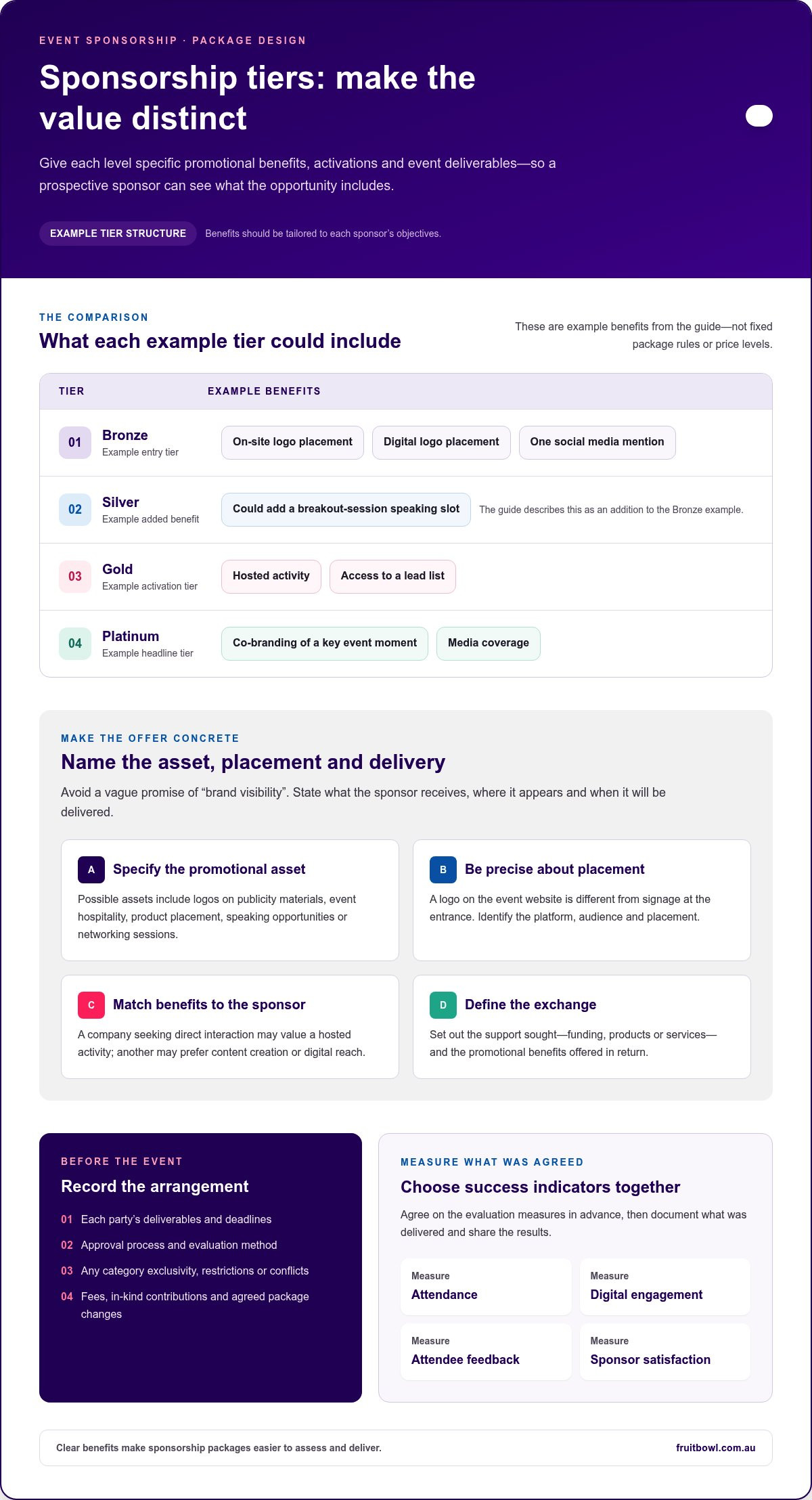
  3. Use tiers to make choices clear. Platinum, Gold, Silver and Bronze are familiar labels, but each tier needs distinct benefits. For example, Bronze might include on-site and digital logo placement plus one social media mention. Silver could add a breakout-session speaking slot, while Gold might include a hosted activity and access to a lead list. Platinum could offer co-branding of a key event moment and media coverage.
  4. Tailor benefits to the sponsor. Match each package to the company’s audience and objectives instead of sending every prospect the same menu. A company seeking direct interaction may value a hosted activity; another may prefer content creation or digital reach. Relevant benefits can help build positive relationships beyond the event day.
  5. Record the arrangement and its measures. For an Australian event, put each party’s deliverables, deadlines, approval process and evaluation method in a written agreement. Measure ROI using agreed indicators such as attendance, digital engagement, attendee feedback and sponsor satisfaction. For GST, tax and invoicing, document whether support is cash or in-kind and which benefits are exchanged, then apply the relevant treatment to the arrangement.
  6. Resolve boundaries before signing. State any category exclusivity, competing-brand restrictions and conflicts of interest precisely. Agree on fees and in-kind contributions in relation to the value and delivery of specific assets, then record the terms, including any changes to package benefits.

Tailoring sponsorship proposals

A strong proposal connects a specific event opportunity with a company’s objectives. Use these steps to make the partnership relevant, measurable and easy to assess.

  1. Prepare a tailored sponsorship proposal

    Research the company’s audience, brand priorities and recent campaigns before drafting. Connect those priorities to a suitable event opportunity, such as an attendee activation or content partnership, and explain why the match works for both parties. Avoid sending a generic document that could apply to any business. The opening should identify the prospective sponsor and the opportunity you’re presenting.

  2. Set out the proposal essentials

    Introduce the event, name its organiser and describe the audience using relevant profile information. State the support you’re seeking, whether financial or in-kind, and specify the benefits offered in return. Explain how the opportunity supports the sponsor’s brand and business objectives and what distinguishes it from other options. Include evaluation measures such as attendance, digital engagement, positive brand experiences or sponsor name recall.

  3. Structure the proposal and plan follow-up

    Arrange the proposal logically: event overview, audience fit, sponsor objectives, proposed benefits, delivery details and success measures. Use clear headings and concise language so decision-makers can find what they need. After sending it, follow up personally and invite questions about the partnership. Use the conversation to understand priorities and refine the opportunity, rather than simply resending the same document.

Keep each proposal focused on one prospective sponsor’s needs, while maintaining a clear record of agreed changes. For event organisers coordinating delivery alongside sponsor discussions, corporate event planning can bring the programme and operational details together.

Finding and approaching event sponsors

Build a focused prospect list and approach each organisation with a relevant reason to support your event. Use these steps to identify suitable companies, reach decision-makers and time your approach.

  1. Find relevant sponsor prospects

    Start with your event’s objectives, audience interests and brand values. List companies whose products, services or public commitments naturally connect with those factors. For a local food festival, relevant prospects might include food producers, hospitality businesses or transport providers. Check whether attendees overlap with each company’s target market, and avoid prospects whose message or credibility conflicts with the event.

  2. Use online tools to find sponsors

    Search company and industry websites, as well as relevant industry databases, for organisations already investing in events or partnerships. Review their recent campaigns and sponsorship activity to understand which audiences they seek. Use event websites and teaser brochures to present your opportunity, then extend your search through networking functions and conferences. Keep a prospect record noting each organisation’s fit, a potential contact and useful evidence.

  3. Attract sponsors for events

    Show each prospect why the event can reach its audience and provide meaningful exposure. Prepare audience-profile information, expected attendance and communication-reach details where available. Connect those figures to a relevant activation or brand experience, rather than relying on general claims about visibility. Identify the right person to approach, then ask for a 15-minute discussion about the opportunity. Keep the first message specific to that company.

  4. Decide when to approach sponsors

    Approach potential sponsors once you can explain the event’s audience, objectives, proposed opportunities and planning timeline. There isn’t one fixed lead time that suits every event; allow enough time for company review, approvals and coordination with event deadlines. For an initial cold call, request 15 minutes to discuss the fit. If a meeting isn’t possible, ask whether you can put a few questions by phone, and say the call will take five minutes.
How to Secure Event Sponsors With a Tailored Proposal

Persuading companies to sponsor an event

Companies commit when an event offers a credible route to their business objectives. Make the case through audience fit, practical engagement and measurable value, not visibility claims alone.

  1. Lead with the sponsor’s priorities. At an initial meeting, ask questions before presenting packages or marketing materials. Find out which audiences the company wants to reach, what kind of brand experience it values and how it assesses partnerships. Then connect the event to those objectives. A direct conversation helps distinguish a relevant opportunity from a polished pitch that misses the company’s needs.
  2. Show the audience connection. Use audience profiles, expected attendance and communication reach to demonstrate overlap with the sponsor’s target audience. Explain how an activation, sponsored session or content opportunity could engage attendees. Be precise about the proposed coverage and platform. A company seeking brand experiences needs a different case from one prioritising digital reach or reputation.
  3. Make success measurable. Agree on useful indicators before the event, then explain how you’ll report the results. Depending on the package, measures could include attendee and lead numbers, audience demographics, social engagement, booth dwell time, email performance, sponsored-session attendance and attendee feedback. Connect each measure to the sponsor’s objective instead of presenting a long list of figures without context.
  4. Explain the value behind the investment. Link each package’s benefits to expected engagement and delivery, and explain what makes the opportunity distinct. Include activation costs in package pricing so the proposed investment reflects the full arrangement. If the event and sponsor share ongoing objectives, propose a multi-year partnership with agreed annual goals and post-event reporting. This gives both parties a basis for reviewing outcomes and planning future activity.

For a sponsor-ready event with coordinated planning and delivery, plan your corporate event with the right operational structure.

Fruitbowl Events Agency: Corporate Events

Fruitbowl Events Agency manages Corporate Events, coordinating strategic planning, logistics and on-site delivery. Turn to the team when sponsor commitments need to fit smoothly into the wider event programme, from activation planning to delivering agreed benefits.

For Festivals & Public Events, Conferences & Seminars, and Government Activations, the same structured approach brings event components together. Clear planning helps organisers coordinate sponsor requirements with the attendee experience, event schedule and operational details. This is particularly useful when multiple sponsor benefits need to be delivered across different parts of an event.

Contact Fruitbowl Events Agency to discuss your event plans and the role sponsorship needs to play.

Turn sponsor interest into a well-run event

A sponsor’s decision marks the start of the working relationship, not the finish. Carry the proposal into delivery by assigning clear ownership for sponsor communication, coordinating agreed benefits with the event schedule and recording what is delivered. This operational follow-through keeps the partnership connected to the attendee experience and gives both parties a clear basis for future discussions.

When planning how to secure event sponsors as part of a broader event, Fruitbowl Events Agency brings planning and delivery together across Corporate Events, Festivals & Public Events, and Conferences & Seminars. This is useful when sponsor activations and event logistics need to work as one coordinated programme.

Explore event planning with Fruitbowl Events Agency and take a considered next step towards an event built around your objectives. A clear plan gives sponsors and organisers a stronger foundation for working together.

Frequently Asked Questions

Who should you approach?

Approach organisations whose customers, values or products connect naturally with the event’s audience. A business selling products used by attendees may value demonstrations, while a professional services firm may prefer a hosted discussion. Identify the marketing, partnerships or sponsorship contact responsible for these decisions. If the event serves a defined community, prioritise prospects with a credible reason to engage that community.

What steps should you take to find and secure sponsors for an event?

To understand how to secure event sponsors, first define the event’s audience and objectives, then shortlist organisations with a relevant connection. Research each prospect’s current campaigns and identify an appropriate contact. Start with a concise conversation about their priorities, then develop a specific offer and agree on responsibilities in writing. During delivery, keep the sponsor informed; afterwards, share evidence of completed benefits and results to support future discussions.

How do you create an event sponsorship proposal that attracts sponsors?

Make the proposal answer the sponsor’s central question: how does this opportunity serve the organisation’s goals? For example, if a company wants product trials, describe where attendees can experience the product and how participation will be recorded. Include the event context, relevant audience evidence, requested support, proposed deliverables and evaluation approach. Tailor the opening and remove benefits that don’t support the sponsor’s stated priorities.

What sponsorship packages and benefits should you offer, and how should they be priced?

Offer benefits that can be delivered and verified, such as signage, hospitality, digital promotion or an activation. Set package pricing according to the value of the assets, audience size, exposure, included benefits and delivery costs. For in-kind support, define the items or services, their agreed contribution and the benefits exchanged. Don’t rely on tier labels alone: explain the distinct value and fulfilment attached to each option.

How can you identify and approach potential event sponsors in Australia?

A practical way to learn how to secure event sponsors in Australia is to use event and industry websites, company campaign pages, industry databases and professional networking to build a prospect list. Compare each organisation’s audience and message with your event’s purpose, then record a relevant contact and reason for approaching them. Write a personal introduction that names the specific opportunity and invites a conversation. Prioritise prospects with a clear audience connection over a long, undifferentiated list.

What are common sponsorship risks, conflicts of interest and exclusivity issues?

Potential issues include category exclusivity, restrictions on competing brands and conflicts of interest. Define these boundaries precisely before signing, and record the agreed terms and any changes to package benefits in writing.

To learn how to secure event sponsors, match your event with companies whose audiences and values align, then present a tailored proposal showing what they’ll receive in return. Sponsorship can involve financial support or in-kind services exchanged for promotional benefits. Make the audience fit, sponsor benefits and ways to measure success clear.

Even a strong event may not speak for itself. Companies need to understand how supporting it advances their objectives, whether that means reaching a relevant audience, creating a brand experience or strengthening their reputation.

This guide explains event sponsorship and outlines a practical process for finding suitable companies, approaching the right people and shaping a proposal around their goals. It also covers defining benefits and reporting outcomes, so the opportunity is clear from the first conversation through to delivery.

Key Takeaways

  • Define each sponsorship tier with specific promotional benefits, activations and event deliverables so companies can compare the value clearly.
  • Shape each proposal around the prospective sponsor’s objectives, audience and preferred ways to measure success.
  • Prioritise companies with a clear connection to your event, then approach the relevant contact with a focused, personal message.
  • Agree on deliverables and communication before the event, then document what was delivered and share the results promptly.

What Is Event Sponsorship?

Event sponsorship is financial or in-kind support exchanged for agreed promotional benefits. A clear package turns that exchange into specific opportunities, rather than a vague promise of “exposure”.

  1. Define the exchange. List the support sought, such as funding, products or services, and the benefits offered in return. For example, a sponsor might provide refreshments in exchange for event signage and a social media mention. Specify what the organiser will deliver, where it will appear and when.
  2. Build packages around real assets. Include specific placements such as logos on publicity materials, event hospitality, product placement, speaking opportunities or networking sessions. Avoid promising “brand visibility” without identifying the platform, audience and placement. A logo on the event website is different from signage at the entrance.
  3. Use tiers to make choices clear. Platinum, Gold, Silver and Bronze are familiar labels, but each tier needs distinct benefits. For example, Bronze might include on-site and digital logo placement plus one social media mention. Silver could add a breakout-session speaking slot, while Gold might include a hosted activity and access to a lead list. Platinum could offer co-branding of a key event moment and media coverage.
  4. Tailor benefits to the sponsor. Match each package to the company’s audience and objectives instead of sending every prospect the same menu. A company seeking direct interaction may value a hosted activity; another may prefer content creation or digital reach. Relevant benefits can help build positive relationships beyond the event day.
  5. Record the arrangement and its measures. For an Australian event, put each party’s deliverables, deadlines, approval process and evaluation method in a written agreement. Measure ROI using agreed indicators such as attendance, digital engagement, attendee feedback and sponsor satisfaction. For GST, tax and invoicing, document whether support is cash or in-kind and which benefits are exchanged, then apply the relevant treatment to the arrangement.
  6. Resolve boundaries before signing. State any category exclusivity, competing-brand restrictions and conflicts of interest precisely. Agree on fees and in-kind contributions in relation to the value and delivery of specific assets, then record the terms, including any changes to package benefits.

Tailoring sponsorship proposals

A strong proposal connects a specific event opportunity with a company’s objectives. Use these steps to make the partnership relevant, measurable and easy to assess.

  1. Prepare a tailored sponsorship proposal

    Research the company’s audience, brand priorities and recent campaigns before drafting. Connect those priorities to a suitable event opportunity, such as an attendee activation or content partnership, and explain why the match works for both parties. Avoid sending a generic document that could apply to any business. The opening should identify the prospective sponsor and the opportunity you’re presenting.

  2. Set out the proposal essentials

    Introduce the event, name its organiser and describe the audience using relevant profile information. State the support you’re seeking, whether financial or in-kind, and specify the benefits offered in return. Explain how the opportunity supports the sponsor’s brand and business objectives and what distinguishes it from other options. Include evaluation measures such as attendance, digital engagement, positive brand experiences or sponsor name recall.

  3. Structure the proposal and plan follow-up

    Arrange the proposal logically: event overview, audience fit, sponsor objectives, proposed benefits, delivery details and success measures. Use clear headings and concise language so decision-makers can find what they need. After sending it, follow up personally and invite questions about the partnership. Use the conversation to understand priorities and refine the opportunity, rather than simply resending the same document.

Keep each proposal focused on one prospective sponsor’s needs, while maintaining a clear record of agreed changes. For event organisers coordinating delivery alongside sponsor discussions, corporate event planning can bring the programme and operational details together.

Finding and approaching event sponsors

Build a focused prospect list and approach each organisation with a relevant reason to support your event. Use these steps to identify suitable companies, reach decision-makers and time your approach.

  1. Find relevant sponsor prospects

    Start with your event’s objectives, audience interests and brand values. List companies whose products, services or public commitments naturally connect with those factors. For a local food festival, relevant prospects might include food producers, hospitality businesses or transport providers. Check whether attendees overlap with each company’s target market, and avoid prospects whose message or credibility conflicts with the event.

  2. Use online tools to find sponsors

    Search company and industry websites, as well as relevant industry databases, for organisations already investing in events or partnerships. Review their recent campaigns and sponsorship activity to understand which audiences they seek. Use event websites and teaser brochures to present your opportunity, then extend your search through networking functions and conferences. Keep a prospect record noting each organisation’s fit, a potential contact and useful evidence.

  3. Attract sponsors for events

    Show each prospect why the event can reach its audience and provide meaningful exposure. Prepare audience-profile information, expected attendance and communication-reach details where available. Connect those figures to a relevant activation or brand experience, rather than relying on general claims about visibility. Identify the right person to approach, then ask for a 15-minute discussion about the opportunity. Keep the first message specific to that company.

  4. Decide when to approach sponsors

    Approach potential sponsors once you can explain the event’s audience, objectives, proposed opportunities and planning timeline. There isn’t one fixed lead time that suits every event; allow enough time for company review, approvals and coordination with event deadlines. For an initial cold call, request 15 minutes to discuss the fit. If a meeting isn’t possible, ask whether you can put a few questions by phone, and say the call will take five minutes.

Persuading companies to sponsor an event

Companies commit when an event offers a credible route to their business objectives. Make the case through audience fit, practical engagement and measurable value, not visibility claims alone.

  1. Lead with the sponsor’s priorities. At an initial meeting, ask questions before presenting packages or marketing materials. Find out which audiences the company wants to reach, what kind of brand experience it values and how it assesses partnerships. Then connect the event to those objectives. A direct conversation helps distinguish a relevant opportunity from a polished pitch that misses the company’s needs.
  2. Show the audience connection. Use audience profiles, expected attendance and communication reach to demonstrate overlap with the sponsor’s target audience. Explain how an activation, sponsored session or content opportunity could engage attendees. Be precise about the proposed coverage and platform. A company seeking brand experiences needs a different case from one prioritising digital reach or reputation.
  3. Make success measurable. Agree on useful indicators before the event, then explain how you’ll report the results. Depending on the package, measures could include attendee and lead numbers, audience demographics, social engagement, booth dwell time, email performance, sponsored-session attendance and attendee feedback. Connect each measure to the sponsor’s objective instead of presenting a long list of figures without context.
  4. Explain the value behind the investment. Link each package’s benefits to expected engagement and delivery, and explain what makes the opportunity distinct. Include activation costs in package pricing so the proposed investment reflects the full arrangement. If the event and sponsor share ongoing objectives, propose a multi-year partnership with agreed annual goals and post-event reporting. This gives both parties a basis for reviewing outcomes and planning future activity.

For a sponsor-ready event with coordinated planning and delivery, plan your corporate event with the right operational structure.

Fruitbowl Events Agency: Corporate Events

Fruitbowl Events Agency manages Corporate Events, coordinating strategic planning, logistics and on-site delivery. Turn to the team when sponsor commitments need to fit smoothly into the wider event programme, from activation planning to delivering agreed benefits.

For Festivals & Public Events, Conferences & Seminars, and Government Activations, the same structured approach brings event components together. Clear planning helps organisers coordinate sponsor requirements with the attendee experience, event schedule and operational details. This is particularly useful when multiple sponsor benefits need to be delivered across different parts of an event.

Contact Fruitbowl Events Agency to discuss your event plans and the role sponsorship needs to play.

Turn sponsor interest into a well-run event

A sponsor’s decision marks the start of the working relationship, not the finish. Carry the proposal into delivery by assigning clear ownership for sponsor communication, coordinating agreed benefits with the event schedule and recording what is delivered. This operational follow-through keeps the partnership connected to the attendee experience and gives both parties a clear basis for future discussions.

When planning how to secure event sponsors as part of a broader event, Fruitbowl Events Agency brings planning and delivery together across Corporate Events, Festivals & Public Events, and Conferences & Seminars. This is useful when sponsor activations and event logistics need to work as one coordinated programme.

Explore event planning with Fruitbowl Events Agency and take a considered next step towards an event built around your objectives. A clear plan gives sponsors and organisers a stronger foundation for working together.

Frequently Asked Questions

Who should you approach?

Approach organisations whose customers, values or products connect naturally with the event’s audience. A business selling products used by attendees may value demonstrations, while a professional services firm may prefer a hosted discussion. Identify the marketing, partnerships or sponsorship contact responsible for these decisions. If the event serves a defined community, prioritise prospects with a credible reason to engage that community.

What steps should you take to find and secure sponsors for an event?

To understand how to secure event sponsors, first define the event’s audience and objectives, then shortlist organisations with a relevant connection. Research each prospect’s current campaigns and identify an appropriate contact. Start with a concise conversation about their priorities, then develop a specific offer and agree on responsibilities in writing. During delivery, keep the sponsor informed; afterwards, share evidence of completed benefits and results to support future discussions.

How do you create an event sponsorship proposal that attracts sponsors?

Make the proposal answer the sponsor’s central question: how does this opportunity serve the organisation’s goals? For example, if a company wants product trials, describe where attendees can experience the product and how participation will be recorded. Include the event context, relevant audience evidence, requested support, proposed deliverables and evaluation approach. Tailor the opening and remove benefits that don’t support the sponsor’s stated priorities.

What sponsorship packages and benefits should you offer, and how should they be priced?

Offer benefits that can be delivered and verified, such as signage, hospitality, digital promotion or an activation. Set package pricing according to the value of the assets, audience size, exposure, included benefits and delivery costs. For in-kind support, define the items or services, their agreed contribution and the benefits exchanged. Don’t rely on tier labels alone: explain the distinct value and fulfilment attached to each option.

How can you identify and approach potential event sponsors in Australia?

A practical way to learn how to secure event sponsors in Australia is to use event and industry websites, company campaign pages, industry databases and professional networking to build a prospect list. Compare each organisation’s audience and message with your event’s purpose, then record a relevant contact and reason for approaching them. Write a personal introduction that names the specific opportunity and invites a conversation. Prioritise prospects with a clear audience connection over a long, undifferentiated list.

What are common sponsorship risks, conflicts of interest and exclusivity issues?

Potential issues include category exclusivity, restrictions on competing brands and conflicts of interest. Define these boundaries precisely before signing, and record the agreed terms and any changes to package benefits in writing.

Back to Articles
Request A Quote

Make an
Enquiry

Untitled design

What Makes Us Different?

True end-to-end solution so you can hand off to us, focus on your priorities and enjoy the event without any stress

Unmatched industry expertise looking after diverse range of high-profile events, cultural festivals & activations

Meticulous attention to every detail and precise execution of events with our streamlined processes

Tailored solutions with bespoke strategies to ensure we align with your brand and objectives

Make an Enquiry

  • This field is for validation purposes and should be left unchanged.
  • This field is for validation purposes and should be left unchanged.