How to plan a public festival, from venue checks to funding

Planning a public festival starts by checking whether the venue can support the event, then mapping the approvals, safety arrangements and funding required to deliver it. Contact the local council where the festival will take place as your first point of contact with government, and allow time for permits: Australian councils commonly take six to twelve weeks to process applications for events in public spaces. A workable plan connects the site, audience capacity, permissions, insurance and budget before you make commitments.

It’s sensible to focus early on public liability cover, since Australian councils and venues commonly require insurance of $10 million to $20 million. But a strong festival plan needs more than a policy: it also needs a capable working group, clear objectives and a funding case that can withstand changes in costs or support. This guide explains how to assess a venue, capacity and layout, clarify permissions and insurance needs, and organise people and funding around a practical delivery plan.

Key Takeaways

  • Walk through the venue before booking and assess access, utilities, weather exposure, noise, and how the site will operate during bump-in and bump-out.
  • Match the capacity calculation to the event layout, then use a clear, scaled site map to plan audience movement, facilities, and emergency access.
  • Map permissions early. If liquor will be sold, served or supplied at a festival in NSW, organisers must apply or notify Liquor & Gaming NSW at least 28 days beforehand.
  • Review the venue’s insurance requirements and build a risk management plan that reflects the festival’s activities, site and audience.
  • Give the working group clear responsibilities, measurable outcomes and a funding case supported by a realistic budget and multiple funding streams.

Intellectual property ownership and permissions

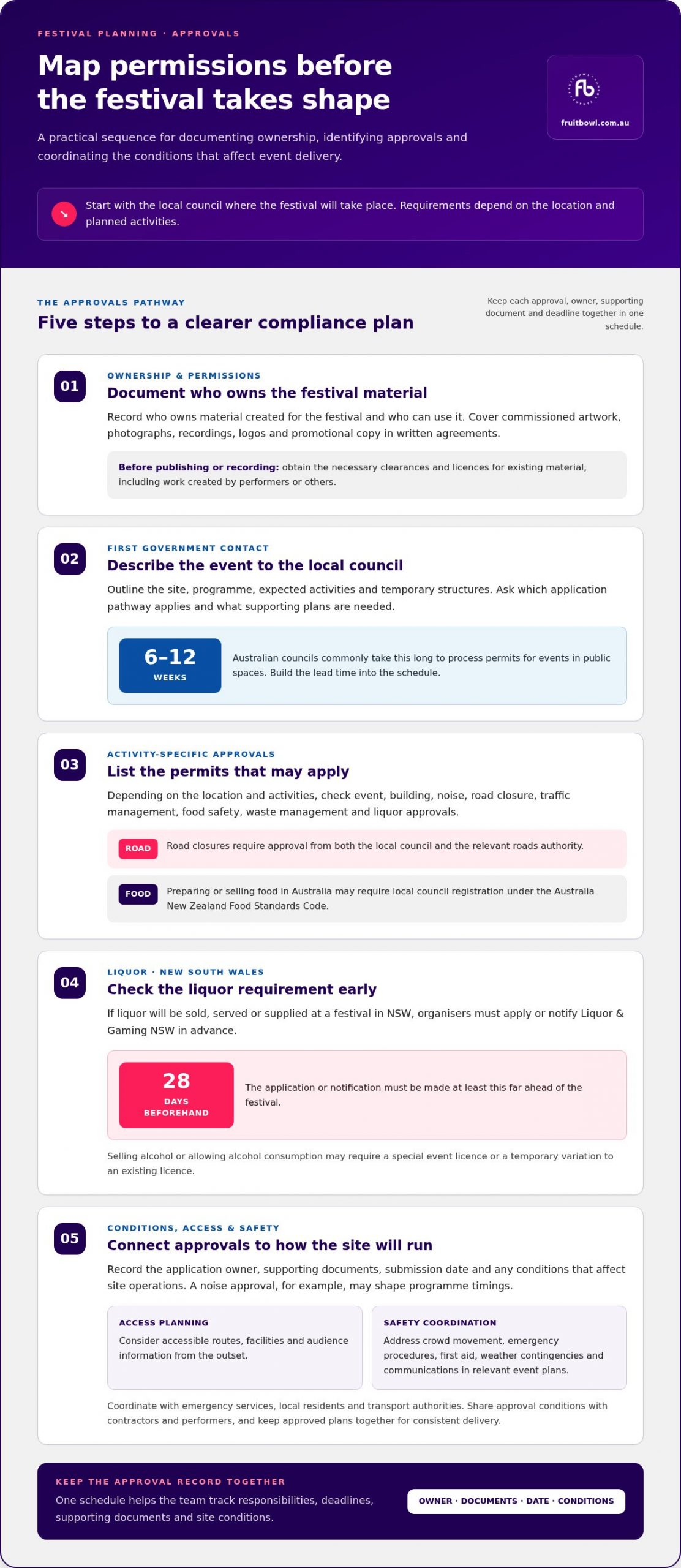
Set permissions and compliance tasks early, alongside the event concept and programme. A clear register helps organisers track each approval, responsible person and deadline.

  1. Check intellectual property ownership and permissions

    Document who owns material created for the festival and who can use it. Cover commissioned artwork, photographs, recordings, logos and promotional copy in written agreements. For existing material, obtain the necessary clearances and licences before performers present work created by others. This avoids uncertainty about whether the festival can publish, record or reuse content.

    Identify any competitions in the programme. Organisers may need a permit to hold a competition as part of a festival. Record the competition format, entry terms and responsible contact, then identify the relevant approval before promoting it. If ownership or permission arrangements are complex, obtain legal advice specific to the festival.

  2. Identify permits and event approvals

    Contact the local council where the event will take place as your first point of contact with government. Describe the site, programme, expected activities and temporary structures. Ask which application pathway applies and what supporting plans the council needs. Councils commonly take six to twelve weeks to process permits for events in public spaces, so build that lead time into your schedule.

    List approvals that may apply, including event, building, noise, road closure, traffic management, food safety, waste management and liquor permits. Requirements vary with the location and activities. Road closures require approval from both the local council and the relevant roads authority. If liquor will be sold, served or supplied at a festival in NSW, organisers must apply or notify Liquor & Gaming NSW at least 28 days beforehand.

  3. Map compliance across government levels. Event organisers must meet applicable legal and statutory requirements at Commonwealth, state and local levels during planning and delivery. In Australia, preparing or selling food may require local council registration under the Australia New Zealand Food Standards Code. Selling alcohol or allowing alcohol consumption may require a special event licence or a temporary variation to an existing licence.

    Record each approval in one schedule. Include the application owner, supporting documents, submission date and any conditions that affect site operations. A noise approval, for example, may shape the programme and event timings. Confirm how each condition will be communicated to contractors and performers.

  4. Include access and safety requirements in the approval plan. The Disability Discrimination Act 1992 sets baseline accessibility requirements in Australia, according to the Federal Register of Legislation. Consider accessible routes, facilities and audience information when planning the site, rather than treating access as a final adjustment.

    Coordinate safety documents with the permit process. Address crowd movement, emergency procedures, first aid, weather contingencies and communications in the relevant event plans. Consult emergency services, local residents and transport authorities during site planning. Keep approved plans and permit conditions together so the event team can apply them consistently during delivery.

Should I visit the venue before booking?

Yes. Visit the venue before committing and assess how the site will work for performers, crew and attendees. A scheduled walk-through can reveal practical constraints that floor plans and photographs may miss.

  1. Arrange an inspection with the venue representative and the person responsible for audio-visual. A venue walk-through with the audio-visual lead can take an hour. Use that time to inspect power access, lighting, sound coverage, loading areas and equipment storage. Ask how venue equipment is operated and where external suppliers can connect. Note any restrictions that could affect performances or production, then record each finding against your draft schedule.

    Walk the attendee route as well. Check entrances, accessible paths, toilets, shelter and spaces where queues could form. At an outdoor venue, inspect the surface, drainage, shade and vehicle access. These observations help determine whether the site suits the festival programme and its operational requirements.

  2. Compare the site with the event’s actual footprint before booking. For open spaces, mark proposed stages, audience areas, food stalls, toilets, first aid, waste points and vehicle routes on a draft map. Consider how performers, contractors and attendees will move without obstructing one another. Check where sound may travel and how neighbouring uses could affect the schedule.

    Ask the venue about access for setup and pack-down, storage, power, lighting and water. Clarify which facilities are included in the booking and which require separate coordination. A park may offer room for an audience but limited infrastructure; a hall may provide services but constrain stage placement. Match the site to the programme, not just its headline capacity.

  3. Confirm the booking conditions before announcing artists. Record the event date, access periods, included facilities, cancellation terms and any restrictions on suppliers or sound. Then build the artist schedule around stage availability, technical changeovers and audience movement. Leave enough time between acts for crews to clear equipment, reset the stage and complete sound checks.

    Share confirmed timings with artists and production staff, and keep one master schedule. Include arrival times, sound checks, performance slots and contact responsibilities. If an act’s technical needs conflict with the venue’s facilities, adjust the programme or production plan before public promotion. This avoids advertising a running order the site cannot support.

  4. Choose a booking method that fits the audience and event format. If attendees need to reserve places, set out the booking steps, event details and attendee contact process clearly. Australian Heritage Festival organisers are strongly recommended to use an online booking platform when attendees need to pre-book. Keep event information consistent across the booking page and promotional material.

    Before publishing, test the attendee journey from event description to confirmation. Check that dates, session times, venue directions and accessibility information are clear. For an event with timed sessions, ensure each booking option matches the programme. Coordinating a festival’s venue, production and programme can also sit within festival and public event planning.

How do I assess venue capacity and layout?

Start planning well before the festival date, because permits and site decisions take time. For public-space events, Australian local authorities commonly take six to twelve weeks to process permits; major music festival organisers should contact their municipal council up to 12 months ahead when planning a public festival.

  1. Calculate usable capacity based on the event format, not the venue’s headline figure. In the same room, a standing cocktail event can accommodate twice as many people as a sit-down dinner. That difference affects circulation, seating, queues and emergency access. Compare expected attendance with the space needed for stages, stalls, toilets, first aid and operations.

    Classify the event by scale and impact. School fetes, small farmers’ markets and street events are examples of small events; regional shows and music festivals are medium-sized. Major events draw large crowds and require more intricate planning. The event’s size and scope shape the detail required in its plans and its legal obligations.

  2. Prepare a clear, scaled site map for approvals and daily operations. Mark entrances, exits, stages, audience zones, food stalls, amenities, first aid, staff areas and vehicle routes. Then test the map against likely crowd movement. For example, a queue near a stage entrance could block a path between the audience area and facilities.

    Include practical site conditions in capacity decisions. Assess transport, parking, noise restrictions, utilities, available space, surface, weather resilience and curfew limits. Consider accessibility, emergency management, medical needs and public health. A site map should show how these needs fit together, not simply where equipment will go.

  3. Coordinate the programme, event notifications and promotion through one master schedule. Align performance times, changeovers, site access and audience arrival information. Share consistent maps, travel details and timetables across event communications and partner channels. Cross-promotion works best when participating organisations use the same event name, dates and booking information.

    Before announcing activities, match the proposed footprint and attendance with local municipal registration rules. Typically, events on council-managed land attracting more than 100 patrons require formal registration, while events on private land may require registration if they attract larger crowds. Submit local council registrations well in advance of the event date to avoid late fees.

  4. Keep a change log as attendance forecasts, stall locations or programme timings shift. Update the site map and management plan together, then share revised versions with staff and relevant stakeholders. Organisers must generally provide a comprehensive Event Management Plan at least four weeks before the event date, alongside separate supporting plans depending on the event’s size, location or audience profile.

    After the event, compare actual attendance and operations with the original plan. Fruitbowl Events Agency recommends reviewing incidents, audience feedback, contractor performance, financial reconciliation and environmental outcomes. Record what worked and what needs adjustment, then use those findings to guide future capacity estimates, event applications and cross-promotion decisions.
How to plan a public festival, from venue checks to funding

Do I need insurance and public liability cover for my venue?

Often, yes: Australian councils and venues commonly require event public liability insurance of $10 million to $20 million. The exact requirement depends on the venue and approval pathway, so include insurance and risk planning in your festival workplan.

  1. Confirm the required public liability cover for the site and permit application. Yarra Ranges Council requires event organisers to provide at least $20 million in cover. A Brisbane assessable event permit application requires at least $20 million, in the proposed permit holder’s name. Australian Heritage Festival organisers must also maintain at least $20 million in public liability insurance.

    Record the required amount, named insured and evidence deadline in your approvals schedule. Compare those requirements with the proposed event structure and venue conditions. If the organising group is unincorporated, members may be personally liable for financial losses or damages arising from the festival. Include the organisation’s structure in your liability review.

  2. Build a risk management plan around actual activities, not a generic checklist. Assess crowd movement, stages, temporary structures, electrical equipment, food and beverages, alcohol, weather and emergency access. A regional outdoor festival, for example, may need to consider site conditions and weather contingencies alongside its creative programme.

    Assign each identified risk an owner and a control. Document how the team will manage crowd control, fire safety, medical response, security, emergency egress and communications. Include safe bump-in and bump-out, contractor compliance, electrical safety, hazard assessments and documentation for builds, lifts and rigging. Review the plan whenever the site layout or programme changes.

  3. Assess insurance needs beyond public liability. Depending on the festival’s activities, organisers may need cover for property and equipment, product liability, workers compensation, volunteers or cancellation. Match each risk to the relevant part of the event plan. For example, equipment cover relates to hired or owned production assets, while product liability is relevant to goods sold or supplied.

    Include employees and volunteers in safety planning, and document their responsibilities. Consider how food stalls, alcohol service, fireworks or audience participation affect the risk profile. Keep insurance records alongside permit conditions and operational plans so the responsible team can access the right information during delivery.

  4. Plan infrastructure as part of risk control. List toilets, drinking water, waste and rubbish removal, power, lighting, signage and site infrastructure on the site plan. Assign a coordinator to each requirement, then schedule delivery, setup, inspection and removal around event access times.

    Check that toilet locations, waste points and power arrangements support the site layout and audience movement. Include temporary food stalls, transport, cleanup and environmental impacts in the plan. Link these arrangements to emergency procedures and contractor briefings. Clear responsibilities help the team identify gaps before the festival opens.

Building a festival working group and funding case

Build the team and funding case around a defined purpose, measurable outcomes and a credible delivery plan. Organising costs depend on the festival’s scale, location, programme, infrastructure and staffing, so the budget should reflect its actual scope.

  1. Write the festival’s purpose and objectives into a business plan. Explain its cultural, community or regional value, then identify who the event is designed to serve. Choose 2-3 measurable outcomes, such as attendee numbers, media reach or local business uplift. Set a practical measure for each outcome, such as ticketing data, media monitoring or a post-event survey.

    Use those objectives to guide programme choices and funding decisions. A regional arts festival, for example, might connect its cultural purpose with opportunities for local artists and businesses. Keep the case specific: show how each proposed activity supports an objective and benefits the intended attendees.

  2. Form a working group with clear roles and decision-making authority. Assign responsibility for programme, finance, permits, sponsorship, communications, safety and delivery. Record who approves spending, manages grant applications and reports progress. For an incorporated organisation, its structure determines the decision-making process it must follow.

    Set a regular meeting rhythm and maintain one action register. Track each task’s owner, deadline, budget impact and dependencies. For example, a programme lead should share artist requirements with production and finance before commitments are made. A defined process keeps funding assumptions aligned with operational decisions.

  3. Start funding preparation early and build several income streams. Planning for a street art festival’s funding is ideally started 6-18 months before the festival. Some grant rounds open only once or twice a year, so map application windows against the event schedule. Combine suitable grants with sponsorship, ticketing, community fundraising and in-kind support where appropriate.

    Present each funder with a tailored case. Link the requested support to a specific activity, outcome and budget line. Record sponsorship and in-kind contributions alongside cash income. Each dollar of in-kind support adds a dollar to the festival budget, making donated services or resources visible in the funding picture.

  4. Prepare a working budget using quotes and firm figures wherever possible. Include income, expenditure, cash-flow timing and a contingency of 10% to 20%. Model best-case, base-case and worst-case scenarios, then identify which costs or programme elements change under each. Keep detailed records of funding received and spending, because funding bodies may require an acquittal and spending report.

    The cost depends on the festival’s scope, site, programme, infrastructure and staffing, and is given after a quote request. For support coordinating the delivery plan, discuss your festival event requirements.

There is no single cost for organising a public festival in Australia. The budget depends on the festival’s scale, location, programme, infrastructure and staffing, so base it on the event’s actual scope.

Fruitbowl Events Agency: Corporate Events

Fruitbowl Events Agency delivers Festivals & Public Events, coordinating strategic planning, logistics, entertainment programming and on-site delivery. This support is useful when a festival’s approvals, suppliers, programme and site operations need to work as one delivery plan. The team can bring these moving parts together, from early planning through event-day execution.

For a festival with multiple stakeholders, a complex programme or a detailed funding case, structured event management can help turn the plan into coordinated action. Fruitbowl Events Agency also delivers Corporate Events, Conferences & Seminars and Government Activations. If you’re preparing a public festival and would like to discuss event management support, contact Fruitbowl Events Agency.

Turn your festival plan into a clear next step

The most useful next move in planning a public festival is to turn your decisions into an agreed delivery plan. Set out who owns each action, what needs approval and how progress will be tracked. This gives your working group a practical basis for moving from concept to delivery, while keeping responsibilities visible as the programme develops.

If coordinating the moving parts would benefit from experienced event management, Fruitbowl Events Agency offers Festivals & Public Events, alongside Corporate Events and Conferences & Seminars. Its team supports organisers with event planning and delivery, bringing programme, logistics and on-site coordination into one considered approach.

Share your event requirements and discuss the support that fits your plans. Contact Fruitbowl Events Agency to take the next step with a clear direction and a well-structured festival plan.

Frequently Asked Questions

How do I negotiate venue costs?

Ask for an itemised venue proposal and clarify what each charge includes. Compare access hours, staffing, cleaning, security, utilities and furniture, rather than considering the hire fee alone. If your event date is flexible, ask whether alternative dates or booking periods change the available package. Put agreed inclusions, access arrangements and cancellation terms in writing before committing, so the final budget reflects the venue’s full contribution and any separate supplier costs.

How important is venue location and transport access?

Location affects who can attend and how smoothly they arrive. Assess public transport routes, parking, drop-off points and walking access, then include clear travel guidance in attendee communications. Consider how deliveries, contractor vehicles and emergency access interact with audience arrival. For a regional venue, account for longer journeys and the availability of nearby services. A site that suits the programme but is difficult to reach may require more transport coordination.

How will decisions be made?

Agree on a decision process before making commitments. Set out who can approve expenditure, programme changes, supplier agreements and public announcements, then record decisions and their reasons in a shared log. For example, a change to performance timings may affect venue access, artist arrangements and attendee information, so identify who coordinates those updates. Establish an escalation route for decisions that affect safety, budget or event scope, and communicate approved changes to the people responsible.

What AV and technical requirements should I check?

Match technical requirements to each performance and the venue’s infrastructure. Confirm stage dimensions, power access, lighting positions, sound coverage, screen visibility and connection points. Ask artists for technical riders, then compare their requirements with the equipment and operating arrangements available on site. Check where the control position will be and how crew can reach equipment during changeovers. Document technical responsibilities, setup access and testing arrangements in the production schedule.

What are the steps to plan a public festival in Australia?

Begin with a clear purpose, audience and programme, then test whether the proposed site suits them. Build a schedule for venue decisions, council engagement, approvals, supplier coordination, insurance and funding applications. Assign each task to a responsible person and track dependencies, such as confirming technical needs before publishing a running order. Prepare event plans for delivery, communicate practical information to attendees, and complete a post-event review to inform future decisions.

How do I choose a festival site and estimate attendance?

Choose a site by matching its usable space, access, infrastructure and surroundings to the event format. Estimate attendance using relevant evidence, such as previous ticketing or registration records, audience demand and the programme’s draw. Separate expected attendance from the site’s operational capacity, since stalls, stages and circulation reduce usable audience space. Record the assumptions behind your estimate, then revisit them as registrations and programme details develop.

What permits and approvals are required for a public festival in Australia?

Requirements depend on the location, land manager, activities and event footprint. Start with the local council and identify approvals that may relate to public land, temporary structures, noise, food, liquor, traffic or road use. State requirements may also apply, as can Commonwealth obligations. Create an approvals register that names each application, supporting document, responsible person and deadline. This helps the team identify related applications and conditions before finalising the event plan.

What are the requirements for event insurance, risk assessments and emergency plans?

Match insurance and safety planning to the venue’s conditions, event activities and permit requirements. Identify hazards such as crowd congestion, severe weather, electrical equipment, fire and medical incidents, then document controls and accountable roles. Emergency plans should explain how the team will raise an alert, communicate instructions, assist evacuation and coordinate responders. Brief staff and contractors on their specific duties, and keep current plans accessible to the people managing the event site.

Planning a public festival starts by checking whether the venue can support the event, then mapping the approvals, safety arrangements and funding required to deliver it. Contact the local council where the festival will take place as your first point of contact with government, and allow time for permits: Australian councils commonly take six to twelve weeks to process applications for events in public spaces. A workable plan connects the site, audience capacity, permissions, insurance and budget before you make commitments.

It’s sensible to focus early on public liability cover, since Australian councils and venues commonly require insurance of $10 million to $20 million. But a strong festival plan needs more than a policy: it also needs a capable working group, clear objectives and a funding case that can withstand changes in costs or support. This guide explains how to assess a venue, capacity and layout, clarify permissions and insurance needs, and organise people and funding around a practical delivery plan.

Key Takeaways

  • Walk through the venue before booking and assess access, utilities, weather exposure, noise, and how the site will operate during bump-in and bump-out.
  • Match the capacity calculation to the event layout, then use a clear, scaled site map to plan audience movement, facilities, and emergency access.
  • Map permissions early. If liquor will be sold, served or supplied at a festival in NSW, organisers must apply or notify Liquor & Gaming NSW at least 28 days beforehand.
  • Review the venue’s insurance requirements and build a risk management plan that reflects the festival’s activities, site and audience.
  • Give the working group clear responsibilities, measurable outcomes and a funding case supported by a realistic budget and multiple funding streams.

Intellectual property ownership and permissions

Set permissions and compliance tasks early, alongside the event concept and programme. A clear register helps organisers track each approval, responsible person and deadline.

  1. Check intellectual property ownership and permissions

    Document who owns material created for the festival and who can use it. Cover commissioned artwork, photographs, recordings, logos and promotional copy in written agreements. For existing material, obtain the necessary clearances and licences before performers present work created by others. This avoids uncertainty about whether the festival can publish, record or reuse content.

    Identify any competitions in the programme. Organisers may need a permit to hold a competition as part of a festival. Record the competition format, entry terms and responsible contact, then identify the relevant approval before promoting it. If ownership or permission arrangements are complex, obtain legal advice specific to the festival.

  2. Identify permits and event approvals

    Contact the local council where the event will take place as your first point of contact with government. Describe the site, programme, expected activities and temporary structures. Ask which application pathway applies and what supporting plans the council needs. Councils commonly take six to twelve weeks to process permits for events in public spaces, so build that lead time into your schedule.

    List approvals that may apply, including event, building, noise, road closure, traffic management, food safety, waste management and liquor permits. Requirements vary with the location and activities. Road closures require approval from both the local council and the relevant roads authority. If liquor will be sold, served or supplied at a festival in NSW, organisers must apply or notify Liquor & Gaming NSW at least 28 days beforehand.

  3. Map compliance across government levels. Event organisers must meet applicable legal and statutory requirements at Commonwealth, state and local levels during planning and delivery. In Australia, preparing or selling food may require local council registration under the Australia New Zealand Food Standards Code. Selling alcohol or allowing alcohol consumption may require a special event licence or a temporary variation to an existing licence.

    Record each approval in one schedule. Include the application owner, supporting documents, submission date and any conditions that affect site operations. A noise approval, for example, may shape the programme and event timings. Confirm how each condition will be communicated to contractors and performers.

  4. Include access and safety requirements in the approval plan. The Disability Discrimination Act 1992 sets baseline accessibility requirements in Australia, according to the Federal Register of Legislation. Consider accessible routes, facilities and audience information when planning the site, rather than treating access as a final adjustment.

    Coordinate safety documents with the permit process. Address crowd movement, emergency procedures, first aid, weather contingencies and communications in the relevant event plans. Consult emergency services, local residents and transport authorities during site planning. Keep approved plans and permit conditions together so the event team can apply them consistently during delivery.

Should I visit the venue before booking?

Yes. Visit the venue before committing and assess how the site will work for performers, crew and attendees. A scheduled walk-through can reveal practical constraints that floor plans and photographs may miss.

  1. Arrange an inspection with the venue representative and the person responsible for audio-visual. A venue walk-through with the audio-visual lead can take an hour. Use that time to inspect power access, lighting, sound coverage, loading areas and equipment storage. Ask how venue equipment is operated and where external suppliers can connect. Note any restrictions that could affect performances or production, then record each finding against your draft schedule.

    Walk the attendee route as well. Check entrances, accessible paths, toilets, shelter and spaces where queues could form. At an outdoor venue, inspect the surface, drainage, shade and vehicle access. These observations help determine whether the site suits the festival programme and its operational requirements.

  2. Compare the site with the event’s actual footprint before booking. For open spaces, mark proposed stages, audience areas, food stalls, toilets, first aid, waste points and vehicle routes on a draft map. Consider how performers, contractors and attendees will move without obstructing one another. Check where sound may travel and how neighbouring uses could affect the schedule.

    Ask the venue about access for setup and pack-down, storage, power, lighting and water. Clarify which facilities are included in the booking and which require separate coordination. A park may offer room for an audience but limited infrastructure; a hall may provide services but constrain stage placement. Match the site to the programme, not just its headline capacity.

  3. Confirm the booking conditions before announcing artists. Record the event date, access periods, included facilities, cancellation terms and any restrictions on suppliers or sound. Then build the artist schedule around stage availability, technical changeovers and audience movement. Leave enough time between acts for crews to clear equipment, reset the stage and complete sound checks.

    Share confirmed timings with artists and production staff, and keep one master schedule. Include arrival times, sound checks, performance slots and contact responsibilities. If an act’s technical needs conflict with the venue’s facilities, adjust the programme or production plan before public promotion. This avoids advertising a running order the site cannot support.

  4. Choose a booking method that fits the audience and event format. If attendees need to reserve places, set out the booking steps, event details and attendee contact process clearly. Australian Heritage Festival organisers are strongly recommended to use an online booking platform when attendees need to pre-book. Keep event information consistent across the booking page and promotional material.

    Before publishing, test the attendee journey from event description to confirmation. Check that dates, session times, venue directions and accessibility information are clear. For an event with timed sessions, ensure each booking option matches the programme. Coordinating a festival’s venue, production and programme can also sit within festival and public event planning.

How do I assess venue capacity and layout?

Start planning well before the festival date, because permits and site decisions take time. For public-space events, Australian local authorities commonly take six to twelve weeks to process permits; major music festival organisers should contact their municipal council up to 12 months ahead when planning a public festival.

  1. Calculate usable capacity based on the event format, not the venue’s headline figure. In the same room, a standing cocktail event can accommodate twice as many people as a sit-down dinner. That difference affects circulation, seating, queues and emergency access. Compare expected attendance with the space needed for stages, stalls, toilets, first aid and operations.

    Classify the event by scale and impact. School fetes, small farmers’ markets and street events are examples of small events; regional shows and music festivals are medium-sized. Major events draw large crowds and require more intricate planning. The event’s size and scope shape the detail required in its plans and its legal obligations.

  2. Prepare a clear, scaled site map for approvals and daily operations. Mark entrances, exits, stages, audience zones, food stalls, amenities, first aid, staff areas and vehicle routes. Then test the map against likely crowd movement. For example, a queue near a stage entrance could block a path between the audience area and facilities.

    Include practical site conditions in capacity decisions. Assess transport, parking, noise restrictions, utilities, available space, surface, weather resilience and curfew limits. Consider accessibility, emergency management, medical needs and public health. A site map should show how these needs fit together, not simply where equipment will go.

  3. Coordinate the programme, event notifications and promotion through one master schedule. Align performance times, changeovers, site access and audience arrival information. Share consistent maps, travel details and timetables across event communications and partner channels. Cross-promotion works best when participating organisations use the same event name, dates and booking information.

    Before announcing activities, match the proposed footprint and attendance with local municipal registration rules. Typically, events on council-managed land attracting more than 100 patrons require formal registration, while events on private land may require registration if they attract larger crowds. Submit local council registrations well in advance of the event date to avoid late fees.

  4. Keep a change log as attendance forecasts, stall locations or programme timings shift. Update the site map and management plan together, then share revised versions with staff and relevant stakeholders. Organisers must generally provide a comprehensive Event Management Plan at least four weeks before the event date, alongside separate supporting plans depending on the event’s size, location or audience profile.

    After the event, compare actual attendance and operations with the original plan. Fruitbowl Events Agency recommends reviewing incidents, audience feedback, contractor performance, financial reconciliation and environmental outcomes. Record what worked and what needs adjustment, then use those findings to guide future capacity estimates, event applications and cross-promotion decisions.

Do I need insurance and public liability cover for my venue?

Often, yes: Australian councils and venues commonly require event public liability insurance of $10 million to $20 million. The exact requirement depends on the venue and approval pathway, so include insurance and risk planning in your festival workplan.

  1. Confirm the required public liability cover for the site and permit application. Yarra Ranges Council requires event organisers to provide at least $20 million in cover. A Brisbane assessable event permit application requires at least $20 million, in the proposed permit holder’s name. Australian Heritage Festival organisers must also maintain at least $20 million in public liability insurance.

    Record the required amount, named insured and evidence deadline in your approvals schedule. Compare those requirements with the proposed event structure and venue conditions. If the organising group is unincorporated, members may be personally liable for financial losses or damages arising from the festival. Include the organisation’s structure in your liability review.

  2. Build a risk management plan around actual activities, not a generic checklist. Assess crowd movement, stages, temporary structures, electrical equipment, food and beverages, alcohol, weather and emergency access. A regional outdoor festival, for example, may need to consider site conditions and weather contingencies alongside its creative programme.

    Assign each identified risk an owner and a control. Document how the team will manage crowd control, fire safety, medical response, security, emergency egress and communications. Include safe bump-in and bump-out, contractor compliance, electrical safety, hazard assessments and documentation for builds, lifts and rigging. Review the plan whenever the site layout or programme changes.

  3. Assess insurance needs beyond public liability. Depending on the festival’s activities, organisers may need cover for property and equipment, product liability, workers compensation, volunteers or cancellation. Match each risk to the relevant part of the event plan. For example, equipment cover relates to hired or owned production assets, while product liability is relevant to goods sold or supplied.

    Include employees and volunteers in safety planning, and document their responsibilities. Consider how food stalls, alcohol service, fireworks or audience participation affect the risk profile. Keep insurance records alongside permit conditions and operational plans so the responsible team can access the right information during delivery.

  4. Plan infrastructure as part of risk control. List toilets, drinking water, waste and rubbish removal, power, lighting, signage and site infrastructure on the site plan. Assign a coordinator to each requirement, then schedule delivery, setup, inspection and removal around event access times.

    Check that toilet locations, waste points and power arrangements support the site layout and audience movement. Include temporary food stalls, transport, cleanup and environmental impacts in the plan. Link these arrangements to emergency procedures and contractor briefings. Clear responsibilities help the team identify gaps before the festival opens.

Building a festival working group and funding case

Build the team and funding case around a defined purpose, measurable outcomes and a credible delivery plan. Organising costs depend on the festival’s scale, location, programme, infrastructure and staffing, so the budget should reflect its actual scope.

  1. Write the festival’s purpose and objectives into a business plan. Explain its cultural, community or regional value, then identify who the event is designed to serve. Choose 2-3 measurable outcomes, such as attendee numbers, media reach or local business uplift. Set a practical measure for each outcome, such as ticketing data, media monitoring or a post-event survey.

    Use those objectives to guide programme choices and funding decisions. A regional arts festival, for example, might connect its cultural purpose with opportunities for local artists and businesses. Keep the case specific: show how each proposed activity supports an objective and benefits the intended attendees.

  2. Form a working group with clear roles and decision-making authority. Assign responsibility for programme, finance, permits, sponsorship, communications, safety and delivery. Record who approves spending, manages grant applications and reports progress. For an incorporated organisation, its structure determines the decision-making process it must follow.

    Set a regular meeting rhythm and maintain one action register. Track each task’s owner, deadline, budget impact and dependencies. For example, a programme lead should share artist requirements with production and finance before commitments are made. A defined process keeps funding assumptions aligned with operational decisions.

  3. Start funding preparation early and build several income streams. Planning for a street art festival’s funding is ideally started 6-18 months before the festival. Some grant rounds open only once or twice a year, so map application windows against the event schedule. Combine suitable grants with sponsorship, ticketing, community fundraising and in-kind support where appropriate.

    Present each funder with a tailored case. Link the requested support to a specific activity, outcome and budget line. Record sponsorship and in-kind contributions alongside cash income. Each dollar of in-kind support adds a dollar to the festival budget, making donated services or resources visible in the funding picture.

  4. Prepare a working budget using quotes and firm figures wherever possible. Include income, expenditure, cash-flow timing and a contingency of 10% to 20%. Model best-case, base-case and worst-case scenarios, then identify which costs or programme elements change under each. Keep detailed records of funding received and spending, because funding bodies may require an acquittal and spending report.

    The cost depends on the festival’s scope, site, programme, infrastructure and staffing, and is given after a quote request. For support coordinating the delivery plan, discuss your festival event requirements.

There is no single cost for organising a public festival in Australia. The budget depends on the festival’s scale, location, programme, infrastructure and staffing, so base it on the event’s actual scope.

Fruitbowl Events Agency: Corporate Events

Fruitbowl Events Agency delivers Festivals & Public Events, coordinating strategic planning, logistics, entertainment programming and on-site delivery. This support is useful when a festival’s approvals, suppliers, programme and site operations need to work as one delivery plan. The team can bring these moving parts together, from early planning through event-day execution.

For a festival with multiple stakeholders, a complex programme or a detailed funding case, structured event management can help turn the plan into coordinated action. Fruitbowl Events Agency also delivers Corporate Events, Conferences & Seminars and Government Activations. If you’re preparing a public festival and would like to discuss event management support, contact Fruitbowl Events Agency.

Turn your festival plan into a clear next step

The most useful next move in planning a public festival is to turn your decisions into an agreed delivery plan. Set out who owns each action, what needs approval and how progress will be tracked. This gives your working group a practical basis for moving from concept to delivery, while keeping responsibilities visible as the programme develops.

If coordinating the moving parts would benefit from experienced event management, Fruitbowl Events Agency offers Festivals & Public Events, alongside Corporate Events and Conferences & Seminars. Its team supports organisers with event planning and delivery, bringing programme, logistics and on-site coordination into one considered approach.

Share your event requirements and discuss the support that fits your plans. Contact Fruitbowl Events Agency to take the next step with a clear direction and a well-structured festival plan.

Frequently Asked Questions

How do I negotiate venue costs?

Ask for an itemised venue proposal and clarify what each charge includes. Compare access hours, staffing, cleaning, security, utilities and furniture, rather than considering the hire fee alone. If your event date is flexible, ask whether alternative dates or booking periods change the available package. Put agreed inclusions, access arrangements and cancellation terms in writing before committing, so the final budget reflects the venue’s full contribution and any separate supplier costs.

How important is venue location and transport access?

Location affects who can attend and how smoothly they arrive. Assess public transport routes, parking, drop-off points and walking access, then include clear travel guidance in attendee communications. Consider how deliveries, contractor vehicles and emergency access interact with audience arrival. For a regional venue, account for longer journeys and the availability of nearby services. A site that suits the programme but is difficult to reach may require more transport coordination.

How will decisions be made?

Agree on a decision process before making commitments. Set out who can approve expenditure, programme changes, supplier agreements and public announcements, then record decisions and their reasons in a shared log. For example, a change to performance timings may affect venue access, artist arrangements and attendee information, so identify who coordinates those updates. Establish an escalation route for decisions that affect safety, budget or event scope, and communicate approved changes to the people responsible.

What AV and technical requirements should I check?

Match technical requirements to each performance and the venue’s infrastructure. Confirm stage dimensions, power access, lighting positions, sound coverage, screen visibility and connection points. Ask artists for technical riders, then compare their requirements with the equipment and operating arrangements available on site. Check where the control position will be and how crew can reach equipment during changeovers. Document technical responsibilities, setup access and testing arrangements in the production schedule.

What are the steps to plan a public festival in Australia?

Begin with a clear purpose, audience and programme, then test whether the proposed site suits them. Build a schedule for venue decisions, council engagement, approvals, supplier coordination, insurance and funding applications. Assign each task to a responsible person and track dependencies, such as confirming technical needs before publishing a running order. Prepare event plans for delivery, communicate practical information to attendees, and complete a post-event review to inform future decisions.

How do I choose a festival site and estimate attendance?

Choose a site by matching its usable space, access, infrastructure and surroundings to the event format. Estimate attendance using relevant evidence, such as previous ticketing or registration records, audience demand and the programme’s draw. Separate expected attendance from the site’s operational capacity, since stalls, stages and circulation reduce usable audience space. Record the assumptions behind your estimate, then revisit them as registrations and programme details develop.

What permits and approvals are required for a public festival in Australia?

Requirements depend on the location, land manager, activities and event footprint. Start with the local council and identify approvals that may relate to public land, temporary structures, noise, food, liquor, traffic or road use. State requirements may also apply, as can Commonwealth obligations. Create an approvals register that names each application, supporting document, responsible person and deadline. This helps the team identify related applications and conditions before finalising the event plan.

What are the requirements for event insurance, risk assessments and emergency plans?

Match insurance and safety planning to the venue’s conditions, event activities and permit requirements. Identify hazards such as crowd congestion, severe weather, electrical equipment, fire and medical incidents, then document controls and accountable roles. Emergency plans should explain how the team will raise an alert, communicate instructions, assist evacuation and coordinate responders. Brief staff and contractors on their specific duties, and keep current plans accessible to the people managing the event site.

Back to Articles
Request A Quote

Make an
Enquiry

Untitled design

What Makes Us Different?

True end-to-end solution so you can hand off to us, focus on your priorities and enjoy the event without any stress

Unmatched industry expertise looking after diverse range of high-profile events, cultural festivals & activations

Meticulous attention to every detail and precise execution of events with our streamlined processes

Tailored solutions with bespoke strategies to ensure we align with your brand and objectives

Make an Enquiry

"*" indicates required fields

This field is for validation purposes and should be left unchanged.

"*" indicates required fields

This field is for validation purposes and should be left unchanged.