A fixed event budget is a delivery control, not just a spending ceiling. When managing a fixed event budget, model attendance at 70%, 100% and 125% of your target, separate fixed commitments from costs that change with headcount, and set aside 5-10% of total costs for contingency, depending on event size and risk. This makes it easier to see where a shortfall could emerge before commitments are locked in.
It’s understandable to want a firm figure from the outset. But a budget supports good decisions only when it reflects likely event income, costs and attendance, and is updated as plans change.
This guide explains how to organise fixed and variable costs, compare attendance scenarios, set a reserve and choose between fixed, flexible and zero-based budgeting. You’ll have a practical framework for controlling costs, protecting the event experience and making informed trade-offs.
Key Takeaways
- Use a budget template to record income, forecast costs and compare actual spending with projections as plans change.
- Separate committed costs from attendee-dependent expenses, and account for fees and operational items that can be easy to overlook.
- Test how different attendance levels affect revenue, cash flow and the event’s break-even point before committing to variable spending.
- Choose a fixed, flexible or zero-based approach according to how settled the scope is and how closely each expense needs to be justified.
Why is budget important for event delivery?
A working budget helps control spending, protect the event’s objectives and flag changes before they affect delivery.
In Australia, record supplier invoice details and any GST shown separately, then reconcile them with your tax records. Tax treatment depends on the transaction and your circumstances, so keep records that support business tax reporting.
-
Set up a budget template
Create a template with categories for projected income, estimated expenses and actual spending. Add columns for supplier, description, approval status and notes so each entry has a clear purpose. A spreadsheet can total costs and flag differences between forecasts and actuals. Avoid combining unrelated items, which makes overspending harder to trace.
-
Track commitments, expenses and forecasts
Record each commitment when approved, then update the same line when an invoice arrives or payment is made. Keep committed amounts separate from actual expenses and forecast costs still expected. This shows what remains available without treating an unpaid supplier commitment as unspent capacity. When the scope changes, revise the forecast and note why.
-
Separate spending from cash-flow timing
Track each expense against the event budget, and record payment dates in a separate cash-flow view. A supplier deposit may be paid well before delivery, while another invoice may fall due afterwards. Comparing expected receipts with scheduled payments helps you see when funds are needed. Don’t mistake projected profit for cash available today.
-
Monitor spending throughout the event lifecycle
Update the template throughout planning, delivery and close-out, not just when invoices arrive. Regularly compare projected expenses with actuals, and revisit the forecast whenever the scope or supplier requirements change. Use spreadsheet formulas or budgeting software to flag variances and produce a current summary. After the event, reconcile transactions and retain records to inform future budgets.
A detailed spreadsheet should show both expenditure and income, giving managers a clearer view of whether available funds match planned delivery. Compare actual spending with estimates regularly, and adjust the budget when needed, especially when the event scope changes.
A venue contract costing $2,500 with $1,000 already incurred remains a $2,500 commitment, not a $3,500 cost. Keep thorough records of financial transactions to support budget tracking and post-event analysis, and compare projected expenses with actual expenses throughout planning and delivery, including after the event concludes.
Fixed and variable event costs
There’s no universal allocation across venue, catering, audiovisual (AV) and staffing. PCMA recommends allocating 55% to food and beverage, AV, and speaker or entertainment expenses; venue and equipment fees might represent 40% of a conference budget. Australian venue and catering prices vary with location, date, capacity, menu and service requirements, so compare quotes for your specific event.
-
Categorise fixed, variable and unexpected costs
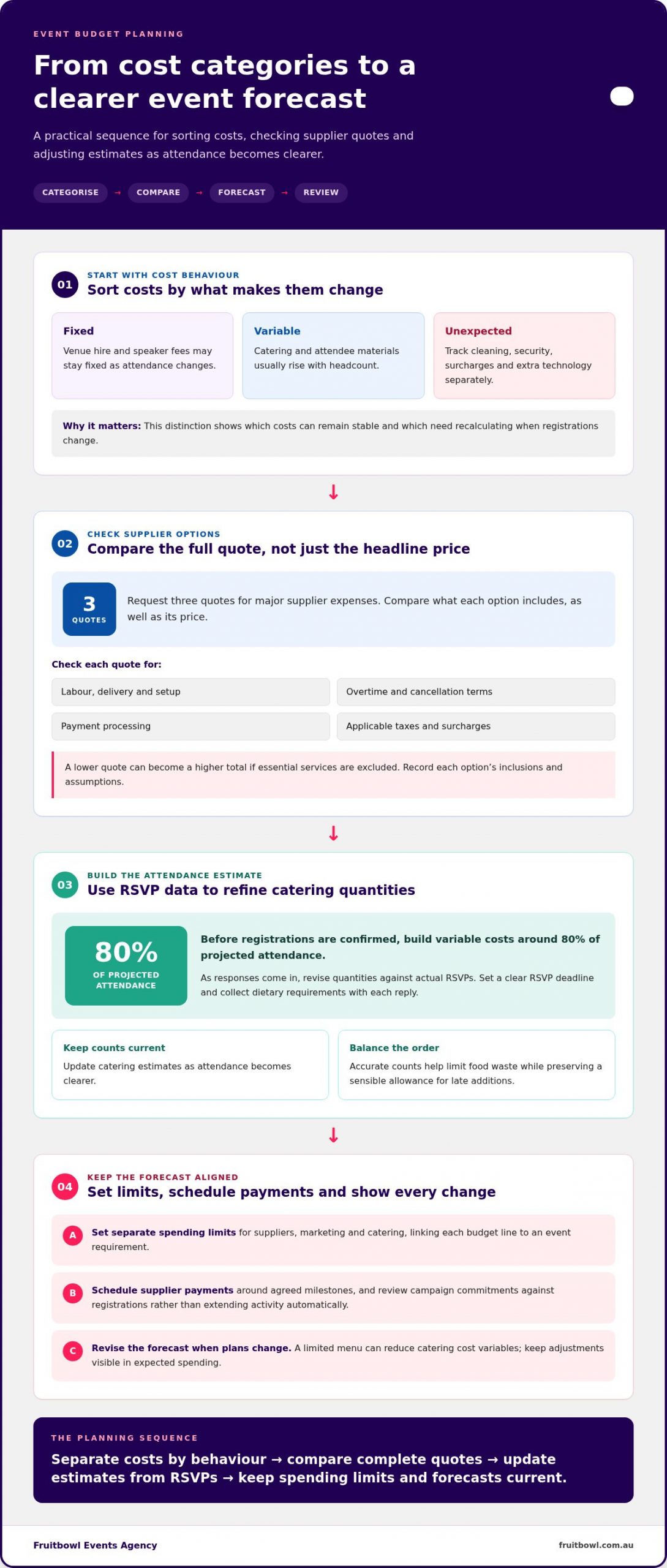
Group expected expenses by how they change as the event scales. Venue hire and speaker fees may stay fixed, while catering and attendee materials usually rise with attendance. Record unexpected costs separately, including cleaning, security, surcharges and extra technology. This distinction shows which costs will remain stable and which need recalculating as registrations change.
-
Compare supplier quotes and hidden costs
Request three quotes for major supplier expenses, then compare what each includes, not just the headline price. Check labour, delivery, setup, overtime, cancellation terms, payment processing and applicable taxes or surcharges. A lower quote can lead to a higher total if essential services are excluded. Record each option’s inclusions and assumptions during event planning.
-
Manage catering costs with RSVP headcounts
Use RSVP data to update catering estimates as attendance becomes clearer. Before registrations are confirmed, build variable costs around 80% of projected attendance, then revise quantities against actual responses. Set a clear RSVP deadline and collect dietary requirements with each reply. Accurate counts help limit food waste while preserving a sensible allowance for late additions.
-
Manage supplier, marketing and catering costs
Set separate spending limits for suppliers, marketing and catering, and link each line to an event requirement. Schedule supplier payments around agreed milestones, and review campaign commitments against registrations rather than extending activity automatically. When budgeting for specialised beverage stations, seeing how services such as Spear Brew Coffee · Johannesburg structure event coffee bar hire can illustrate how equipment, labour, and consumables are divided into fixed and variable rates. A limited menu can reduce catering cost variables. Keep changes visible in the forecast so expected spending reflects the current plan.
Testing attendance scenarios and contingency reserves
Model attendance at 70%, 100% and 125% of target to see how revenue and expenses shift. Common risks include lower turnout, scope changes, overlooked costs and rising supplier charges; scenario testing and an approved contingency help control overruns.
-
Estimate expenses and contingency funds
Calculate projected income and expenses separately for each attendance scenario, then identify the break-even point. Set a contingency against projected costs: 10-15% is recommended for established events with historical data, while first-time events or new formats call for 15-20%. Keep the reserve separate from planned spending, and document which unexpected costs could justify releasing it.
-
Plan for contingencies and rising costs
Review each estimate for exposure to supplier changes, late additions and cost increases. Event costs are rising by 5-14% annually, so revisit older estimates before locking in commitments. Match the contingency to the event’s complexity and uncertainty, then model how a cost increase affects the total forecast. Don’t use the reserve to fund optional upgrades or routine scope changes.
-
Prevent unexpected cost overruns
Assign an owner to each major risk, such as attendance shortfall or additional production needs, and set a clear approval process for new spending. In an illustrative corporate event scenario, 500 attendees would produce a loss, while profitability requires at least 750. Compare registrations with those thresholds throughout planning, then adjust commitments or scope before costs exceed the available budget.
Event planners are advised to reserve 5 to 15 per cent of projected expenses as a contingency and should set aside contingency funds for unforeseen expenses or emergencies. In Knowland’s 2023 State of the Meetings Industry survey, 46.3% of event professionals cited rising costs as their biggest concern in event planning. In the same survey, 39.8% of event planners anticipated audiovisual costs rising between 20% and 50%. These findings underline why the reserve should remain available for unexpected costs rather than being treated as planned spending.
The illustrative corporate event budget scenario anticipates attendance of between 500 and 1000 people. Use the attendance scenarios to check whether projected expenses and contingency funds remain suitable as expected turnout changes. Keep the reserve distinct from ordinary costs, and release it only for unforeseen expenses or emergencies.
Fixed, flexible and zero-based budgets
Choose an approach that reflects how settled the scope is and how much attendance may change. Managing a fixed event budget is easier when spending rules match the event’s income model and delivery needs.
-
Compare fixed, flexible and zero-based budgets
Use a fixed budget when the spending ceiling is firm and the scope can be delivered within it. A flexible budget adjusts variable costs, such as catering or staffing, as attendance changes. Zero-based budgeting requires you to justify each expense afresh instead of carrying forward previous allocations. For a conference with fluctuating registrations, a flexible approach can adapt costs while keeping the overall limit in view.
-
Prioritise expenses within a fixed budget
Rank proposed expenses by how directly they support the event’s purpose, attendee experience or essential delivery. Protect core elements first, then assess whether marketing, production or staffing can be adjusted without weakening outcomes. A 60/30/10 framework allocates 60% to core experience, 30% to marketing, staffing and operations, and 10% to contingency. Use it as a planning tool, not a universal rule.
- Before approving discretionary costs, test projected ticket revenue against likely attendance. Managing a fixed event budget means making trade-offs that preserve what matters most about the event. If projected revenue falls short, defer lower-priority elements before reducing essential delivery. Record the rationale and communicate decisions to the team so approved changes stay aligned with the event’s objectives.
For a conference, align event scope, staffing and delivery with the budget through conference event planning.
Fruitbowl Events Agency: Corporate Events
Fruitbowl Events Agency brings corporate event planning, logistics and on-site delivery together in a coordinated plan. Its team can support conferences, seminars and corporate events that need a clear scope and disciplined oversight, from early planning through delivery. This helps align creative decisions with practical requirements, so budget priorities shape the event plan from the start.
For festivals, public events and government activations, structured planning also supports coherent delivery. The right approach depends on the event’s objectives, audience and operational requirements. Clear priorities help guide decisions as plans develop.
Contact Fruitbowl Events Agency to discuss your corporate event.
Put your event plan into motion
A sound budget is most useful when it shapes decisions before commitments are made. Treat it as a working agreement: clarify who can approve changes, how updates reach the team and which outcomes matter most. That shared understanding keeps creative choices aligned with delivery needs as plans develop.
Managing a fixed event budget also means making deliberate trade-offs, rather than treating every line item as untouchable. If the event’s scope or priorities shift, bring decision-makers together, assess the implications and agree on the next step. A clear process helps preserve the event’s purpose while keeping financial decisions accountable.
Fruitbowl Events Agency works across Corporate Events, Festivals & Public Events, and Conferences & Seminars. If you’re ready to discuss an event and the planning it requires, contact Fruitbowl Events Agency. Take the next step with a clear view of your objectives and move forward with confidence.
Frequently Asked Questions
What contingency percentage should be included in an event budget?
As a starting point, reserve 5-10% of total costs, adjusting the amount for event size and risk. A new format with uncertain production needs may warrant a larger buffer than a familiar event with reliable cost history. Keep the reserve distinct from planned expenses, and agree who can authorise its use. That way, genuine surprises don’t become untracked additions.
What are typical event venue and catering prices in Australia?
Australian venue and catering prices vary by location, date, capacity, menu and service requirements. Compare quotes for your specific event.
OUR BLOG
Event Insights & Expertise
Our blog is your go-to resource for all things events. From expert insights and the latest industry trends to practical planning tips, we share everything you need to deliver standout experiences.
Contact Us