How to Justify an Event Budget to Management: A Strategic Framework for Approval

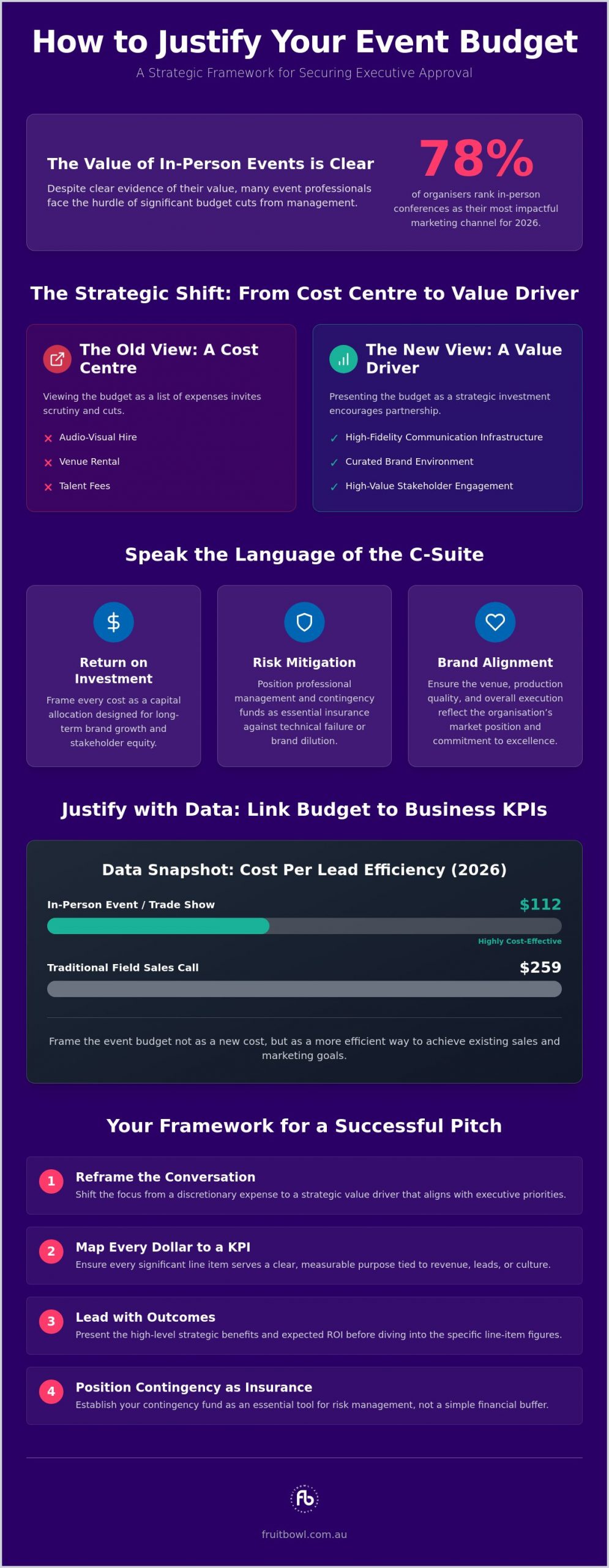
Did you know that 78% of event organisers now rank in-person conferences as their most impactful marketing channel for 2026? Despite this clear evidence of value, many professionals still face a familiar hurdle: the fear that a well-crafted plan will be dismantled by significant budget cuts. You likely understand the challenge of trying to explain why a premium technical setup or a specific venue is a necessity rather than a luxury, especially when you are under pressure to deliver high impact with limited resources.

Learning how to justify an event budget to management is about more than just defending figures; it’s about translating logistical requirements into the language of strategic investment. In this article, you will learn how to transform your spreadsheet into a compelling business case that secures executive sign-off and builds your reputation as a meticulous strategist. We will walk through a framework for aligning event goals with organisational KPIs, managing complex vendor quotes, and ensuring your next project is backed by the realistic funding it deserves for high-quality execution.

Key Takeaways

  • Reframe your event from a discretionary expense into a strategic value driver that aligns directly with executive priorities and organisational goals.
  • Map every significant line item to specific business KPIs to ensure that every dollar spent serves a clear, measurable purpose.
  • Master the precise presentation framework for how to justify an event budget to management by leading with high-level outcomes before presenting benchmarked figures.
  • Establish a transparent risk assessment by positioning your contingency fund as essential project insurance rather than a simple financial buffer.
  • Identify how professional management acts as a robust risk-mitigation strategy, reducing hidden labour costs and ensuring a seamless, high-stakes delivery.

The Strategic Shift: Moving from Cost Centre to Value Driver

Budget justification is the rigorous process of demonstrating an event’s absolute necessity to organisational stakeholders. It requires a fundamental shift in perspective. You must stop viewing a budget as a list of unavoidable expenses and start seeing it as a blueprint for business growth. Management often views events as discretionary spend because the connection between the invoice and the outcome is unclear. When a budget is presented as a series of costs, it invites scrutiny and cuts. When it’s presented as a strategic investment, it invites partnership.

The 2026 corporate environment has made this shift more critical than ever. In a market saturated with digital noise, face-to-face engagement has emerged as a primary competitive advantage. To succeed, you need a Translation Framework. This involves converting every technical line item into a tangible business benefit. Instead of listing “Audio-Visual Hire,” you present “High-Fidelity Communication Infrastructure for Executive Messaging.” This approach changes the conversation from “how much does it cost?” to “what does this achieve?”

Understanding the Executive Mindset

The C-suite operates on three primary pillars: return on investment, risk mitigation, and brand alignment. To understand how to justify an event budget to management, you must speak their language. Start by addressing the Opportunity Cost. Clearly articulate what the organisation loses if the event doesn’t occur, such as a decline in market sentiment or a missed window for lead acquisition. When management suggests you “do it cheaper,” respond with the authority of risk assessment. Explain that reducing resources often increases the probability of technical failure or brand dilution, which costs significantly more than the initial saving.

Defining the Difference Between Price and Investment

An event investment is a capital allocation intended to secure long-term brand growth and stakeholder equity. While price is what you pay for a service, investment is the value that service returns to the business over time. Choosing value-driven execution over a “cheap” alternative directly impacts attendee perception. A well-resourced event, managed with precision, protects the organisation’s reputation and ensures that the brand’s message is delivered without friction. This level of quality suggests a brand that is in control, stable, and committed to excellence.

  • Strategic Alignment: Every expense should map back to a core business objective.
  • Risk Mitigation: Professional management fees are an insurance policy against high-stakes failure.
  • Competitive Advantage: Events provide the high-touch engagement that digital channels cannot replicate.

Aligning Event Objectives with Organisational KPIs

Securing executive approval requires you to prove that every dollar spent is an intentional step toward a corporate objective. A budget without a corresponding Key Performance Indicator (KPI) is merely a wish list. To succeed, you must categorise your objectives into three primary buckets: revenue generation, lead acquisition, or internal culture building. By mapping every major expense to one of these pillars, you demonstrate a level of fiscal responsibility that resonates with the C-suite.

Data-driven forecasting is your most potent tool in this process. For instance, recent 2026 industry data from Wave Connect indicates that the average cost per lead at trade shows is $112, compared to $259 for traditional field sales calls. Presenting these comparative figures allows you to frame the event as a cost-saving measure for the sales department. When you understand how to justify an event budget to management, you stop presenting costs and start presenting efficiency. Engaging a partner with strategic event management expertise allows you to build these measurable metrics into your project from the initial proposal phase.

Mapping Logistics to Strategic Outcomes

Every logistical choice must serve a strategic purpose. High-end technical production is not about aesthetic flair; it is about ensuring audience engagement levels remain high enough to absorb executive messaging. Similarly, talent procurement should be presented as a drawcard for high-value stakeholders who would otherwise be inaccessible. Your venue selection is equally critical. It should reflect the organisation’s market positioning, whether that is one of established stability or cutting-edge innovation. If the venue doesn’t align with the brand’s identity, the investment is compromised.

Hard ROI vs. Brand Equity

While hard ROI is calculated through ticket sales or direct revenue, brand equity requires a more nuanced approach. In 2026, 78% of organisers rank in-person conferences as their most impactful marketing channel, according to Kande Photo Booths. This impact often manifests as “soft” metrics like sentiment and relationship building. You can quantify these by using historical data to benchmark expected outcomes. For example, if networking leads to a 15% increase in client retention over twelve months, that “soft” benefit becomes a “hard” financial justification. Use pre-event and post-event surveys to turn abstract brand equity into concrete data points that management can validate.

  • Revenue Focus: Direct income from sponsorships, registrations, or product launches.
  • Lead Focus: Calculating the reduction in cost-per-lead compared to digital channels.
  • Culture Focus: Measuring the impact of internal activations on staff retention and productivity.

Mitigating Financial Risk and Building Contingency

Management often views a contingency fund as a “nice-to-have” buffer or, worse, a hidden stash of extra cash. To secure approval, you must reframe this line item as essential Project Insurance. A transparent risk assessment demonstrates that you have considered every variable, from supply chain volatility to technical failures. By presenting a budget that acknowledges potential pitfalls, you project the image of a disciplined technician who is prepared for any outcome. This level of foresight is a core component of how to justify an event budget to management effectively.

The Role of a Robust Contingency Fund

For events planned in 2026, industry standards recommend a contingency fund of 10% to 20% of the total projected budget. If you are delivering a first-time activation, lean towards the 20% mark to account for the lack of historical data. If the event has at least three years of history, 10% to 15% is typically sufficient. This fund isn’t there to expand the project’s scope; it exists to protect the existing plan from unforeseen costs like sudden weather shifts or emergency technical support. A well-defined contingency fund actually prevents overspending by providing a pre-approved financial ceiling for high-stakes problem solving.

A Scalable Budget Model

Demonstrating fiscal responsibility requires a clear distinction between fixed and variable costs. Fixed costs, such as venue hire and core production, remain constant regardless of attendance. Variable costs, like catering and transport, should be presented in a modular format. This “Modular” approach allows you to show management how the budget scales up or down based on final registration numbers. It provides a sense of security, knowing that the financial commitment is tied directly to the level of engagement achieved.

Addressing the “Scope Creep” conversation early is vital. Establish the boundaries of the project during the initial pitch to ensure that additional requests later in the timeline are accompanied by additional funding. Integrating professional corporate event management into your proposal ensures that risk oversight is handled by experts who have navigated these challenges before. This partnership acts as a safeguard, ensuring that the project remains on track and within the agreed financial parameters.

  • Fixed Costs: Venue hire, keynote speaker fees, and basic AV infrastructure.
  • Variable Costs: Catering, delegate packs, and transport based on per-head counts.
  • Risk Mitigation: Explicitly linking contingency to specific, high-probability risks.
The Presentation Framework: How to Pitch the Numbers

The final hurdle in securing approval is the pitch itself. A spreadsheet may contain the data, but it doesn’t provide the narrative. When you are preparing how to justify an event budget to management, your presentation should follow a logical, sequential structure that leads the executive team to a natural “yes.” This framework ensures that your financial requests are always anchored in strategic value rather than mere logistical necessity.

  • Step 1: Executive Summary: Lead with the “Why.” Reiterate the strategic value and the primary business objectives the event will achieve.
  • Step 2: The Data Core: Present transparent, benchmarked figures that show you have done the homework.
  • Step 3: The Risk Mitigation Plan: Reference your contingency fund and risk assessment to show you are in full control of the variables.
  • Step 4: The Comparison: Contrast your proposed approach with the “do it cheaper” alternative, highlighting the hidden costs of low-quality execution.
  • Step 5: The Call to Action: Provide a clear path forward with specific timelines for approval and commencement.

Using Historical Data as a Benchmark

Benchmarking is the most effective way to build trust with the finance department. Gather data from previous years to show how past investments translated into tangible returns. For 2026, you must adjust these figures to account for industry-specific price increases and inflation, ensuring your projections remain realistic. By showing that your current request is a logical progression of successful past initiatives, you reduce the perceived risk of the investment. Accurate benchmarking proves that your budget isn’t a guess; it’s an informed calculation based on proven results.

Visualising the Budget for Clarity

Executive presentations often suffer from “Death by Spreadsheet.” To maintain engagement, use charts and graphs to visualise high-level data points. A pie chart showing the allocation of resources can quickly demonstrate that the bulk of the investment is focused on high-impact areas like audience engagement and technical excellence. For example, using av management for events as a case study allows you to visualise how technical costs scale with the complexity of the message delivery. This clarity ensures that management sees the structure of the project without getting bogged down in minor line items.

If you need assistance in structuring a persuasive financial case for your next activation, contact our team to discuss how our strategic methodology can help you secure executive sign-off.

Securing the ‘Yes’ through Professional Partnerships

The final element in a successful budget proposal is the delivery mechanism. Management is often less concerned with the specific dollar amount than they are with the certainty of the outcome. By introducing a professional agency as a “safe pair of hands,” you shift the focus from the cost of the project to the security of the execution. An agency with 28+ years of industry experience provides a level of seasoned expertise that internal teams simply cannot replicate. This partnership acts as a strategic asset for the Board, ensuring that high-stakes activations are delivered without the friction of logistical errors or compliance failures.

The ROI of End-to-End Event Management

When calculating the true cost of an event, many organisations overlook the heavy toll on internal labour. Assigning complex logistical tasks to staff who are already at capacity leads to project delays and increased error-based costs. Professional corporate event management services provide a clear return on investment by reclaiming this internal productivity and increasing project velocity. A specialised team ensures that every phase of the methodology, from technical direction to government compliance, is handled with precision. This end-to-end oversight reduces the burden on your team and ensures that the project remains within the approved financial parameters.

Leverage Industry Networks for Cost Efficiency

Established agencies possess deep procurement networks that one-off planners cannot access. These long-term relationships allow for better value across venue hire, technical production, and talent procurement. When you are determining how to justify an event budget to management, highlighting these procurement advantages is a powerful argument. It shows that you are not just spending money, but leveraging professional buying power to secure the highest possible quality for the lowest possible outlay. This total project oversight ensures budget integrity from the initial quote through to the final reconciliation.

A professional partnership provides more than just logistical support; it provides the confidence that the organisation’s reputation is in expert hands. By positioning an agency as a strategic partner, you demonstrate that you have prioritised risk mitigation and quality control at every level. This approach transforms the budget from a source of departmental tension into a shared investment in corporate success. Ready to present a bulletproof case? Consult with Fruitbowl Events Agency to refine your strategic event budget and secure the executive sign-off you need for your next high-impact delivery.

  • Risk Mitigation: Seasoned expertise reduces the probability of costly technical or logistical failures.
  • Labour Efficiency: Reclaiming internal staff time for core business activities.
  • Procurement Value: Accessing industry-only rates through established agency networks.

Securing Your Strategic Event Approval

Mastering the art of how to justify an event budget to management requires a transition from logistical coordinator to strategic business partner. By mapping every line item to specific organisational KPIs and presenting a robust risk mitigation plan, you demonstrate the fiscal discipline that executives demand. You have moved beyond simply listing costs; you are now proving that your event is a vital engine for brand growth and stakeholder engagement.

Securing a “yes” is ultimately about providing management with the confidence that their capital is in a safe pair of hands. With 28+ years of delivering high-impact corporate experiences, Fruitbowl Events Agency offers the national reach and technical direction required to ensure your activation is a measurable success. We specialise in the seamless integration of creative vision and logistical precision, allowing you to focus on your core objectives while we manage the complex details of high-stakes delivery.

Ready to build a bulletproof investment case for your next activation? Partner with the experts at Fruitbowl Events Agency for a strategic approach to your next event. We look forward to helping you deliver an exceptional result that exceeds every organisational expectation.

Frequently Asked Questions

How do I handle management’s request to cut the event budget by 20%?

When management requests a significant cut, you should immediately map that reduction to the specific business outcomes that will be lost. Present a “Reduced Impact” scenario that clearly shows which KPIs, such as lead generation targets or attendee engagement levels, will be compromised. This allows stakeholders to make an informed decision about whether the financial saving is worth the corresponding loss in strategic value.

What is the most effective way to quantify the ROI of a corporate conference?

Quantifying ROI is most effective when you combine hard financial data with qualitative metrics. Track the cost-per-lead and compare it to other marketing channels while measuring attendee sentiment through post-event surveys. Historical data from 2026 indicates that 78% of organisers find in-person conferences their most impactful channel; use these benchmarks to prove long-term brand equity and client retention.

Should I include a contingency fund in my first budget proposal to management?

You must include a contingency fund in your initial proposal to demonstrate a comprehensive understanding of risk management. Reframe this 10% to 20% allocation as “Project Insurance” rather than extra cash. This transparency builds trust with the finance department, showing you have planned for the volatile supply chain conditions and potential technical failures that can occur in high-stakes environments.

How can I justify the cost of hiring a professional event management agency?

Justifying a professional agency involves highlighting the mitigation of high-stakes risks and the significant saving of internal labour. An agency acts as a “safe pair of hands,” preventing the costly errors that often occur when internal staff are stretched too thin. This is a core strategy for how to justify an event budget to management when you need to ensure the project remains on track and within the agreed financial parameters.

What are the hidden costs in an event budget that management often misses?

Hidden costs often include internal staff hours, freight logistics, and comprehensive event insurance. Management frequently overlooks the “soft” cost of pulling team members away from their core duties for event planning. Ensuring these items are transparently listed in your initial budget prevents unexpected financial strain and demonstrates a level of logistical precision that reassures the executive team.

How do I explain the value of high-end technical production to non-technical stakeholders?

Explain high-end production through the lens of message retention and brand authority. If the technical setup fails, the executive message is lost, and the organisation’s reputation suffers. High-quality audio-visual infrastructure ensures that your message is delivered without friction, which is essential for maintaining the attention of high-value stakeholders and projecting an image of corporate stability.

Is it better to present a ‘best-case’ or ‘realistic’ budget to the Board?

Always present a realistic budget to the Board to maintain your professional credibility and build long-term trust. A “best-case” budget often leads to mid-project requests for more funding, which suggests a lack of strategic foresight. Providing a realistic financial model with built-in contingencies shows that you are a disciplined strategist who is in full control of the project’s fiscal health.

How do I use competitor benchmarking to justify my event spend?

Use competitor benchmarking to show the standard required to maintain market share and brand relevance in your sector. If industry leaders are investing in high-touch brand activations, a lower spend may result in a decline in market sentiment. Demonstrating that your proposed spend aligns with industry standards is a persuasive part of how to justify an event budget to management during a competitive business cycle.

Did you know that 78% of event organisers now rank in-person conferences as their most impactful marketing channel for 2026? Despite this clear evidence of value, many professionals still face a familiar hurdle: the fear that a well-crafted plan will be dismantled by significant budget cuts. You likely understand the challenge of trying to explain why a premium technical setup or a specific venue is a necessity rather than a luxury, especially when you are under pressure to deliver high impact with limited resources.

Learning how to justify an event budget to management is about more than just defending figures; it’s about translating logistical requirements into the language of strategic investment. In this article, you will learn how to transform your spreadsheet into a compelling business case that secures executive sign-off and builds your reputation as a meticulous strategist. We will walk through a framework for aligning event goals with organisational KPIs, managing complex vendor quotes, and ensuring your next project is backed by the realistic funding it deserves for high-quality execution.

Key Takeaways

  • Reframe your event from a discretionary expense into a strategic value driver that aligns directly with executive priorities and organisational goals.
  • Map every significant line item to specific business KPIs to ensure that every dollar spent serves a clear, measurable purpose.
  • Master the precise presentation framework for how to justify an event budget to management by leading with high-level outcomes before presenting benchmarked figures.
  • Establish a transparent risk assessment by positioning your contingency fund as essential project insurance rather than a simple financial buffer.
  • Identify how professional management acts as a robust risk-mitigation strategy, reducing hidden labour costs and ensuring a seamless, high-stakes delivery.

The Strategic Shift: Moving from Cost Centre to Value Driver

Budget justification is the rigorous process of demonstrating an event’s absolute necessity to organisational stakeholders. It requires a fundamental shift in perspective. You must stop viewing a budget as a list of unavoidable expenses and start seeing it as a blueprint for business growth. Management often views events as discretionary spend because the connection between the invoice and the outcome is unclear. When a budget is presented as a series of costs, it invites scrutiny and cuts. When it’s presented as a strategic investment, it invites partnership.

The 2026 corporate environment has made this shift more critical than ever. In a market saturated with digital noise, face-to-face engagement has emerged as a primary competitive advantage. To succeed, you need a Translation Framework. This involves converting every technical line item into a tangible business benefit. Instead of listing “Audio-Visual Hire,” you present “High-Fidelity Communication Infrastructure for Executive Messaging.” This approach changes the conversation from “how much does it cost?” to “what does this achieve?”

Understanding the Executive Mindset

The C-suite operates on three primary pillars: return on investment, risk mitigation, and brand alignment. To understand how to justify an event budget to management, you must speak their language. Start by addressing the Opportunity Cost. Clearly articulate what the organisation loses if the event doesn’t occur, such as a decline in market sentiment or a missed window for lead acquisition. When management suggests you “do it cheaper,” respond with the authority of risk assessment. Explain that reducing resources often increases the probability of technical failure or brand dilution, which costs significantly more than the initial saving.

Defining the Difference Between Price and Investment

An event investment is a capital allocation intended to secure long-term brand growth and stakeholder equity. While price is what you pay for a service, investment is the value that service returns to the business over time. Choosing value-driven execution over a “cheap” alternative directly impacts attendee perception. A well-resourced event, managed with precision, protects the organisation’s reputation and ensures that the brand’s message is delivered without friction. This level of quality suggests a brand that is in control, stable, and committed to excellence.

  • Strategic Alignment: Every expense should map back to a core business objective.
  • Risk Mitigation: Professional management fees are an insurance policy against high-stakes failure.
  • Competitive Advantage: Events provide the high-touch engagement that digital channels cannot replicate.

Aligning Event Objectives with Organisational KPIs

Securing executive approval requires you to prove that every dollar spent is an intentional step toward a corporate objective. A budget without a corresponding Key Performance Indicator (KPI) is merely a wish list. To succeed, you must categorise your objectives into three primary buckets: revenue generation, lead acquisition, or internal culture building. By mapping every major expense to one of these pillars, you demonstrate a level of fiscal responsibility that resonates with the C-suite.

Data-driven forecasting is your most potent tool in this process. For instance, recent 2026 industry data from Wave Connect indicates that the average cost per lead at trade shows is $112, compared to $259 for traditional field sales calls. Presenting these comparative figures allows you to frame the event as a cost-saving measure for the sales department. When you understand how to justify an event budget to management, you stop presenting costs and start presenting efficiency. Engaging a partner with strategic event management expertise allows you to build these measurable metrics into your project from the initial proposal phase.

Mapping Logistics to Strategic Outcomes

Every logistical choice must serve a strategic purpose. High-end technical production is not about aesthetic flair; it is about ensuring audience engagement levels remain high enough to absorb executive messaging. Similarly, talent procurement should be presented as a drawcard for high-value stakeholders who would otherwise be inaccessible. Your venue selection is equally critical. It should reflect the organisation’s market positioning, whether that is one of established stability or cutting-edge innovation. If the venue doesn’t align with the brand’s identity, the investment is compromised.

Hard ROI vs. Brand Equity

While hard ROI is calculated through ticket sales or direct revenue, brand equity requires a more nuanced approach. In 2026, 78% of organisers rank in-person conferences as their most impactful marketing channel, according to Kande Photo Booths. This impact often manifests as “soft” metrics like sentiment and relationship building. You can quantify these by using historical data to benchmark expected outcomes. For example, if networking leads to a 15% increase in client retention over twelve months, that “soft” benefit becomes a “hard” financial justification. Use pre-event and post-event surveys to turn abstract brand equity into concrete data points that management can validate.

  • Revenue Focus: Direct income from sponsorships, registrations, or product launches.
  • Lead Focus: Calculating the reduction in cost-per-lead compared to digital channels.
  • Culture Focus: Measuring the impact of internal activations on staff retention and productivity.

Mitigating Financial Risk and Building Contingency

Management often views a contingency fund as a “nice-to-have” buffer or, worse, a hidden stash of extra cash. To secure approval, you must reframe this line item as essential Project Insurance. A transparent risk assessment demonstrates that you have considered every variable, from supply chain volatility to technical failures. By presenting a budget that acknowledges potential pitfalls, you project the image of a disciplined technician who is prepared for any outcome. This level of foresight is a core component of how to justify an event budget to management effectively.

The Role of a Robust Contingency Fund

For events planned in 2026, industry standards recommend a contingency fund of 10% to 20% of the total projected budget. If you are delivering a first-time activation, lean towards the 20% mark to account for the lack of historical data. If the event has at least three years of history, 10% to 15% is typically sufficient. This fund isn’t there to expand the project’s scope; it exists to protect the existing plan from unforeseen costs like sudden weather shifts or emergency technical support. A well-defined contingency fund actually prevents overspending by providing a pre-approved financial ceiling for high-stakes problem solving.

A Scalable Budget Model

Demonstrating fiscal responsibility requires a clear distinction between fixed and variable costs. Fixed costs, such as venue hire and core production, remain constant regardless of attendance. Variable costs, like catering and transport, should be presented in a modular format. This “Modular” approach allows you to show management how the budget scales up or down based on final registration numbers. It provides a sense of security, knowing that the financial commitment is tied directly to the level of engagement achieved.

Addressing the “Scope Creep” conversation early is vital. Establish the boundaries of the project during the initial pitch to ensure that additional requests later in the timeline are accompanied by additional funding. Integrating professional corporate event management into your proposal ensures that risk oversight is handled by experts who have navigated these challenges before. This partnership acts as a safeguard, ensuring that the project remains on track and within the agreed financial parameters.

  • Fixed Costs: Venue hire, keynote speaker fees, and basic AV infrastructure.
  • Variable Costs: Catering, delegate packs, and transport based on per-head counts.
  • Risk Mitigation: Explicitly linking contingency to specific, high-probability risks.

The Presentation Framework: How to Pitch the Numbers

The final hurdle in securing approval is the pitch itself. A spreadsheet may contain the data, but it doesn’t provide the narrative. When you are preparing how to justify an event budget to management, your presentation should follow a logical, sequential structure that leads the executive team to a natural “yes.” This framework ensures that your financial requests are always anchored in strategic value rather than mere logistical necessity.

  • Step 1: Executive Summary: Lead with the “Why.” Reiterate the strategic value and the primary business objectives the event will achieve.
  • Step 2: The Data Core: Present transparent, benchmarked figures that show you have done the homework.
  • Step 3: The Risk Mitigation Plan: Reference your contingency fund and risk assessment to show you are in full control of the variables.
  • Step 4: The Comparison: Contrast your proposed approach with the “do it cheaper” alternative, highlighting the hidden costs of low-quality execution.
  • Step 5: The Call to Action: Provide a clear path forward with specific timelines for approval and commencement.

Using Historical Data as a Benchmark

Benchmarking is the most effective way to build trust with the finance department. Gather data from previous years to show how past investments translated into tangible returns. For 2026, you must adjust these figures to account for industry-specific price increases and inflation, ensuring your projections remain realistic. By showing that your current request is a logical progression of successful past initiatives, you reduce the perceived risk of the investment. Accurate benchmarking proves that your budget isn’t a guess; it’s an informed calculation based on proven results.

Visualising the Budget for Clarity

Executive presentations often suffer from “Death by Spreadsheet.” To maintain engagement, use charts and graphs to visualise high-level data points. A pie chart showing the allocation of resources can quickly demonstrate that the bulk of the investment is focused on high-impact areas like audience engagement and technical excellence. For example, using av management for events as a case study allows you to visualise how technical costs scale with the complexity of the message delivery. This clarity ensures that management sees the structure of the project without getting bogged down in minor line items.

If you need assistance in structuring a persuasive financial case for your next activation, contact our team to discuss how our strategic methodology can help you secure executive sign-off.

Securing the ‘Yes’ through Professional Partnerships

The final element in a successful budget proposal is the delivery mechanism. Management is often less concerned with the specific dollar amount than they are with the certainty of the outcome. By introducing a professional agency as a “safe pair of hands,” you shift the focus from the cost of the project to the security of the execution. An agency with 28+ years of industry experience provides a level of seasoned expertise that internal teams simply cannot replicate. This partnership acts as a strategic asset for the Board, ensuring that high-stakes activations are delivered without the friction of logistical errors or compliance failures.

The ROI of End-to-End Event Management

When calculating the true cost of an event, many organisations overlook the heavy toll on internal labour. Assigning complex logistical tasks to staff who are already at capacity leads to project delays and increased error-based costs. Professional corporate event management services provide a clear return on investment by reclaiming this internal productivity and increasing project velocity. A specialised team ensures that every phase of the methodology, from technical direction to government compliance, is handled with precision. This end-to-end oversight reduces the burden on your team and ensures that the project remains within the approved financial parameters.

Leverage Industry Networks for Cost Efficiency

Established agencies possess deep procurement networks that one-off planners cannot access. These long-term relationships allow for better value across venue hire, technical production, and talent procurement. When you are determining how to justify an event budget to management, highlighting these procurement advantages is a powerful argument. It shows that you are not just spending money, but leveraging professional buying power to secure the highest possible quality for the lowest possible outlay. This total project oversight ensures budget integrity from the initial quote through to the final reconciliation.

A professional partnership provides more than just logistical support; it provides the confidence that the organisation’s reputation is in expert hands. By positioning an agency as a strategic partner, you demonstrate that you have prioritised risk mitigation and quality control at every level. This approach transforms the budget from a source of departmental tension into a shared investment in corporate success. Ready to present a bulletproof case? Consult with Fruitbowl Events Agency to refine your strategic event budget and secure the executive sign-off you need for your next high-impact delivery.

  • Risk Mitigation: Seasoned expertise reduces the probability of costly technical or logistical failures.
  • Labour Efficiency: Reclaiming internal staff time for core business activities.
  • Procurement Value: Accessing industry-only rates through established agency networks.

Securing Your Strategic Event Approval

Mastering the art of how to justify an event budget to management requires a transition from logistical coordinator to strategic business partner. By mapping every line item to specific organisational KPIs and presenting a robust risk mitigation plan, you demonstrate the fiscal discipline that executives demand. You have moved beyond simply listing costs; you are now proving that your event is a vital engine for brand growth and stakeholder engagement.

Securing a “yes” is ultimately about providing management with the confidence that their capital is in a safe pair of hands. With 28+ years of delivering high-impact corporate experiences, Fruitbowl Events Agency offers the national reach and technical direction required to ensure your activation is a measurable success. We specialise in the seamless integration of creative vision and logistical precision, allowing you to focus on your core objectives while we manage the complex details of high-stakes delivery.

Ready to build a bulletproof investment case for your next activation? Partner with the experts at Fruitbowl Events Agency for a strategic approach to your next event. We look forward to helping you deliver an exceptional result that exceeds every organisational expectation.

Frequently Asked Questions

How do I handle management’s request to cut the event budget by 20%?

When management requests a significant cut, you should immediately map that reduction to the specific business outcomes that will be lost. Present a “Reduced Impact” scenario that clearly shows which KPIs, such as lead generation targets or attendee engagement levels, will be compromised. This allows stakeholders to make an informed decision about whether the financial saving is worth the corresponding loss in strategic value.

What is the most effective way to quantify the ROI of a corporate conference?

Quantifying ROI is most effective when you combine hard financial data with qualitative metrics. Track the cost-per-lead and compare it to other marketing channels while measuring attendee sentiment through post-event surveys. Historical data from 2026 indicates that 78% of organisers find in-person conferences their most impactful channel; use these benchmarks to prove long-term brand equity and client retention.

Should I include a contingency fund in my first budget proposal to management?

You must include a contingency fund in your initial proposal to demonstrate a comprehensive understanding of risk management. Reframe this 10% to 20% allocation as “Project Insurance” rather than extra cash. This transparency builds trust with the finance department, showing you have planned for the volatile supply chain conditions and potential technical failures that can occur in high-stakes environments.

How can I justify the cost of hiring a professional event management agency?

Justifying a professional agency involves highlighting the mitigation of high-stakes risks and the significant saving of internal labour. An agency acts as a “safe pair of hands,” preventing the costly errors that often occur when internal staff are stretched too thin. This is a core strategy for how to justify an event budget to management when you need to ensure the project remains on track and within the agreed financial parameters.

What are the hidden costs in an event budget that management often misses?

Hidden costs often include internal staff hours, freight logistics, and comprehensive event insurance. Management frequently overlooks the “soft” cost of pulling team members away from their core duties for event planning. Ensuring these items are transparently listed in your initial budget prevents unexpected financial strain and demonstrates a level of logistical precision that reassures the executive team.

How do I explain the value of high-end technical production to non-technical stakeholders?

Explain high-end production through the lens of message retention and brand authority. If the technical setup fails, the executive message is lost, and the organisation’s reputation suffers. High-quality audio-visual infrastructure ensures that your message is delivered without friction, which is essential for maintaining the attention of high-value stakeholders and projecting an image of corporate stability.

Is it better to present a ‘best-case’ or ‘realistic’ budget to the Board?

Always present a realistic budget to the Board to maintain your professional credibility and build long-term trust. A “best-case” budget often leads to mid-project requests for more funding, which suggests a lack of strategic foresight. Providing a realistic financial model with built-in contingencies shows that you are a disciplined strategist who is in full control of the project’s fiscal health.

How do I use competitor benchmarking to justify my event spend?

Use competitor benchmarking to show the standard required to maintain market share and brand relevance in your sector. If industry leaders are investing in high-touch brand activations, a lower spend may result in a decline in market sentiment. Demonstrating that your proposed spend aligns with industry standards is a persuasive part of how to justify an event budget to management during a competitive business cycle.

Back to Articles
Request A Quote

Make an
Enquiry

Untitled design

What Makes Us Different?

True end-to-end solution so you can hand off to us, focus on your priorities and enjoy the event without any stress

Unmatched industry expertise looking after diverse range of high-profile events, cultural festivals & activations

Meticulous attention to every detail and precise execution of events with our streamlined processes

Tailored solutions with bespoke strategies to ensure we align with your brand and objectives

Make an Enquiry

"*" indicates required fields

This field is for validation purposes and should be left unchanged.

"*" indicates required fields

This field is for validation purposes and should be left unchanged.