The best event agency is not necessarily the one with the most polished presentation. It is the one that can connect creative ideas with the practical details of delivery. If you’re considering how to choose an event agency, assess its relevant experience, capabilities and working approach. The real test is whether those elements come together when plans meet the realities of an event.
Choosing well can be difficult when agencies make similar claims, but event formats, scale and objectives call for specific experience. You also need confidence that planning, logistics, production, safety and on-site management will be coordinated, with clear accountability throughout.
This guide gives you a practical framework for assessing an agency’s track record, delivery capability and collaboration style. You’ll learn what to look for in case studies, how to examine the links between creative planning and operational execution, and how to clarify responsibilities before event day. Fruitbowl Events Agency has delivered 2,500+ events for councils, government bodies and major festivals, bringing experience in the decisions that shape successful events.
Key Takeaways
- Start with your event’s purpose, audience and format to define the support you need.
- Learn how to choose an event agency by matching its evidence and capabilities to your event’s demands, not presentation quality alone.
- Set clear roles, decision pathways and escalation procedures to maintain visibility and control throughout delivery.
- Use a consistent four-step process to prepare your brief, shortlist agencies, compare delivery approaches and agree responsibilities.
- Consider how an integrated delivery approach can bring planning, production, logistics and event-day management together.
Table of Contents
- How to Choose an Event Agency Starts With Your Event’s Purpose
- Match an Event Agency’s Experience to Your Event’s Real Demands
- Check How the Event Agency Will Manage Collaboration and Risk
- Use a Structured Process to Compare and Select an Event Agency
- Why Fruitbowl Is an Event Agency Built for End-to-End Delivery
How to Choose an Event Agency Starts With Your Event’s Purpose
Choosing an agency can feel difficult when an event carries organisational or reputational stakes. A clear brief gives you a reliable starting point. Before comparing approaches, define what the event needs to achieve, who it needs to serve and what kind of experience will support those aims. The right fit depends on these factors, not just the event’s size or the ambition of its creative concept.
Separate the audience outcome from the delivery requirements. An outcome might be helping delegates understand a new strategy, encouraging community participation or creating meaningful engagement with a brand. Delivery requirements are the work needed to support that result, such as registration, technical production, programme design or audience communications. This distinction helps you assess how to choose an event agency by its ability to connect the purpose with the practical work.
What should an event agency understand before recommending an approach?
Explain why the event is happening, what the audience needs from it and what you want people to think, feel or do afterwards. Then define success from both the stakeholder and attendee perspectives. For example, stakeholders may prioritise clear communication of a new initiative, while attendees need a relevant, well-paced programme. Use these measures to guide recommendations, rather than adding them as an afterthought.
Be clear about constraints and unknowns. These might include an existing venue, a fixed date, accessibility needs, internal approval processes or programme elements still under consideration. Distinguishing firm requirements from unresolved decisions lets an agency develop a workable approach without treating every early idea as a commitment. A basic grounding in event management principles can also help your team frame the scope and responsibilities involved.
Which event requirements shape the agency brief?
Identify the format first, whether it’s a major trade exhibition, a public event, a brand activation or a specialised industry summit like Construction Technology ConFeX KSA. Describe the expected audience, programme, setting and stakeholder groups, including the people who will approve decisions or contribute content. Then separate essential outcomes from optional creative or operational elements. This makes it easier to discuss what the event requires without locking the team into a particular solution too early.
Use this checklist to establish a shared brief:
- Purpose: What organisational or audience need should the event address?
- Audience: Who will attend, and what do they need from the experience?
- Format and scale: What type of event is planned, and what is its expected reach?
- Success measures: What evidence will show that the event met its objectives?
- Decision-makers: Who sets priorities, approves changes and provides essential input?
Use the checklist to distinguish outcomes from scope. If audience participation is essential, identify it as a success measure, then discuss which programme and production requirements could support it. If a feature is optional, label it accordingly. That clarity gives agencies a consistent basis for developing their approach and helps your organisation compare proposals against the same purpose, audience and delivery needs.
Match an Event Agency’s Experience to Your Event’s Real Demands
A strong reputation or polished presentation can indicate professionalism, but neither proves that an agency is equipped for your event’s specific demands. Assess the fit between its experience, your format and the responsibilities it can manage. This matters especially for complex public and organisational events, where creative work, technical production, logistics and safety need to be coordinated rather than treated as separate tasks.
How do you assess relevant event experience?
Look for examples that reflect your event’s format, audience and delivery complexity. Go beyond photographs: establish what the agency was responsible for, which capabilities it brought together and how its role supported the event’s objectives. Fruitbowl has delivered 2,500+ events for councils, government bodies and major festivals. That breadth provides context for its track record, while your assessment should still focus on the experience most relevant to your brief.
Which capabilities should align with your event format?
Match the required work to the capabilities an agency can bring together. A conference may need registration, ticketing and technical production to support its programme. A public event may depend on programming, marketing, safety and compliance working in concert. For an activation, consider how design, sponsorship and audience-focused execution fit together. Not every event needs every service, so focus on the combination that supports your objectives.
Use this comparison to test the fit:
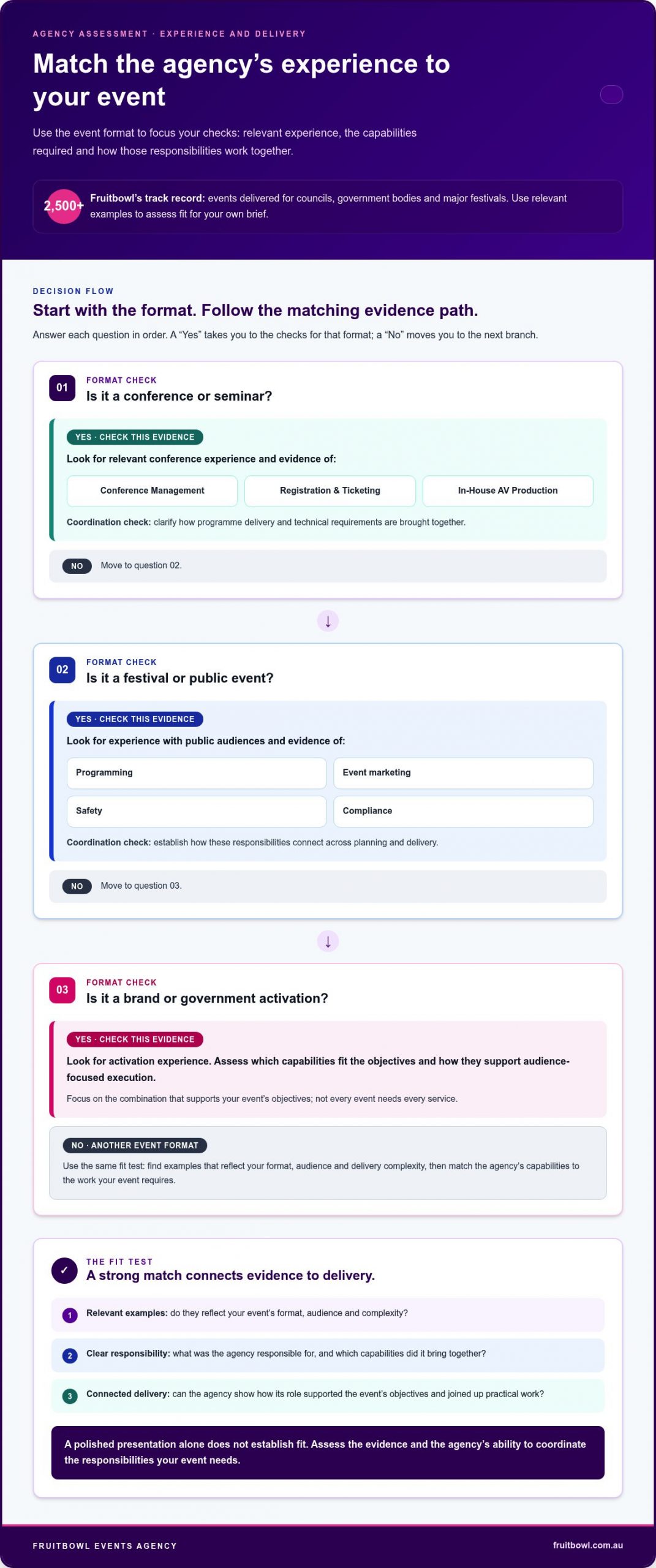
Conference or seminar: Look for relevant conference experience and evidence of Conference Management, Registration & Ticketing and In-House AV Production. Clarify how programme delivery and technical requirements are coordinated.
Festival or public event: Look for experience with public audiences and evidence of programming, event marketing, safety and compliance. Establish how these responsibilities connect across planning and delivery.
Brand or government activation: Look for activation experience and capabilities in event design, marketing, sponsorship and audience-focused execution. Clarify how the concept translates into practical delivery.
Fruitbowl’s event work spans corporate events, conferences, public events, festivals, government activations and brand activations. Its services include Event Management, Conference Management, Registration & Ticketing, Marketing & Sponsorship, Event Design & Consulting, Entertainment & Programming, In-House AV Production, Virtual & Hybrid Events, and Event Safety & Compliance. This range can support an integrated approach when the project calls for it, without implying that every event needs the same scope.
As you review examples, note whether the agency’s role covered strategy, coordination, production or on-site delivery, and where responsibilities sat with others. Find out how the work was organised across those stages, not just what the finished event looked like. This helps reveal whether the agency can manage the connections between the tasks your event depends on.
For an overview of how these capabilities come together across event formats, explore Fruitbowl’s event management experience. Use the same lens to compare each agency: relevant evidence, aligned capabilities and clear delivery responsibilities. That’s a more reliable basis for how to choose an event agency than presentation quality alone.
Check How the Event Agency Will Manage Collaboration and Risk
Bringing an agency into an event shouldn’t mean losing visibility or control. A clear working arrangement gives your team defined approval points while allowing the agency to coordinate delivery. This matters particularly for public and organisational events, where decisions about programme changes, suppliers or site operations can affect several stakeholders at once. When considering how to choose an event agency, assess how collaboration and risk planning will work in practice, not just which services appear in a proposal.
How should responsibilities and decisions be organised?
Agree who owns each decision and how updates will reach the right people. Set out client and agency responsibilities for planning, approvals, stakeholder communication and event-day delivery. Establish a regular communication rhythm, identify who can approve changes and define how urgent issues are escalated. Fruitbowl brings planning, logistics, production and on-site delivery together, helping coordinate the details while keeping clients informed about key decisions.
A practical responsibility plan should clarify:
- Ownership: Who leads each workstream, and who provides input?
- Approvals: Which decisions need client sign-off, and who can give it?
- Updates: How will progress, dependencies and emerging issues be communicated?
- Escalation: Who is contacted if a decision or operational issue needs prompt attention?
For example, if a programme change affects production, audience communications and stakeholder expectations, the team should know who assesses the implications, who authorises the change and how the update is shared. Clear pathways reduce duplicated requests and keep decisions connected to the event’s objectives.
How should safety and operational risk be discussed?
Safety planning needs to reflect the event’s setting and activities. Discuss how risk assessments relate to crowd movement, traffic arrangements and emergency procedures, and how responsibilities, documentation and compliance requirements will be coordinated. The aim is to understand how risks will be identified and managed, not to assume they can be eliminated. Plans also need clear owners and an agreed process for reviewing changes.
Consider how this work connects to the wider delivery plan. A change in site layout, for instance, may affect access, crowd flow and operational arrangements. Establish how relevant teams will share updates and how documentation will reflect agreed changes. For public events, clarify how safety and compliance planning fits alongside programming, production and on-site coordination, rather than treating it as a separate checklist.
Fruitbowl provides Event Safety & Compliance as part of its event delivery approach. This connects operational planning with the wider coordination of logistics, production and on-site delivery. Read more about Fruitbowl’s event management approach.
Before appointing an agency, make sure the working arrangement gives your team both oversight and a clear route for action. Defined responsibilities, communication and escalation procedures help keep collaboration organised, while considered safety planning supports dependable delivery.
Use a Structured Process to Compare and Select an Event Agency
A consistent process turns a shortlist into a reasoned appointment decision. Give each agency the same brief and assess its response against your event’s objectives, capability needs, evidence and collaboration requirements. This makes differences easier to identify and keeps the decision focused on fit, rather than presentation style or generic rankings. It also gives stakeholders a shared basis for discussing how to choose an event agency.
- Prepare the brief. Set out the event purpose, audience, format, expected scale, essential outcomes and known constraints. Identify the capabilities the project needs, such as registration, programming, production or safety planning, and note which decisions are still open. A clear brief gives each agency the same starting point.
- Shortlist by fit. Review experience that reflects your event format and delivery demands. Consider the agency’s role in relevant examples, the work it coordinated and the capabilities it brought together. Shortlist based on evidence of fit, not simply the number or visual impact of case studies.
- Compare delivery approaches. Ask each shortlisted agency to explain how it would translate your objectives into a coordinated plan. Compare how planning, stakeholders, production, communications and event-day delivery connect where relevant. Notice whether the proposed approach addresses your priorities or relies on broad service claims.
- Agree responsibilities. Before appointment, document the scope, client and agency roles, approval points, communication rhythm and escalation pathway. Make sure both sides understand who owns decisions and how changes will be handled as planning progresses.
What should an event agency comparison scorecard include?
Use a simple scorecard based on your brief, rather than a generic ranking. Give each agency the same criteria and record the evidence behind your assessment. You could include:
- Relevant experience: Similarity of format, audience and delivery complexity.
- Service fit: Alignment between required capabilities and proposed scope.
- Delivery approach: How planning, logistics, production and event-day coordination connect.
- Evidence: Case studies that explain the agency’s responsibilities and contribution.
- Collaboration: Clarity around roles, approvals, updates and escalation.
Leave space for strengths, unanswered operational questions and stakeholder feedback. If one response is strong on creative direction but unclear about delivery ownership, record both points. The aim isn’t to reward the agency with the most polished submission. It’s to see which approach addresses the event’s priorities and offers a clear path from proposal to execution.
How do you move from shortlist to appointment?
Use a structured conversation to test how well each agency understands the brief. Ask it to explain its proposed delivery model, the responsibilities it would take on and the decisions it would need from your team. Review case studies for the agency’s actual role, not just the event format or finished result. Then compare stakeholder feedback against the scorecard and resolve key questions before agreeing the scope.
A disciplined comparison helps your team make the appointment with clarity about both the work and the working relationship. See how Fruitbowl supports event delivery.
Why Fruitbowl Is an Event Agency Built for End-to-End Delivery
Once you’ve defined your objectives, identified the capabilities your event needs and set selection criteria, look for an agency whose services can connect across delivery. Fruitbowl is an independent event management agency with 28+ years of operation and a team with 85+ years of combined industry experience. Its work spans corporate events, conferences, public events, festivals, government activations and brand activations.
Which Fruitbowl services can support an event lifecycle?
Different events call for different combinations of support. Fruitbowl’s services cover strategic planning, audience engagement, technical delivery and operational coordination, allowing the scope to reflect the event rather than forcing every service into every project.
- Planning and coordination: Event Management and Conference Management support event organisation and delivery, while Event Design & Consulting helps shape the event approach.
- Attendee and programme delivery: Registration & Ticketing supports the attendee journey. Entertainment & Programming helps develop programme content, while Virtual & Hybrid Events supports formats that combine in-person and online participation.
- Production: In-House AV Production brings technical production into the wider delivery plan where the event requires it.
- Operational planning: Event Safety & Compliance supports safety-related planning and compliance considerations as part of event delivery.
- Reach and partnerships: Event Marketing Services support event promotion, while Event Sponsorship Services address sponsorship activity.
The value of a broad service range lies in how relevant elements work together. A conference, for example, may bring together conference management, registration, programming and AV production. A public event may have different priorities around programming, marketing and safety. Fruitbowl aligns the work to the event’s objectives and delivery requirements, coordinating the details so clients can focus on their audience.
What evidence supports Fruitbowl’s event experience?
Fruitbowl has delivered 2,500+ events. The team delivers 50+ successful events every year, with experience across councils, government bodies and major festivals. These figures provide context for its track record, while its range of event formats and services shows how that experience can relate to different project requirements.
For organisations considering how to choose an event agency, the practical question is whether experience, services and delivery approach align with the event at hand. Fruitbowl brings planning, logistics, production and on-site delivery into a coordinated process, with event safety and compliance included in its wider capabilities. The scope can be shaped around your objectives, audience and required support.
Explore Fruitbowl’s event management services to see how the agency brings event delivery together.
Turn Your Event Brief Into a Confident Next Step
The agency decision is also an opportunity to align your internal team. Before moving ahead, make sure stakeholders share a clear view of what the event needs to achieve and how they’ll contribute to decisions. A concise brief can serve as a working document, keeping priorities visible as plans develop.
Knowing how to choose an event agency means looking beyond the initial proposal to the partnership you’ll need throughout delivery. The right conversation should clarify how your objectives will guide the work, where your team’s input matters and how the event can move from an agreed direction into action.
Fruitbowl brings event planning, production, marketing, safety and delivery capabilities together, supported by 28+ years of operation, 85+ years of combined team experience, 2,500+ events delivered and 50+ successful events every year. Discuss your event with Fruitbowl to explore an approach shaped around your objectives and delivery needs.
Frequently Asked Questions
Is an event agency the same as an event planner?
The terms can overlap, but an event agency may bring together a broader mix of expertise than an individual planner. Depending on the agreed scope, that can include event design, registration, marketing, programming, production and safety planning. The important distinction is the work being delivered, not the title. A conference, for example, may need coordinated registration and AV production as well as planning, while a smaller brief may require a narrower set of services.
How far in advance should I engage an event agency?
Engage an agency as early as you can once the event has a purpose and a likely format. There’s no single lead time that suits every project: a public event with multiple stakeholders and operational dependencies may need more planning than a straightforward internal gathering. Early involvement can help shape decisions before they’re fixed, including programme design, production needs and delivery responsibilities. If your date is already set, share it at the outset.
What information should I prepare before approaching an event agency?
Alongside your objectives and event format, gather materials that could affect the approach: previous event evaluations, draft agendas, brand guidelines, venue information and stakeholder expectations. Note what’s approved, what remains open and who owns each decision. You don’t need a finished concept. A working brief with clear knowns and unknowns gives an agency useful context and helps distinguish early ideas from final requirements.
Can an event agency work with an event concept that is still developing?
Yes. An event concept can be refined with an agency while the brief is taking shape. Share the thinking behind it, the audience experience you want to create and any firm constraints, then distinguish these from ideas that are still exploratory. Event Design & Consulting can help develop the approach, while practical considerations such as programme, production and setting inform how it could be delivered. Keep a record of agreed changes as the concept evolves.
How can I compare event agency proposals fairly?
Give each shortlisted agency the same brief and ask for responses against the same scope assumptions. Compare how each proposal addresses your objectives, which responsibilities it covers and what evidence supports its approach. If attendee registration is central, for example, look for a clear explanation of how that requirement fits the proposed delivery plan. Record strengths, gaps and follow-up questions in one shared document so stakeholder feedback is assessed consistently.
What should happen after I appoint an event agency?
Start with a project kick-off that turns the agreed proposal into a working plan. Confirm key contacts, immediate actions, decision owners and how changes to the brief will be recorded. Share relevant documents, such as brand assets, existing supplier details or draft programme materials, through an agreed process. A maintained action list helps both teams track progress and dependencies, while regular reviews keep the work aligned as details are confirmed.
Can an event agency support a one-off event as well as a recurring programme?
Yes. An agency can work on a single event or support a recurring programme, with the scope shaped to suit each. For a one-off event, the focus may be delivering a defined brief. For a series, consistent planning documents, audience feedback and post-event reviews can help carry useful learning into the next edition. If dates, formats or audiences vary, capture those differences clearly so each event is planned for its own requirements.
The best event agency is not necessarily the one with the most polished presentation. It is the one that can connect creative ideas with the practical details of delivery. If you’re considering how to choose an event agency, assess its relevant experience, capabilities and working approach. The real test is whether those elements come together when plans meet the realities of an event.
Choosing well can be difficult when agencies make similar claims, but event formats, scale and objectives call for specific experience. You also need confidence that planning, logistics, production, safety and on-site management will be coordinated, with clear accountability throughout.
This guide gives you a practical framework for assessing an agency’s track record, delivery capability and collaboration style. You’ll learn what to look for in case studies, how to examine the links between creative planning and operational execution, and how to clarify responsibilities before event day. Fruitbowl Events Agency has delivered 2,500+ events for councils, government bodies and major festivals, bringing experience in the decisions that shape successful events.
Key Takeaways
- Start with your event’s purpose, audience and format to define the support you need.
- Learn how to choose an event agency by matching its evidence and capabilities to your event’s demands, not presentation quality alone.
- Set clear roles, decision pathways and escalation procedures to maintain visibility and control throughout delivery.
- Use a consistent four-step process to prepare your brief, shortlist agencies, compare delivery approaches and agree responsibilities.
- Consider how an integrated delivery approach can bring planning, production, logistics and event-day management together.
Table of Contents
- How to Choose an Event Agency Starts With Your Event’s Purpose
- Match an Event Agency’s Experience to Your Event’s Real Demands
- Check How the Event Agency Will Manage Collaboration and Risk
- Use a Structured Process to Compare and Select an Event Agency
- Why Fruitbowl Is an Event Agency Built for End-to-End Delivery
How to Choose an Event Agency Starts With Your Event’s Purpose
Choosing an agency can feel difficult when an event carries organisational or reputational stakes. A clear brief gives you a reliable starting point. Before comparing approaches, define what the event needs to achieve, who it needs to serve and what kind of experience will support those aims. The right fit depends on these factors, not just the event’s size or the ambition of its creative concept.
Separate the audience outcome from the delivery requirements. An outcome might be helping delegates understand a new strategy, encouraging community participation or creating meaningful engagement with a brand. Delivery requirements are the work needed to support that result, such as registration, technical production, programme design or audience communications. This distinction helps you assess how to choose an event agency by its ability to connect the purpose with the practical work.
What should an event agency understand before recommending an approach?
Explain why the event is happening, what the audience needs from it and what you want people to think, feel or do afterwards. Then define success from both the stakeholder and attendee perspectives. For example, stakeholders may prioritise clear communication of a new initiative, while attendees need a relevant, well-paced programme. Use these measures to guide recommendations, rather than adding them as an afterthought.
Be clear about constraints and unknowns. These might include an existing venue, a fixed date, accessibility needs, internal approval processes or programme elements still under consideration. Distinguishing firm requirements from unresolved decisions lets an agency develop a workable approach without treating every early idea as a commitment. A basic grounding in event management principles can also help your team frame the scope and responsibilities involved.
Which event requirements shape the agency brief?
Identify the format first, whether it’s a conference, public event, brand activation or another type of gathering. Describe the expected audience, programme, setting and stakeholder groups, including the people who will approve decisions or contribute content. Then separate essential outcomes from optional creative or operational elements. This makes it easier to discuss what the event requires without locking the team into a particular solution too early.
Use this checklist to establish a shared brief:
- Purpose: What organisational or audience need should the event address?
- Audience: Who will attend, and what do they need from the experience?
- Format and scale: What type of event is planned, and what is its expected reach?
- Success measures: What evidence will show that the event met its objectives?
- Decision-makers: Who sets priorities, approves changes and provides essential input?
Use the checklist to distinguish outcomes from scope. If audience participation is essential, identify it as a success measure, then discuss which programme and production requirements could support it. If a feature is optional, label it accordingly. That clarity gives agencies a consistent basis for developing their approach and helps your organisation compare proposals against the same purpose, audience and delivery needs.
Match an Event Agency’s Experience to Your Event’s Real Demands
A strong reputation or polished presentation can indicate professionalism, but neither proves that an agency is equipped for your event’s specific demands. Assess the fit between its experience, your format and the responsibilities it can manage. This matters especially for complex public and organisational events, where creative work, technical production, logistics and safety need to be coordinated rather than treated as separate tasks.
How do you assess relevant event experience?
Look for examples that reflect your event’s format, audience and delivery complexity. Go beyond photographs: establish what the agency was responsible for, which capabilities it brought together and how its role supported the event’s objectives. Fruitbowl has delivered 2,500+ events for councils, government bodies and major festivals. That breadth provides context for its track record, while your assessment should still focus on the experience most relevant to your brief.
Which capabilities should align with your event format?
Match the required work to the capabilities an agency can bring together. A conference may need registration, ticketing and technical production to support its programme. A public event may depend on programming, marketing, safety and compliance working in concert. For an activation, consider how design, sponsorship and audience-focused execution fit together. Not every event needs every service, so focus on the combination that supports your objectives.
Use this comparison to test the fit:
Conference or seminar: Look for relevant conference experience and evidence of Conference Management, Registration & Ticketing and In-House AV Production. Clarify how programme delivery and technical requirements are coordinated.
Festival or public event: Look for experience with public audiences and evidence of programming, event marketing, safety and compliance. Establish how these responsibilities connect across planning and delivery.
Brand or government activation: Look for activation experience and capabilities in event design, marketing, sponsorship and audience-focused execution. Clarify how the concept translates into practical delivery.
Fruitbowl’s event work spans corporate events, conferences, public events, festivals, government activations and brand activations. Its services include Event Management, Conference Management, Registration & Ticketing, Marketing & Sponsorship, Event Design & Consulting, Entertainment & Programming, In-House AV Production, Virtual & Hybrid Events, and Event Safety & Compliance. This range can support an integrated approach when the project calls for it, without implying that every event needs the same scope.
As you review examples, note whether the agency’s role covered strategy, coordination, production or on-site delivery, and where responsibilities sat with others. Find out how the work was organised across those stages, not just what the finished event looked like. This helps reveal whether the agency can manage the connections between the tasks your event depends on.
For an overview of how these capabilities come together across event formats, explore Fruitbowl’s event management experience. Use the same lens to compare each agency: relevant evidence, aligned capabilities and clear delivery responsibilities. That’s a more reliable basis for how to choose an event agency than presentation quality alone.
Check How the Event Agency Will Manage Collaboration and Risk
Bringing an agency into an event shouldn’t mean losing visibility or control. A clear working arrangement gives your team defined approval points while allowing the agency to coordinate delivery. This matters particularly for public and organisational events, where decisions about programme changes, suppliers or site operations can affect several stakeholders at once. When considering how to choose an event agency, assess how collaboration and risk planning will work in practice, not just which services appear in a proposal.
How should responsibilities and decisions be organised?
Agree who owns each decision and how updates will reach the right people. Set out client and agency responsibilities for planning, approvals, stakeholder communication and event-day delivery. Establish a regular communication rhythm, identify who can approve changes and define how urgent issues are escalated. Fruitbowl brings planning, logistics, production and on-site delivery together, helping coordinate the details while keeping clients informed about key decisions.
A practical responsibility plan should clarify:
- Ownership: Who leads each workstream, and who provides input?
- Approvals: Which decisions need client sign-off, and who can give it?
- Updates: How will progress, dependencies and emerging issues be communicated?
- Escalation: Who is contacted if a decision or operational issue needs prompt attention?
For example, if a programme change affects production, audience communications and stakeholder expectations, the team should know who assesses the implications, who authorises the change and how the update is shared. Clear pathways reduce duplicated requests and keep decisions connected to the event’s objectives.
How should safety and operational risk be discussed?
Safety planning needs to reflect the event’s setting and activities. Discuss how risk assessments relate to crowd movement, traffic arrangements and emergency procedures, and how responsibilities, documentation and compliance requirements will be coordinated. The aim is to understand how risks will be identified and managed, not to assume they can be eliminated. Plans also need clear owners and an agreed process for reviewing changes.
Consider how this work connects to the wider delivery plan. A change in site layout, for instance, may affect access, crowd flow and operational arrangements. Establish how relevant teams will share updates and how documentation will reflect agreed changes. For public events, clarify how safety and compliance planning fits alongside programming, production and on-site coordination, rather than treating it as a separate checklist.
Fruitbowl provides Event Safety & Compliance as part of its event delivery approach. This connects operational planning with the wider coordination of logistics, production and on-site delivery. Read more about Fruitbowl’s event management approach.
Before appointing an agency, make sure the working arrangement gives your team both oversight and a clear route for action. Defined responsibilities, communication and escalation procedures help keep collaboration organised, while considered safety planning supports dependable delivery.
Use a Structured Process to Compare and Select an Event Agency
A consistent process turns a shortlist into a reasoned appointment decision. Give each agency the same brief and assess its response against your event’s objectives, capability needs, evidence and collaboration requirements. This makes differences easier to identify and keeps the decision focused on fit, rather than presentation style or generic rankings. It also gives stakeholders a shared basis for discussing how to choose an event agency.
- Prepare the brief. Set out the event purpose, audience, format, expected scale, essential outcomes and known constraints. Identify the capabilities the project needs, such as registration, programming, production or safety planning, and note which decisions are still open. A clear brief gives each agency the same starting point.
- Shortlist by fit. Review experience that reflects your event format and delivery demands. Consider the agency’s role in relevant examples, the work it coordinated and the capabilities it brought together. Shortlist based on evidence of fit, not simply the number or visual impact of case studies.
- Compare delivery approaches. Ask each shortlisted agency to explain how it would translate your objectives into a coordinated plan. Compare how planning, stakeholders, production, communications and event-day delivery connect where relevant. Notice whether the proposed approach addresses your priorities or relies on broad service claims.
- Agree responsibilities. Before appointment, document the scope, client and agency roles, approval points, communication rhythm and escalation pathway. Make sure both sides understand who owns decisions and how changes will be handled as planning progresses.
What should an event agency comparison scorecard include?
Use a simple scorecard based on your brief, rather than a generic ranking. Give each agency the same criteria and record the evidence behind your assessment. You could include:
- Relevant experience: Similarity of format, audience and delivery complexity.
- Service fit: Alignment between required capabilities and proposed scope.
- Delivery approach: How planning, logistics, production and event-day coordination connect.
- Evidence: Case studies that explain the agency’s responsibilities and contribution.
- Collaboration: Clarity around roles, approvals, updates and escalation.
Leave space for strengths, unanswered operational questions and stakeholder feedback. If one response is strong on creative direction but unclear about delivery ownership, record both points. The aim isn’t to reward the agency with the most polished submission. It’s to see which approach addresses the event’s priorities and offers a clear path from proposal to execution.
How do you move from shortlist to appointment?
Use a structured conversation to test how well each agency understands the brief. Ask it to explain its proposed delivery model, the responsibilities it would take on and the decisions it would need from your team. Review case studies for the agency’s actual role, not just the event format or finished result. Then compare stakeholder feedback against the scorecard and resolve key questions before agreeing the scope.
A disciplined comparison helps your team make the appointment with clarity about both the work and the working relationship. See how Fruitbowl supports event delivery.
Why Fruitbowl Is an Event Agency Built for End-to-End Delivery
Once you’ve defined your objectives, identified the capabilities your event needs and set selection criteria, look for an agency whose services can connect across delivery. Fruitbowl is an independent event management agency with 28+ years of operation and a team with 85+ years of combined industry experience. Its work spans corporate events, conferences, public events, festivals, government activations and brand activations.
Which Fruitbowl services can support an event lifecycle?
Different events call for different combinations of support. Fruitbowl’s services cover strategic planning, audience engagement, technical delivery and operational coordination, allowing the scope to reflect the event rather than forcing every service into every project.
- Planning and coordination: Event Management and Conference Management support event organisation and delivery, while Event Design & Consulting helps shape the event approach.
- Attendee and programme delivery: Registration & Ticketing supports the attendee journey. Entertainment & Programming helps develop programme content, while Virtual & Hybrid Events supports formats that combine in-person and online participation.
- Production: In-House AV Production brings technical production into the wider delivery plan where the event requires it.
- Operational planning: Event Safety & Compliance supports safety-related planning and compliance considerations as part of event delivery.
- Reach and partnerships: Event Marketing Services support event promotion, while Event Sponsorship Services address sponsorship activity.
The value of a broad service range lies in how relevant elements work together. A conference, for example, may bring together conference management, registration, programming and AV production. A public event may have different priorities around programming, marketing and safety. Fruitbowl aligns the work to the event’s objectives and delivery requirements, coordinating the details so clients can focus on their audience.
What evidence supports Fruitbowl’s event experience?
Fruitbowl has delivered 2,500+ events. The team delivers 50+ successful events every year, with experience across councils, government bodies and major festivals. These figures provide context for its track record, while its range of event formats and services shows how that experience can relate to different project requirements.
For organisations considering how to choose an event agency, the practical question is whether experience, services and delivery approach align with the event at hand. Fruitbowl brings planning, logistics, production and on-site delivery into a coordinated process, with event safety and compliance included in its wider capabilities. The scope can be shaped around your objectives, audience and required support.
Explore Fruitbowl’s event management services to see how the agency brings event delivery together.
Turn Your Event Brief Into a Confident Next Step
The agency decision is also an opportunity to align your internal team. Before moving ahead, make sure stakeholders share a clear view of what the event needs to achieve and how they’ll contribute to decisions. A concise brief can serve as a working document, keeping priorities visible as plans develop.
Knowing how to choose an event agency means looking beyond the initial proposal to the partnership you’ll need throughout delivery. The right conversation should clarify how your objectives will guide the work, where your team’s input matters and how the event can move from an agreed direction into action.
Fruitbowl brings event planning, production, marketing, safety and delivery capabilities together, supported by 28+ years of operation, 85+ years of combined team experience, 2,500+ events delivered and 50+ successful events every year. Discuss your event with Fruitbowl to explore an approach shaped around your objectives and delivery needs.
Frequently Asked Questions
Is an event agency the same as an event planner?
The terms can overlap, but an event agency may bring together a broader mix of expertise than an individual planner. Depending on the agreed scope, that can include event design, registration, marketing, programming, production and safety planning. The important distinction is the work being delivered, not the title. A conference, for example, may need coordinated registration and AV production as well as planning, while a smaller brief may require a narrower set of services.
How far in advance should I engage an event agency?
Engage an agency as early as you can once the event has a purpose and a likely format. There’s no single lead time that suits every project: a public event with multiple stakeholders and operational dependencies may need more planning than a straightforward internal gathering. Early involvement can help shape decisions before they’re fixed, including programme design, production needs and delivery responsibilities. If your date is already set, share it at the outset.
What information should I prepare before approaching an event agency?
Alongside your objectives and event format, gather materials that could affect the approach: previous event evaluations, draft agendas, brand guidelines, venue information and stakeholder expectations. Note what’s approved, what remains open and who owns each decision. You don’t need a finished concept. A working brief with clear knowns and unknowns gives an agency useful context and helps distinguish early ideas from final requirements.
Can an event agency work with an event concept that is still developing?
Yes. An event concept can be refined with an agency while the brief is taking shape. Share the thinking behind it, the audience experience you want to create and any firm constraints, then distinguish these from ideas that are still exploratory. Event Design & Consulting can help develop the approach, while practical considerations such as programme, production and setting inform how it could be delivered. Keep a record of agreed changes as the concept evolves.
How can I compare event agency proposals fairly?
Give each shortlisted agency the same brief and ask for responses against the same scope assumptions. Compare how each proposal addresses your objectives, which responsibilities it covers and what evidence supports its approach. If attendee registration is central, for example, look for a clear explanation of how that requirement fits the proposed delivery plan. Record strengths, gaps and follow-up questions in one shared document so stakeholder feedback is assessed consistently.
What should happen after I appoint an event agency?
Start with a project kick-off that turns the agreed proposal into a working plan. Confirm key contacts, immediate actions, decision owners and how changes to the brief will be recorded. Share relevant documents, such as brand assets, existing supplier details or draft programme materials, through an agreed process. A maintained action list helps both teams track progress and dependencies, while regular reviews keep the work aligned as details are confirmed.
Can an event agency support a one-off event as well as a recurring programme?
Yes. An agency can work on a single event or support a recurring programme, with the scope shaped to suit each. For a one-off event, the focus may be delivering a defined brief. For a series, consistent planning documents, audience feedback and post-event reviews can help carry useful learning into the next edition. If dates, formats or audiences vary, capture those differences clearly so each event is planned for its own requirements.
OUR BLOG
Event Insights & Expertise
Our blog is your go-to resource for all things events. From expert insights and the latest industry trends to practical planning tips, we share everything you need to deliver standout experiences.
Contact Us