High impact corporate event ideas 2026 that support business goals

Immersive experiences are a leading direction for high impact corporate event ideas for 2026: in PCMA’s Freeman Trends Report 2024, 64% of attendees rated them the most important driver of event satisfaction. The strongest concepts also make participation easy, connect clearly to business goals and give in-person and remote audiences a meaningful role.

It’s understandable to want an event that feels fresh, but novelty alone won’t make it effective. The right format should reflect your company culture, suit the audience and support a defined outcome, whether that’s stronger team connection, more active networking or a clearer understanding of a strategic message.

This article explores practical ways to turn that aim into an experience, from immersive themes and collaborative challenges to hybrid formats and interactive entertainment. You’ll see how to match each idea to its purpose, build in audience participation and assess whether it fits your people and event goals.

Key Takeaways

  • Start with a clear business objective, then choose a format and experience that suit your audience, company culture and event setting.
  • Design team-building activities around how colleagues need to connect, collaborate or solve problems, rather than choosing an activity for novelty alone.
  • Use festival-style experiences or themed gala dinners to create a distinctive atmosphere that supports your event’s purpose.
  • Plan hybrid participation as part of the event experience, with interactive moments that help remote attendees take part and connect.
  • Build in audience participation through activities such as live polls, Q&A or team challenges, then assess the event against its intended outcomes.

1. Custom experiences aligned with organisational strategy

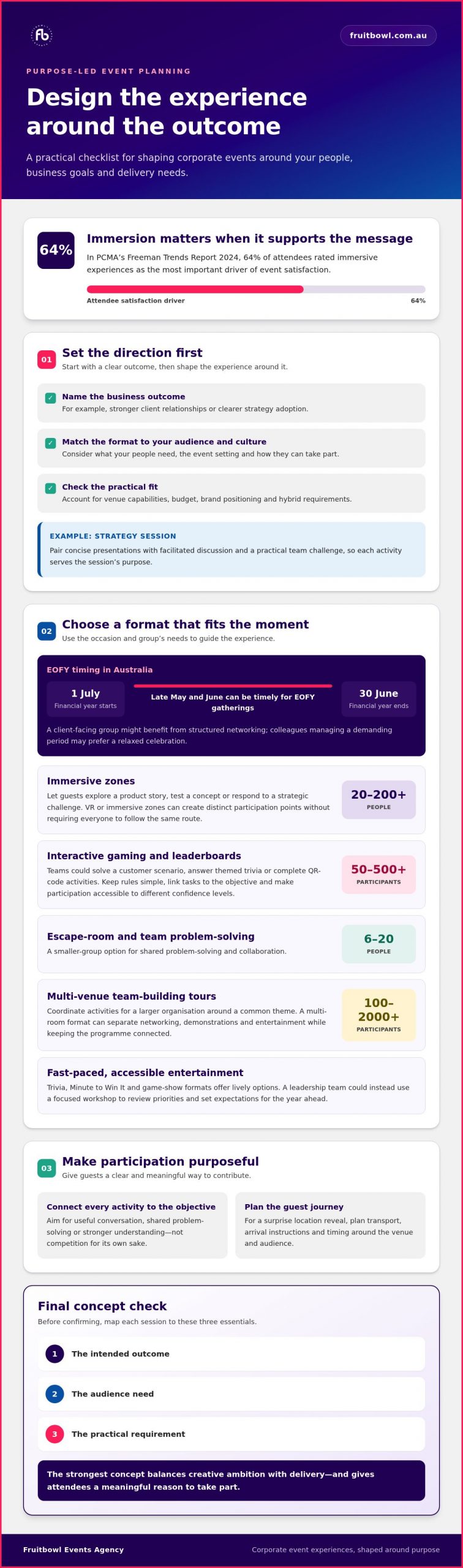
Start with a measurable business outcome, such as stronger client relationships or clearer strategy adoption. Then shape the event around your audience, objectives, venue capabilities, budget, brand positioning and hybrid requirements. For example, a leadership session focused on a new strategy could pair concise presentations with facilitated discussion and a practical team challenge. This ensures each activity serves a purpose instead of competing for attention.

Australia’s financial year runs from 1 July to 30 June, making late May and June timely for EOFY gatherings. Choose the experience to suit each team’s needs: a client-facing group might benefit from structured networking, while colleagues managing a demanding period may prefer a relaxed celebration. Trivia, Minute to Win It and game-show formats offer accessible, fast-paced options. A leadership team could use a focused workshop to review priorities and set expectations for the year ahead.

Immersion can strengthen the experience when it supports the event’s message. In PCMA’s Freeman Trends Report 2024, 64% of attendees rated immersive experiences as the most important driver of event satisfaction. Consider a custom environment that lets guests explore a product story, test a concept or respond to a strategic challenge. For events with 20–200+ people, VR or immersive experience zones can create distinct participation points without requiring every guest to follow the same route.

Gamification gives attendees a clear way to contribute. A business-focused challenge might ask teams to solve a customer scenario, answer themed trivia or complete QR-code activities. Interactive gaming and leaderboard competitions suit groups of 50–500+ participants. Keep the rules simple, connect each task to the event objective and make participation accessible to different confidence levels. The result should be useful conversation, shared problem-solving or stronger understanding, not competition for its own sake.

For smaller groups, escape-room and team problem-solving challenges are listed for 6–20 people. Larger organisations can consider multi-venue team-building tours and travelling events for 100–2000+ participants, with activities coordinated around a common theme. A multi-room format can also separate networking, demonstrations and entertainment while keeping the programme connected. If using a surprise location reveal, make the transition part of the experience and plan transport, arrival instructions and timing around the venue and audience.

Before confirming a concept, map each session to an outcome, audience need and practical requirement. This helps leadership balance creative ambition with delivery and gives attendees a meaningful reason to take part.

2. How can I align corporate event entertainment with my company’s business goals and culture?

Begin with the outcome, then choose entertainment that helps achieve it. For example, a team rebuilding cross-functional trust could take part in a collaborative cooking session, with groups preparing a shared meal. A company introducing new values could use short, interactive scenarios that let colleagues practise those behaviours. The activity should feel welcoming and purposeful, not like an unrelated performance.

Team-building works best when the format suits the people involved. Cooking competitions encourage shared decisions, while improv workshops help colleagues practise listening and adapting. A scavenger hunt can prompt teams to solve clues together and explore a venue. For a quieter group, try a creative challenge instead of a loud, competitive format. Give every activity a clear purpose, such as strengthening communication or helping new colleagues connect.

Inclusive event planning in Australia starts with access across the full guest journey. Consider step-free routes, accessible toilets, seating options, clear signage, dietary needs and captions for spoken content. Ask attendees about access requirements during registration, then build suitable adjustments into the venue, programme and activities. For example, offer seated and standing ways to take part in the same team challenge.

Permits, safety planning and insurance depend on the venue, location and planned activities. An outdoor event in a public space may involve different approvals from a session inside a hired venue. Identify risks such as weather, crowd movement, food service and temporary structures, then plan controls, emergency access and appropriate insurance around them.

Choose a venue by matching its layout to the audience and programme. A boardroom or private dining room can support focused discussion; a larger function space can accommodate demonstrations and networking. Outdoor adventure activities are listed for groups of 15–100+ participants. For any setting, check that activity areas, amenities and arrival arrangements work for the people attending.

Sustainable practices can include digital invitations and event materials, reusable badges, sustainable catering and venues selected with carbon impact in mind. For example, a networking event could use digital schedules, avoid single-use name badges and include plant-based catering. Choose measures that suit the format, and make them visible through practical choices rather than unsupported claims.

Outdoor networking can pair a guided walk with conversation prompts, while indoor formats can use quizzes or creative challenges. Wellness options such as guided meditation, yoga, healthy snacks and relaxation areas offer attendees a quieter way to reset. Match these sessions to the event’s pace and culture, and make participation optional.

For an event that needs coordinated activities, guest flow and delivery, explore corporate event planning as part of the programme design.

The most impactful corporate event ideas for 2026 combine immersive themes, festival-style programming and interactive experiences with a clear business purpose. A multi-stage company festival can encourage informal connections, while a themed gala can recognise achievements and reinforce organisational values.

Festival-style events give attendees different ways to participate. Arrange multiple stages, food trucks, live entertainment, open networking areas and interactive installations around a unifying idea. For example, an innovation festival could pair short product demonstrations with conversations led by teams, then use a central stage for key announcements. Open areas let guests move between content and networking at their own pace.

A musical decade theme can make the programme memorable without relying on décor alone. A 1980s-inspired event might pair era-specific music with a trivia session, while a 1990s theme could feature familiar songs and a shared dance floor. Choose music that suits the audience and event purpose, then use lighting, dress cues and entertainment to support the theme. Give attendees options to join in or simply enjoy the atmosphere.

Creative themes work best when they connect to the organisation’s story. A future-focused concept can use modern lighting, digital displays and interactive elements to bring a product vision to life. A sustainability theme might use reusable décor, digital event materials and a programme centred on responsible business. A global-culture concept can feature varied food and performances, with care taken to represent cultures respectfully rather than reducing them to visual motifs.

For a gala dinner, create a coherent journey from arrival to closing. A Hollywood-inspired evening might open with a photo moment, move into a formal dinner and finish with live entertainment. A casino-style theme can pair playful table activities with awards or a client appreciation segment. Futuristic innovation, global culture and sustainability also offer strong directions. Connect each choice to the occasion, whether you’re celebrating milestones, recognising staff or strengthening client relationships.

Execution brings the concept together. Set the event objective first, then map the audience journey, venue layout, entertainment and production requirements. For a multi-room format, give each space a distinct role, such as networking, presentations or interactive displays. Use consistent signage and a shared visual identity to help attendees navigate. A clear programme also keeps transitions between sessions, dinner and entertainment organised.

Choose the format according to the connections you want attendees to make. A festival layout encourages movement and informal conversations; a gala supports shared recognition and a more structured evening. In either case, make the theme visible through purposeful details and ensure each activity contributes to the event’s intended outcome.
High impact corporate event ideas 2026 that support business goals

4. Hybrid event studios and virtual networking

A hybrid event should give remote and in-person attendees meaningful ways to participate. For an organisation with teams in different locations, live streaming can connect staff who can’t travel. Add interactive polls, audience questions and dedicated virtual networking sessions. These features give online participants ways to contribute instead of leaving them as passive viewers.

Design the virtual programme alongside the onsite agenda. For example, schedule a remote question period after each major presentation, then reserve time for online discussion. A host can monitor incoming questions and bring them into the room. This makes online participation visible and helps remote employees follow the same key topics as colleagues onsite.

A hybrid event studio can support live broadcasts, creator sessions and interactive livestream spaces. Plan a quiet, organised area for speakers, cameras and production activity. Test the run sheet, presentation materials and audience interaction before the event begins. Clear transitions between live speakers, recorded content and online contributions keep the programme coherent.

Virtual networking needs structure. Use attendee preference data to suggest relevant conversations, then create dedicated sessions around shared interests or business goals. AI-powered platforms can match people by industry, interests and preferred meeting types. One proposed approach gives each guest 3–4 recommended connections. That creates a starting point for introductions without forcing every attendee into the same networking format.

Build in simple ways for people to meet. A virtual lounge can host small-group conversations, while a facilitated session can pair remote participants around a discussion prompt. In person, a host can connect those conversations to the room through questions or a shared activity. For example, a product launch could invite online attendees to vote on a feature, then discuss the result with onsite guests.

Hybrid design can reduce travel requirements and broaden participation for distributed teams. It works best when the online experience has its own pacing, host and interaction plan. Avoid treating the stream as a fixed camera pointed at the stage. Give virtual attendees clear instructions for joining sessions, submitting questions and moving between networking spaces.

Use attendee feedback and participation data to refine future events. Review poll responses, submitted questions and session attendance across both formats. These measures can show which topics drew interest and where the programme needs adjustment. Keep data collection relevant to the event purpose, then use the findings to shape content and networking opportunities.

With clear roles for hosts, speakers and technical operators, hybrid delivery becomes a coordinated programme rather than two disconnected audiences. A well-planned agenda, accessible interaction points and deliberate networking design help employees take part from wherever they’re joining.

5. Interactive entertainment and audience participation

Interactive entertainment gives attendees an active role instead of making them spectators. Choose a format that fits the audience, event theme and intended outcome. For example, a product conference could invite guests to test a simulation, then share observations through a live Q&A. A staff celebration might use a hosted game-show format to encourage friendly participation. The activity should support the programme, not interrupt it.

Game-based events work best when the rules are clear and participation is the real reward. Scavenger hunts, interactive quizzes, audience voting and QR-code challenges can engage guests with content between sessions. For a customer event, teams could solve clues related to a product journey. For an internal conference, a short quiz could reinforce key messages from a leadership presentation.

Interactive gaming and leaderboard competitions suit groups of 50–500+ participants. Racing simulators are listed for groups of 20–200+ people, while sports simulator tournaments suit 30–300+ participants. A flight simulator experience is listed for smaller groups of 10–50. These formats create a visible activity point, but organisers should plan queue flow, clear instructions and alternatives for guests who prefer not to compete.

Competition needs careful framing. Set accessible rounds, explain scoring before play and keep leaderboards easy to follow. A team-based racing challenge, for instance, can rotate players while teammates cheer them on. This makes the entertainment social rather than a test of individual ability. Keep the activity connected to the event’s purpose, and avoid rewards that overshadow the experience.

For a long conference, energisers and interactive keynotes may work better than a standalone entertainment block. A speaker might use audience polls to surface different perspectives, then respond to the results during the session. Short movement breaks or a facilitated group prompt can reset attention between presentations. Build each activity into the run sheet, allowing time for transitions and questions.

Match entertainment to audience interests and the event’s tone. A creative industry gathering may respond to live illustration or an interactive installation; a technical audience might prefer a hands-on demonstration. The Crowd-Curated Concert concept estimates guest engagement at 65–80%, compared with 30–40% for traditional bands. Treat this as a format comparison, then decide whether audience music choices suit the event’s purpose and guests.

Measure engagement against the objective. Track participation in polls, games or Q&A, then use attendee feedback to refine future events. For coordinated conference and event experiences, build the entertainment, audience journey and programme around the same goal.

Fruitbowl Events Agency: Corporate Events

Fruitbowl Events Agency can turn a business objective into a coordinated event, from strategic planning and logistics through entertainment programming and on-site delivery. Its Corporate Events, Conferences & Seminars, Festivals & Public Events and Government Activations help organisations plan experiences for staff, clients or public audiences.

Bring in an event partner when you need creative programming and practical delivery to work together, whether you’re shaping a conference, an internal gathering or a public-facing activation. A clear brief covering your audience, objectives and preferred format gives planning a focused direction.

To discuss an event, contact Fruitbowl Events Agency or visit fruitbowl.com.au.

Make your next event a strategic step forward

Before setting a theme or booking a venue, decide what should change as a result of the event. It might be a decision made, a relationship strengthened or a message understood more clearly. Use that outcome to guide the brief, shape the attendee journey and define how you’ll evaluate the event afterwards.

That focus also helps your team make choices with purpose. Each element, from the invitation to the final session, can support the experience you want people to have. Treat high-impact corporate event ideas for 2026 as a starting point, then tailor the concept to your organisation’s priorities and the people attending.

For support developing and delivering an event aligned with your goals, contact Fruitbowl Events Agency. A clear brief is a practical first step towards an event that feels considered, runs cohesively and gives your audience a reason to participate.

Frequently Asked Questions

What are the biggest corporate event trends for 2026?

Key trends include immersive environments, hybrid participation, AI-supported personalisation and more sustainable event choices. The useful shift is to select trends for a reason, rather than adopt every new format. For example, use attendee preferences to shape session recommendations, or make sustainability visible through digital schedules and reusable materials. A trend earns its place when it improves the guest experience or supports a specific organisational priority.

How can I align corporate event entertainment with my company’s business goals and culture?

Choose entertainment that helps attendees practise or experience the outcome you want. If collaboration is a priority, a facilitated creative challenge can bring people from different teams together. If the event recognises achievement, choose a format that gives colleagues space to contribute and celebrate. Set the objective first, then assess each option against audience preferences, company values and the tone you want the event to establish.

How do I make a corporate event engaging for all age groups?

Offer varied ways to participate instead of making assumptions based on age. A programme might combine a live performance, a seated creative activity and informal conversation areas. Share clear instructions, make activities easy to join midway and avoid relying on a single app or physical challenge. Ask about access and participation preferences during registration, then use responses to plan suitable formats, breaks and quieter spaces.

Why is it important to have a clear theme for a corporate event?

A clear theme gives the event a practical design filter. It helps organisers make consistent choices about invitations, room styling, entertainment and programme language. For a customer innovation event, for example, a future-focused theme can guide demonstrations and discussion prompts without making every detail feel theatrical. A coherent idea also helps attendees understand the event’s purpose and remember its central message afterwards.

What corporate event trends are expected in Australia in 2026?

Australian organisations can expect continued interest in hybrid access, interactive experiences and sustainability-led planning. EOFY gatherings also remain a useful opportunity to recognise teams and establish priorities for the next financial year. For high impact corporate event ideas in 2026, consider how the format suits local attendees, travel needs and organisational objectives. A well-planned event can combine in-person connection with practical options for people joining remotely.

What are the best corporate event ideas for hybrid and distributed teams?

Choose formats that give remote colleagues a meaningful contribution, not just a view of the room. A distributed team could join a facilitated problem-solving session, contribute ideas to a shared workshop board or take part in a live team quiz. For an event spanning time zones, provide key materials in advance and allow follow-up discussion afterwards. These choices help employees participate even when they can’t attend live.

Immersive experiences are a leading direction for high impact corporate event ideas for 2026: in PCMA’s Freeman Trends Report 2024, 64% of attendees rated them the most important driver of event satisfaction. The strongest concepts also make participation easy, connect clearly to business goals and give in-person and remote audiences a meaningful role.

It’s understandable to want an event that feels fresh, but novelty alone won’t make it effective. The right format should reflect your company culture, suit the audience and support a defined outcome, whether that’s stronger team connection, more active networking or a clearer understanding of a strategic message.

This article explores practical ways to turn that aim into an experience, from immersive themes and collaborative challenges to hybrid formats and interactive entertainment. You’ll see how to match each idea to its purpose, build in audience participation and assess whether it fits your people and event goals.

Key Takeaways

  • Start with a clear business objective, then choose a format and experience that suit your audience, company culture and event setting.
  • Design team-building activities around how colleagues need to connect, collaborate or solve problems, rather than choosing an activity for novelty alone.
  • Use festival-style experiences or themed gala dinners to create a distinctive atmosphere that supports your event’s purpose.
  • Plan hybrid participation as part of the event experience, with interactive moments that help remote attendees take part and connect.
  • Build in audience participation through activities such as live polls, Q&A or team challenges, then assess the event against its intended outcomes.

1. Custom experiences aligned with organisational strategy

Start with a measurable business outcome, such as stronger client relationships or clearer strategy adoption. Then shape the event around your audience, objectives, venue capabilities, budget, brand positioning and hybrid requirements. For example, a leadership session focused on a new strategy could pair concise presentations with facilitated discussion and a practical team challenge. This ensures each activity serves a purpose instead of competing for attention.

Australia’s financial year runs from 1 July to 30 June, making late May and June timely for EOFY gatherings. Choose the experience to suit each team’s needs: a client-facing group might benefit from structured networking, while colleagues managing a demanding period may prefer a relaxed celebration. Trivia, Minute to Win It and game-show formats offer accessible, fast-paced options. A leadership team could use a focused workshop to review priorities and set expectations for the year ahead.

Immersion can strengthen the experience when it supports the event’s message. In PCMA’s Freeman Trends Report 2024, 64% of attendees rated immersive experiences as the most important driver of event satisfaction. Consider a custom environment that lets guests explore a product story, test a concept or respond to a strategic challenge. For events with 20–200+ people, VR or immersive experience zones can create distinct participation points without requiring every guest to follow the same route.

Gamification gives attendees a clear way to contribute. A business-focused challenge might ask teams to solve a customer scenario, answer themed trivia or complete QR-code activities. Interactive gaming and leaderboard competitions suit groups of 50–500+ participants. Keep the rules simple, connect each task to the event objective and make participation accessible to different confidence levels. The result should be useful conversation, shared problem-solving or stronger understanding, not competition for its own sake.

For smaller groups, escape-room and team problem-solving challenges are listed for 6–20 people. Larger organisations can consider multi-venue team-building tours and travelling events for 100–2000+ participants, with activities coordinated around a common theme. A multi-room format can also separate networking, demonstrations and entertainment while keeping the programme connected. If using a surprise location reveal, make the transition part of the experience and plan transport, arrival instructions and timing around the venue and audience.

Before confirming a concept, map each session to an outcome, audience need and practical requirement. This helps leadership balance creative ambition with delivery and gives attendees a meaningful reason to take part.

2. How can I align corporate event entertainment with my company’s business goals and culture?

Begin with the outcome, then choose entertainment that helps achieve it. For example, a team rebuilding cross-functional trust could take part in a collaborative cooking session, with groups preparing a shared meal. A company introducing new values could use short, interactive scenarios that let colleagues practise those behaviours. The activity should feel welcoming and purposeful, not like an unrelated performance.

Team-building works best when the format suits the people involved. Cooking competitions encourage shared decisions, while improv workshops help colleagues practise listening and adapting. A scavenger hunt can prompt teams to solve clues together and explore a venue. For a quieter group, try a creative challenge instead of a loud, competitive format. Give every activity a clear purpose, such as strengthening communication or helping new colleagues connect.

Inclusive event planning in Australia starts with access across the full guest journey. Consider step-free routes, accessible toilets, seating options, clear signage, dietary needs and captions for spoken content. Ask attendees about access requirements during registration, then build suitable adjustments into the venue, programme and activities. For example, offer seated and standing ways to take part in the same team challenge.

Permits, safety planning and insurance depend on the venue, location and planned activities. An outdoor event in a public space may involve different approvals from a session inside a hired venue. Identify risks such as weather, crowd movement, food service and temporary structures, then plan controls, emergency access and appropriate insurance around them.

Choose a venue by matching its layout to the audience and programme. A boardroom or private dining room can support focused discussion; a larger function space can accommodate demonstrations and networking. Outdoor adventure activities are listed for groups of 15–100+ participants. For any setting, check that activity areas, amenities and arrival arrangements work for the people attending.

Sustainable practices can include digital invitations and event materials, reusable badges, sustainable catering and venues selected with carbon impact in mind. For example, a networking event could use digital schedules, avoid single-use name badges and include plant-based catering. Choose measures that suit the format, and make them visible through practical choices rather than unsupported claims.

Outdoor networking can pair a guided walk with conversation prompts, while indoor formats can use quizzes or creative challenges. Wellness options such as guided meditation, yoga, healthy snacks and relaxation areas offer attendees a quieter way to reset. Match these sessions to the event’s pace and culture, and make participation optional.

For an event that needs coordinated activities, guest flow and delivery, explore corporate event planning as part of the programme design.

The most impactful corporate event ideas for 2026 combine immersive themes, festival-style programming and interactive experiences with a clear business purpose. A multi-stage company festival can encourage informal connections, while a themed gala can recognise achievements and reinforce organisational values.

Festival-style events give attendees different ways to participate. Arrange multiple stages, food trucks, live entertainment, open networking areas and interactive installations around a unifying idea. For example, an innovation festival could pair short product demonstrations with conversations led by teams, then use a central stage for key announcements. Open areas let guests move between content and networking at their own pace.

A musical decade theme can make the programme memorable without relying on décor alone. A 1980s-inspired event might pair era-specific music with a trivia session, while a 1990s theme could feature familiar songs and a shared dance floor. Choose music that suits the audience and event purpose, then use lighting, dress cues and entertainment to support the theme. Give attendees options to join in or simply enjoy the atmosphere.

Creative themes work best when they connect to the organisation’s story. A future-focused concept can use modern lighting, digital displays and interactive elements to bring a product vision to life. A sustainability theme might use reusable décor, digital event materials and a programme centred on responsible business. A global-culture concept can feature varied food and performances, with care taken to represent cultures respectfully rather than reducing them to visual motifs.

For a gala dinner, create a coherent journey from arrival to closing. A Hollywood-inspired evening might open with a photo moment, move into a formal dinner and finish with live entertainment. A casino-style theme can pair playful table activities with awards or a client appreciation segment. Futuristic innovation, global culture and sustainability also offer strong directions. Connect each choice to the occasion, whether you’re celebrating milestones, recognising staff or strengthening client relationships.

Execution brings the concept together. Set the event objective first, then map the audience journey, venue layout, entertainment and production requirements. For a multi-room format, give each space a distinct role, such as networking, presentations or interactive displays. Use consistent signage and a shared visual identity to help attendees navigate. A clear programme also keeps transitions between sessions, dinner and entertainment organised.

Choose the format according to the connections you want attendees to make. A festival layout encourages movement and informal conversations; a gala supports shared recognition and a more structured evening. In either case, make the theme visible through purposeful details and ensure each activity contributes to the event’s intended outcome.

4. Hybrid event studios and virtual networking

A hybrid event should give remote and in-person attendees meaningful ways to participate. For an organisation with teams in different locations, live streaming can connect staff who can’t travel. Add interactive polls, audience questions and dedicated virtual networking sessions. These features give online participants ways to contribute instead of leaving them as passive viewers.

Design the virtual programme alongside the onsite agenda. For example, schedule a remote question period after each major presentation, then reserve time for online discussion. A host can monitor incoming questions and bring them into the room. This makes online participation visible and helps remote employees follow the same key topics as colleagues onsite.

A hybrid event studio can support live broadcasts, creator sessions and interactive livestream spaces. Plan a quiet, organised area for speakers, cameras and production activity. Test the run sheet, presentation materials and audience interaction before the event begins. Clear transitions between live speakers, recorded content and online contributions keep the programme coherent.

Virtual networking needs structure. Use attendee preference data to suggest relevant conversations, then create dedicated sessions around shared interests or business goals. AI-powered platforms can match people by industry, interests and preferred meeting types. One proposed approach gives each guest 3–4 recommended connections. That creates a starting point for introductions without forcing every attendee into the same networking format.

Build in simple ways for people to meet. A virtual lounge can host small-group conversations, while a facilitated session can pair remote participants around a discussion prompt. In person, a host can connect those conversations to the room through questions or a shared activity. For example, a product launch could invite online attendees to vote on a feature, then discuss the result with onsite guests.

Hybrid design can reduce travel requirements and broaden participation for distributed teams. It works best when the online experience has its own pacing, host and interaction plan. Avoid treating the stream as a fixed camera pointed at the stage. Give virtual attendees clear instructions for joining sessions, submitting questions and moving between networking spaces.

Use attendee feedback and participation data to refine future events. Review poll responses, submitted questions and session attendance across both formats. These measures can show which topics drew interest and where the programme needs adjustment. Keep data collection relevant to the event purpose, then use the findings to shape content and networking opportunities.

With clear roles for hosts, speakers and technical operators, hybrid delivery becomes a coordinated programme rather than two disconnected audiences. A well-planned agenda, accessible interaction points and deliberate networking design help employees take part from wherever they’re joining.

5. Interactive entertainment and audience participation

Interactive entertainment gives attendees an active role instead of making them spectators. Choose a format that fits the audience, event theme and intended outcome. For example, a product conference could invite guests to test a simulation, then share observations through a live Q&A. A staff celebration might use a hosted game-show format to encourage friendly participation. The activity should support the programme, not interrupt it.

Game-based events work best when the rules are clear and participation is the real reward. Scavenger hunts, interactive quizzes, audience voting and QR-code challenges can engage guests with content between sessions. For a customer event, teams could solve clues related to a product journey. For an internal conference, a short quiz could reinforce key messages from a leadership presentation.

Interactive gaming and leaderboard competitions suit groups of 50–500+ participants. Racing simulators are listed for groups of 20–200+ people, while sports simulator tournaments suit 30–300+ participants. A flight simulator experience is listed for smaller groups of 10–50. These formats create a visible activity point, but organisers should plan queue flow, clear instructions and alternatives for guests who prefer not to compete.

Competition needs careful framing. Set accessible rounds, explain scoring before play and keep leaderboards easy to follow. A team-based racing challenge, for instance, can rotate players while teammates cheer them on. This makes the entertainment social rather than a test of individual ability. Keep the activity connected to the event’s purpose, and avoid rewards that overshadow the experience.

For a long conference, energisers and interactive keynotes may work better than a standalone entertainment block. A speaker might use audience polls to surface different perspectives, then respond to the results during the session. Short movement breaks or a facilitated group prompt can reset attention between presentations. Build each activity into the run sheet, allowing time for transitions and questions.

Match entertainment to audience interests and the event’s tone. A creative industry gathering may respond to live illustration or an interactive installation; a technical audience might prefer a hands-on demonstration. The Crowd-Curated Concert concept estimates guest engagement at 65–80%, compared with 30–40% for traditional bands. Treat this as a format comparison, then decide whether audience music choices suit the event’s purpose and guests.

Measure engagement against the objective. Track participation in polls, games or Q&A, then use attendee feedback to refine future events. For coordinated conference and event experiences, build the entertainment, audience journey and programme around the same goal.

Fruitbowl Events Agency: Corporate Events

Fruitbowl Events Agency can turn a business objective into a coordinated event, from strategic planning and logistics through entertainment programming and on-site delivery. Its Corporate Events, Conferences & Seminars, Festivals & Public Events and Government Activations help organisations plan experiences for staff, clients or public audiences.

Bring in an event partner when you need creative programming and practical delivery to work together, whether you’re shaping a conference, an internal gathering or a public-facing activation. A clear brief covering your audience, objectives and preferred format gives planning a focused direction.

To discuss an event, contact Fruitbowl Events Agency or visit fruitbowl.com.au.

Make your next event a strategic step forward

Before setting a theme or booking a venue, decide what should change as a result of the event. It might be a decision made, a relationship strengthened or a message understood more clearly. Use that outcome to guide the brief, shape the attendee journey and define how you’ll evaluate the event afterwards.

That focus also helps your team make choices with purpose. Each element, from the invitation to the final session, can support the experience you want people to have. Treat high-impact corporate event ideas for 2026 as a starting point, then tailor the concept to your organisation’s priorities and the people attending.

For support developing and delivering an event aligned with your goals, contact Fruitbowl Events Agency. A clear brief is a practical first step towards an event that feels considered, runs cohesively and gives your audience a reason to participate.

Frequently Asked Questions

What are the biggest corporate event trends for 2026?

Key trends include immersive environments, hybrid participation, AI-supported personalisation and more sustainable event choices. The useful shift is to select trends for a reason, rather than adopt every new format. For example, use attendee preferences to shape session recommendations, or make sustainability visible through digital schedules and reusable materials. A trend earns its place when it improves the guest experience or supports a specific organisational priority.

How can I align corporate event entertainment with my company’s business goals and culture?

Choose entertainment that helps attendees practise or experience the outcome you want. If collaboration is a priority, a facilitated creative challenge can bring people from different teams together. If the event recognises achievement, choose a format that gives colleagues space to contribute and celebrate. Set the objective first, then assess each option against audience preferences, company values and the tone you want the event to establish.

How do I make a corporate event engaging for all age groups?

Offer varied ways to participate instead of making assumptions based on age. A programme might combine a live performance, a seated creative activity and informal conversation areas. Share clear instructions, make activities easy to join midway and avoid relying on a single app or physical challenge. Ask about access and participation preferences during registration, then use responses to plan suitable formats, breaks and quieter spaces.

Why is it important to have a clear theme for a corporate event?

A clear theme gives the event a practical design filter. It helps organisers make consistent choices about invitations, room styling, entertainment and programme language. For a customer innovation event, for example, a future-focused theme can guide demonstrations and discussion prompts without making every detail feel theatrical. A coherent idea also helps attendees understand the event’s purpose and remember its central message afterwards.

What corporate event trends are expected in Australia in 2026?

Australian organisations can expect continued interest in hybrid access, interactive experiences and sustainability-led planning. EOFY gatherings also remain a useful opportunity to recognise teams and establish priorities for the next financial year. For high impact corporate event ideas in 2026, consider how the format suits local attendees, travel needs and organisational objectives. A well-planned event can combine in-person connection with practical options for people joining remotely.

What are the best corporate event ideas for hybrid and distributed teams?

Choose formats that give remote colleagues a meaningful contribution, not just a view of the room. A distributed team could join a facilitated problem-solving session, contribute ideas to a shared workshop board or take part in a live team quiz. For an event spanning time zones, provide key materials in advance and allow follow-up discussion afterwards. These choices help employees participate even when they can’t attend live.

Back to Articles
Request A Quote

Make an
Enquiry

Untitled design

What Makes Us Different?

True end-to-end solution so you can hand off to us, focus on your priorities and enjoy the event without any stress

Unmatched industry expertise looking after diverse range of high-profile events, cultural festivals & activations

Meticulous attention to every detail and precise execution of events with our streamlined processes

Tailored solutions with bespoke strategies to ensure we align with your brand and objectives

Make an Enquiry

"*" indicates required fields

This field is for validation purposes and should be left unchanged.

"*" indicates required fields

This field is for validation purposes and should be left unchanged.