The most consequential gap in an event budget may sit between two supplier quotes. A venue proposal can cover the room but leave security, cleaning or technical requirements to be confirmed elsewhere. These hidden costs in event budgets are easy to miss when each proposal uses different assumptions and inclusions.
It’s understandable to focus first on the visible line items. Yet late changes, operational needs and unclear cost ownership can put pressure on approvals and leave stakeholders working from different versions of the budget. Comparing totals alone won’t show whether suppliers are pricing the same scope or relying on another party to provide essential support.
This article outlines costs Australian organisers should check before approving a budget, from venue and technical dependencies to permits, insurance and contingency planning where relevant. It also explains how to compare proposals on a like-for-like basis by confirming scope, exclusions, responsibilities and assumptions. Establishing these details early helps you make financial decisions that support the event’s objectives and delivery requirements, with fewer surprises as planning progresses.
Key Takeaways
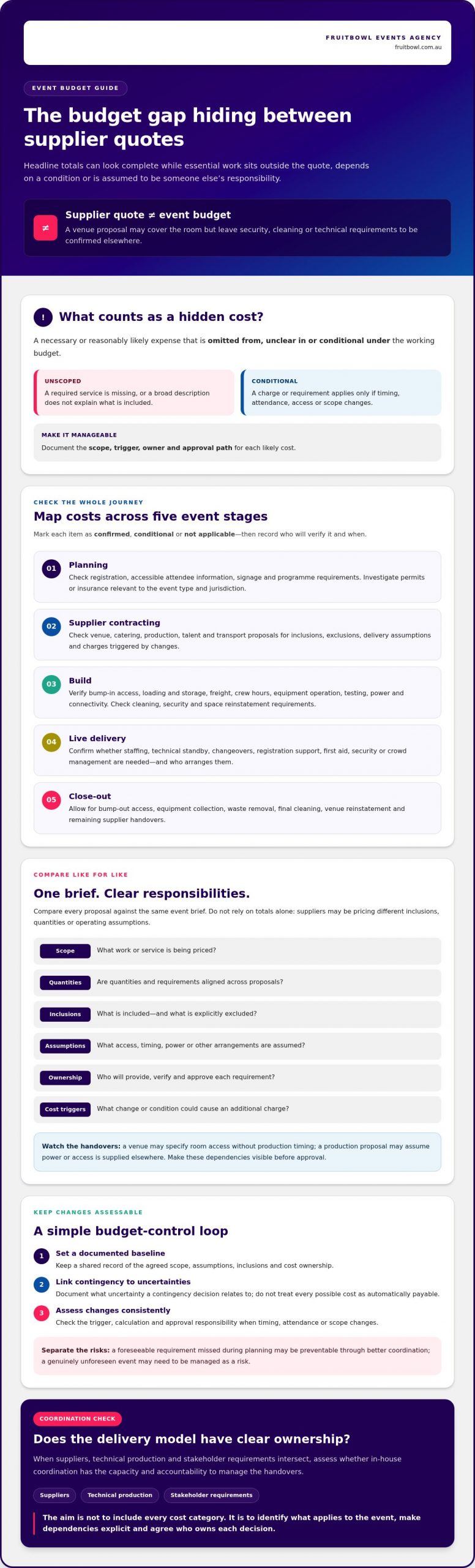
- Map likely expenses across planning, contracting, build, live delivery and close-out to spot gaps before they reach approval.
- Review hidden costs in event budgets by checking which venue and supplier items depend on access, timing or other conditions.
- Use a shared comparison table to record quantities, assumptions, inclusions, responsible parties and cost triggers.
- Set a documented budget baseline and link contingency decisions to specific uncertainties, so changes can be assessed consistently.
- Assess whether in-house coordination has the capacity and clear accountability needed when suppliers, technical production and stakeholder requirements intersect.
Hidden costs in event budgets: why headline quotes rarely show the full picture
A supplier quote is one input to an event budget, not the budget itself. It may cover a defined service while leaving related requirements to another supplier, the organiser or a later decision. Hidden costs in event budgets are often less about unexpected charges and more about scope, assumptions and responsibilities that haven’t been made clear.
Working definition: A hidden event cost is a necessary or reasonably likely expense that is omitted from, unclear in or conditional under the working budget. It becomes manageable when its scope, trigger, owner and approval path are documented.
What counts as a hidden cost in an event budget?
Some omissions become clear when you check the event plan: a required service may not appear as a separate line item. Other costs are buried in broad descriptions such as “venue support” or “technical package”, where the quote doesn’t specify what is included. Clarify what each supplier will provide, what falls outside the quote and who will arrange any remaining requirements.
Conditional charges need the same scrutiny. A fee or additional requirement might depend on event timing, attendance, venue access or a change in scope. Its presence in a contract or proposal doesn’t necessarily mean it will be payable. Confirm the condition that activates it, how it will be calculated and who can approve the change.
Distinguish foreseeable, unscoped costs from genuinely unforeseen events. A requirement missed during planning may be preventable through better coordination; an event outside the team’s reasonable assumptions may need to be managed as a risk. Not every event needs every cost category. The relevant checks depend on the event brief, venue, delivery model and jurisdiction.
Why event quotes and approved budgets can differ
Two suppliers may appear to offer the same service while pricing different inclusions, quantities or operating assumptions. A venue might specify room access but not the timing needed for production. A production proposal may assume power or access arrangements are supplied elsewhere. Catering, talent and transport can create similar gaps between workstreams, where each party assumes another has covered the requirement.
Event management involves connected planning and coordination activities, which is why reviewing each quote in isolation can obscure dependencies. Compare proposals against one brief, and make inclusions, exclusions, assumptions and handovers visible before approval.
A hidden event cost is a foreseeable or conditional expense that the working budget hasn’t clearly scoped, assigned or linked to an approval process.
Which event budget costs are commonly overlooked across planning and delivery?
Review costs across the event lifecycle, not just by supplier. A requirement may be included in one proposal, assumed by another or left for the organiser to arrange. For each item, mark it confirmed, conditional or not applicable, then note who will verify it and when. Not every event needs every item; the aim is to identify what applies to your scope.
- Planning: Check registration needs, accessible attendee information, signage, programme requirements and any permits or insurance to investigate for the event type and jurisdiction.
- Supplier contracting: Confirm what venue, catering, production, talent and transport proposals include. Check exclusions, delivery assumptions and charges that may be triggered by changes to timing, attendance or scope.
- Build: Verify bump-in access windows, loading and storage arrangements, freight, crew hours, equipment operation, testing, power and connectivity. Ask whether the venue has specific requirements for cleaning, security, or protecting and reinstating the space.
- Live delivery: Check whether staffing, technical standby, changeovers, registration support, first aid, security or crowd management are needed, and who is responsible for arranging them.
- Close-out: Allow for bump-out access, equipment collection, waste removal, final cleaning, venue reinstatement and supplier handovers that remain after attendees leave.
Venue, production and supplier interface costs
Venue and production plans often rely on one another. A production supplier may need access for testing before the event, while the venue may set limits on access, loading or storage. Confirm whether technical labour covers operation, testing and standby support, and whether extra crew time or equipment depends on the schedule. Assign one owner to coordinate dependencies between the venue and external suppliers, rather than leaving each party to assume someone else has it covered.
People, compliance and attendee experience costs
Match people and compliance checks to the event’s format, audience and jurisdiction. Confirm whether staffing, security, first aid, accessibility provisions and crowd management are required, and who will assess or arrange them. Speakers and performers may also have technical, travel or accommodation requirements that affect the programme and logistics. Check relevant safety obligations, permits, insurance and music licensing with the appropriate authorities or advisers for the event and jurisdiction. Requirements vary, so treat these as verification prompts, not universal costs.
This lifecycle review makes hidden costs in event budgets easier to identify before they become urgent delivery decisions. For complex corporate, public or government events, end-to-end event planning can help bring connected logistics, technical requirements and budget responsibilities into one coordinated view.
How to compare event proposals and expose exclusions before approval
A useful comparison starts with one shared brief, not a stack of supplier totals. Give each supplier the same event scope, attendance assumption, delivery schedule and venue information. Then compare what each proposal will deliver and under what conditions. This makes hidden costs in event budgets easier to spot, particularly where a requirement falls between suppliers.
Compare proposals on the same basis
Record assumptions about event hours, attendee numbers, venue access and production requirements. Separate each proposal into fixed scope, provisional allowances, optional upgrades and exclusions. A provisional item is not a confirmed inclusion. Ask what information will finalise it and what could change it. Don’t treat a lower total as better value until the service level and deliverables match.
Use a comparison table to make gaps visible. The entries below are prompts, not assumptions about what every event requires.
| Item | Included status | Quantity or assumption | Responsible party | Trigger |
|---|---|---|---|---|
| Technical testing | Included, conditional or excluded | Testing time and requirements | Supplier to confirm | Schedule or scope change |
| Venue access | Included, conditional or excluded | Access windows and loading needs | Venue or organiser | Additional access required |
| Attendee services | Included, conditional or excluded | Attendance and service assumptions | Supplier to confirm | Attendance or brief changes |
Ask suppliers to explain every exclusion and conditional item in writing. Check who will coordinate the handover if, for example, production needs venue access or another supplier’s equipment. Confirm GST treatment, payment milestones and cancellation or change terms with the relevant supplier. Refer tax or contractual questions to a qualified adviser where needed.
Resolve responsibilities before approval
Before signing or seeking internal approval, establish who can authorise a scope change and how its budget impact will be recorded. Assign an accountable party to each supplier interface, handover and on-site decision. Confirm which insurance, permit or licensing details apply to the specific event and jurisdiction rather than assuming requirements are universal.
- Does each proposal use the same brief, schedule and attendance assumption?
- Which items are fixed, provisional, optional or excluded?
- What event condition could trigger an additional charge or scope change?
- Who confirms the change, records its impact and approves it?
This comparison process supports clearer corporate event management by connecting scope, supplier responsibilities and budget oversight. Resolve gaps before approval, while there’s still time to align proposals with the event’s objectives and delivery plan.
How to control event budget risks as scope and delivery conditions change
A budget is a control document, not a one-off approval figure. Establish a baseline that records the approved scope, planning assumptions, budget owners and decision authority. As suppliers are appointed and delivery details develop, track commitments, actuals, forecasts and pending changes against that baseline. This gives stakeholders a clear view of what’s agreed, what’s spent and what may still affect the forecast.
Build a proportionate contingency and risk register
Link contingency to identifiable uncertainties rather than adding an unexplained blanket allowance. It should reflect assessed event risks, their likelihood and potential impact, not a universal formula. Validate the proposed allowance with finance and project stakeholders, taking account of the event scope and the organisation’s approval requirements.
A practical register can capture the risk, likelihood, impact, mitigation, owner and review date. Depending on the event, risks might include changing attendance, weather exposure for an outdoor programme, a schedule adjustment or a dependency between venue access and production setup. Assign each risk to a named owner and state what would prompt escalation. This makes the allowance easier to explain and review as circumstances change.
Manage approvals, variations and final reconciliation
Use a change log to record each request, its rationale, the approver, the budget effect and any delivery implications. A change to event hours, for example, may affect supplier commitments or crew arrangements. Make the likely impact visible before authorising the variation, rather than relying on informal updates after work has been agreed.
Review the forecast at meaningful planning milestones and before making supplier commitments. Compare the latest estimate with the approved scope and confirmed commitments. Escalate variances early, with a concise record of the decision, who approved it and why. If a change is declined, document that too, so the delivery team is working to the same brief.
At close-out, reconcile final invoices against contracts, approved variations and services delivered. Query differences through the agreed supplier process, and distinguish approved scope changes from amounts that need clarification. This closes the loop between budget approval, event delivery and financial reporting.
For complex workstreams, coordinated budget management can help keep assumptions, responsibilities and changes visible across the project. Discuss event budget management for corporate, public or government events with Fruitbowl Events Agency.
When event budget complexity calls for end-to-end management
Some events can be coordinated effectively by an internal team. The demands change when several suppliers, complex technical production or high-stakes stakeholders need decisions and handovers to stay aligned. If internal staff are balancing event delivery with other responsibilities, the risk may be less about any single quote and more about gaps between scopes, approvals and reporting. End-to-end management can provide a coordinated view of connected workstreams, but it isn’t a guarantee of lower costs or a particular financial outcome.
Choosing between internal coordination and event management support
Assess your team’s capacity to manage procurement, stakeholder liaison, production oversight, budget reporting and live delivery. Compare internal coordination with external support by asking who owns the overall scope, how much capacity is available, what reporting stakeholders need and who is accountable for supplier handovers. Before appointing an event partner, document responsibilities, deliverables, approval limits and escalation paths. An agency fee is a visible project cost, so consider it alongside the scope and accountability provided, not as a promised saving.
What to include in an event management brief
A clear brief helps you assess whether a proposed level of support fits the event. Set out its objectives, audience, format, agreed scope, known constraints and decision-making structure. Ask for a transparent breakdown of planning, production, talent and on-site responsibilities, including how supplier coordination and budget reporting will be handled.
If audiovisual production is a major budget workstream, define the technical requirements and interfaces clearly in the brief. Clarify what the production supplier is expected to deliver, which decisions remain with your organisation and how changes will be approved. This gives stakeholders a firmer basis for assessing both the proposed scope and the team needed to oversee it.
Fruitbowl Events Agency provides planning, budget management, supplier coordination, technical direction and on-site delivery for corporate, public and government events across Australia. With more than 28 years of event industry experience, the agency can support a coordinated approach to these responsibilities. The right arrangement still depends on your event objectives, internal capacity and required level of accountability.
If you’re weighing up the support your event requires, discuss your event planning and delivery requirements with Fruitbowl Events Agency.
Build a budget that supports confident delivery
Better budget control starts with clear scope. Check what each proposal includes, identify supplier dependencies and assign an owner to every conditional cost. Then track commitments, forecasts and approved changes against a documented baseline, so decisions remain aligned with the event’s objectives as plans develop.
These steps make hidden costs in event budgets easier to identify before they become last-minute decisions. Not every cost applies to every event; a consistent review helps distinguish genuine requirements from assumptions, exclusions and optional additions.
For more complex programmes, coordinated planning can bring budget management, logistics and on-site delivery into a clearer operating framework. Fruitbowl Events Agency has more than 28 years of event industry experience across corporate events, festivals, conferences and government activations, with end-to-end planning and delivery capabilities.
If you’re assessing the support your event requires, discuss your event planning and delivery requirements. With clear responsibilities and realistic assumptions, you can move forward with greater confidence in both the budget and the delivery plan.
Frequently Asked Questions
What are hidden costs in an event budget?
Hidden costs in an event budget are necessary or likely expenses that are omitted, unclear or conditional in the working budget. They may be separate items not yet scoped, or requirements buried in broad supplier descriptions. A charge may also depend on an agreed trigger, such as extra access time or a change in attendance. These costs are not automatically payable. Confirm the scope, trigger, responsible party and approval process.
What costs are commonly left out of an event budget?
Common omissions can include venue access, cleaning, security, utilities, storage or reinstatement, plus production labour, testing, equipment operation, power, connectivity and freight. Depending on the event, registration, signage, accessibility provisions, talent requirements, insurance, permits or music licensing may also need review. Treat these as prompts, not a universal checklist of charges. Confirm which items apply to your event, what suppliers include and who will arrange any remaining requirements.
How do I compare event management proposals fairly?
Give each supplier the same event brief, scope, attendance assumption, schedule and venue information. Compare deliverables and service levels, not just proposal totals. Record each item’s inclusion status, quantity or assumption, responsible party and any condition that could change the scope. Separate fixed work from provisional allowances, optional upgrades and exclusions. Ask suppliers to clarify gaps and confirm GST treatment, payment milestones and change or cancellation terms before approval.
Should contingency be included in an event budget?
Include contingency when it is appropriate to the event’s assessed risks and your organisation’s approval process. Identify plausible uncertainties, such as attendance changes, weather exposure or supplier dependencies, then assess their likelihood, impact, mitigation and owner. Contingency should reflect those assessed risks, not a universal percentage. Agree the allowance with finance and relevant project stakeholders, document what it may cover and establish who can approve its use.
Does an event management fee reduce hidden costs?
An event management fee doesn’t automatically reduce costs or guarantee a particular budget outcome. It is a visible project cost for agreed planning or coordination responsibilities. Experienced oversight can help clarify scope, supplier interfaces, assumptions and approval paths, making potential omissions easier to identify. Assess the proposed fee alongside its deliverables, reporting, capacity and accountability. Confirm which responsibilities remain with your organisation and what work is outside the agreed scope.
When should event suppliers confirm exclusions and additional charges?
Suppliers should identify exclusions, conditional items and potential additional charges while proposals are being compared, before you seek approval or sign an agreement. Ask them to state what triggers each charge, which assumptions it relies on, how changes are priced and who must authorise them. Record the answers in the scope or comparison document. If plans change later, request the budget and delivery impact in writing before approving the variation.
What should an Australian event budget include for compliance?
Allow for compliance-related costs that apply to the event’s activities, venue and jurisdiction. Check whether permits, insurance, safety planning, accessibility provisions, licensing or music permissions need to be addressed, and identify who will verify and arrange each item. Requirements differ, so don’t treat every category as compulsory for every event. Confirm current obligations with the relevant authority or a qualified adviser, and record any associated costs, responsibilities and approval dates in the budget.
The most consequential gap in an event budget may sit between two supplier quotes. A venue proposal can cover the room but leave security, cleaning or technical requirements to be confirmed elsewhere. These hidden costs in event budgets are easy to miss when each proposal uses different assumptions and inclusions.
It’s understandable to focus first on the visible line items. Yet late changes, operational needs and unclear cost ownership can put pressure on approvals and leave stakeholders working from different versions of the budget. Comparing totals alone won’t show whether suppliers are pricing the same scope or relying on another party to provide essential support.
This article outlines costs Australian organisers should check before approving a budget, from venue and technical dependencies to permits, insurance and contingency planning where relevant. It also explains how to compare proposals on a like-for-like basis by confirming scope, exclusions, responsibilities and assumptions. Establishing these details early helps you make financial decisions that support the event’s objectives and delivery requirements, with fewer surprises as planning progresses.
Key Takeaways
- Map likely expenses across planning, contracting, build, live delivery and close-out to spot gaps before they reach approval.
- Review hidden costs in event budgets by checking which venue and supplier items depend on access, timing or other conditions.
- Use a shared comparison table to record quantities, assumptions, inclusions, responsible parties and cost triggers.
- Set a documented budget baseline and link contingency decisions to specific uncertainties, so changes can be assessed consistently.
- Assess whether in-house coordination has the capacity and clear accountability needed when suppliers, technical production and stakeholder requirements intersect.
Hidden costs in event budgets: why headline quotes rarely show the full picture
A supplier quote is one input to an event budget, not the budget itself. It may cover a defined service while leaving related requirements to another supplier, the organiser or a later decision. Hidden costs in event budgets are often less about unexpected charges and more about scope, assumptions and responsibilities that haven’t been made clear.
Working definition: A hidden event cost is a necessary or reasonably likely expense that is omitted from, unclear in or conditional under the working budget. It becomes manageable when its scope, trigger, owner and approval path are documented.
What counts as a hidden cost in an event budget?
Some omissions become clear when you check the event plan: a required service may not appear as a separate line item. Other costs are buried in broad descriptions such as “venue support” or “technical package”, where the quote doesn’t specify what is included. Clarify what each supplier will provide, what falls outside the quote and who will arrange any remaining requirements.
Conditional charges need the same scrutiny. A fee or additional requirement might depend on event timing, attendance, venue access or a change in scope. Its presence in a contract or proposal doesn’t necessarily mean it will be payable. Confirm the condition that activates it, how it will be calculated and who can approve the change.
Distinguish foreseeable, unscoped costs from genuinely unforeseen events. A requirement missed during planning may be preventable through better coordination; an event outside the team’s reasonable assumptions may need to be managed as a risk. Not every event needs every cost category. The relevant checks depend on the event brief, venue, delivery model and jurisdiction.
Why event quotes and approved budgets can differ
Two suppliers may appear to offer the same service while pricing different inclusions, quantities or operating assumptions. A venue might specify room access but not the timing needed for production. A production proposal may assume power or access arrangements are supplied elsewhere. Catering, talent and transport can create similar gaps between workstreams, where each party assumes another has covered the requirement.
Event management involves connected planning and coordination activities, which is why reviewing each quote in isolation can obscure dependencies. Compare proposals against one brief, and make inclusions, exclusions, assumptions and handovers visible before approval.
A hidden event cost is a foreseeable or conditional expense that the working budget hasn’t clearly scoped, assigned or linked to an approval process.
Which event budget costs are commonly overlooked across planning and delivery?
Review costs across the event lifecycle, not just by supplier. A requirement may be included in one proposal, assumed by another or left for the organiser to arrange. For each item, mark it confirmed, conditional or not applicable, then note who will verify it and when. Not every event needs every item; the aim is to identify what applies to your scope.
- Planning: Check registration needs, accessible attendee information, signage, programme requirements and any permits or insurance to investigate for the event type and jurisdiction.
- Supplier contracting: Confirm what venue, catering, production, talent and transport proposals include. Check exclusions, delivery assumptions and charges that may be triggered by changes to timing, attendance or scope.
- Build: Verify bump-in access windows, loading and storage arrangements, freight, crew hours, equipment operation, testing, power and connectivity. Ask whether the venue has specific requirements for cleaning, security, or protecting and reinstating the space.
- Live delivery: Check whether staffing, technical standby, changeovers, registration support, first aid, security or crowd management are needed, and who is responsible for arranging them.
- Close-out: Allow for bump-out access, equipment collection, waste removal, final cleaning, venue reinstatement and supplier handovers that remain after attendees leave.
Venue, production and supplier interface costs
Venue and production plans often rely on one another. A production supplier may need access for testing before the event, while the venue may set limits on access, loading or storage. Confirm whether technical labour covers operation, testing and standby support, and whether extra crew time or equipment depends on the schedule. Assign one owner to coordinate dependencies between the venue and external suppliers, rather than leaving each party to assume someone else has it covered.
People, compliance and attendee experience costs
Match people and compliance checks to the event’s format, audience and jurisdiction. Confirm whether staffing, security, first aid, accessibility provisions and crowd management are required, and who will assess or arrange them. Speakers and performers may also have technical, travel or accommodation requirements that affect the programme and logistics. Check relevant safety obligations, permits, insurance and music licensing with the appropriate authorities or advisers for the event and jurisdiction. Requirements vary, so treat these as verification prompts, not universal costs.
This lifecycle review makes hidden costs in event budgets easier to identify before they become urgent delivery decisions. For complex corporate, public or government events, end-to-end event planning can help bring connected logistics, technical requirements and budget responsibilities into one coordinated view.
How to compare event proposals and expose exclusions before approval
A useful comparison starts with one shared brief, not a stack of supplier totals. Give each supplier the same event scope, attendance assumption, delivery schedule and venue information. Then compare what each proposal will deliver and under what conditions. This makes hidden costs in event budgets easier to spot, particularly where a requirement falls between suppliers.
Compare proposals on the same basis
Record assumptions about event hours, attendee numbers, venue access and production requirements. Separate each proposal into fixed scope, provisional allowances, optional upgrades and exclusions. A provisional item is not a confirmed inclusion. Ask what information will finalise it and what could change it. Don’t treat a lower total as better value until the service level and deliverables match.
Use a comparison table to make gaps visible. The entries below are prompts, not assumptions about what every event requires.
| Item | Included status | Quantity or assumption | Responsible party | Trigger |
|---|---|---|---|---|
| Technical testing | Included, conditional or excluded | Testing time and requirements | Supplier to confirm | Schedule or scope change |
| Venue access | Included, conditional or excluded | Access windows and loading needs | Venue or organiser | Additional access required |
| Attendee services | Included, conditional or excluded | Attendance and service assumptions | Supplier to confirm | Attendance or brief changes |
Ask suppliers to explain every exclusion and conditional item in writing. Check who will coordinate the handover if, for example, production needs venue access or another supplier’s equipment. Confirm GST treatment, payment milestones and cancellation or change terms with the relevant supplier. Refer tax or contractual questions to a qualified adviser where needed.
Resolve responsibilities before approval
Before signing or seeking internal approval, establish who can authorise a scope change and how its budget impact will be recorded. Assign an accountable party to each supplier interface, handover and on-site decision. Confirm which insurance, permit or licensing details apply to the specific event and jurisdiction rather than assuming requirements are universal.
- Does each proposal use the same brief, schedule and attendance assumption?
- Which items are fixed, provisional, optional or excluded?
- What event condition could trigger an additional charge or scope change?
- Who confirms the change, records its impact and approves it?
This comparison process supports clearer corporate event management by connecting scope, supplier responsibilities and budget oversight. Resolve gaps before approval, while there’s still time to align proposals with the event’s objectives and delivery plan.
How to control event budget risks as scope and delivery conditions change
A budget is a control document, not a one-off approval figure. Establish a baseline that records the approved scope, planning assumptions, budget owners and decision authority. As suppliers are appointed and delivery details develop, track commitments, actuals, forecasts and pending changes against that baseline. This gives stakeholders a clear view of what’s agreed, what’s spent and what may still affect the forecast.
Build a proportionate contingency and risk register
Link contingency to identifiable uncertainties rather than adding an unexplained blanket allowance. It should reflect assessed event risks, their likelihood and potential impact, not a universal formula. Validate the proposed allowance with finance and project stakeholders, taking account of the event scope and the organisation’s approval requirements.
A practical register can capture the risk, likelihood, impact, mitigation, owner and review date. Depending on the event, risks might include changing attendance, weather exposure for an outdoor programme, a schedule adjustment or a dependency between venue access and production setup. Assign each risk to a named owner and state what would prompt escalation. This makes the allowance easier to explain and review as circumstances change.
Manage approvals, variations and final reconciliation
Use a change log to record each request, its rationale, the approver, the budget effect and any delivery implications. A change to event hours, for example, may affect supplier commitments or crew arrangements. Make the likely impact visible before authorising the variation, rather than relying on informal updates after work has been agreed.
Review the forecast at meaningful planning milestones and before making supplier commitments. Compare the latest estimate with the approved scope and confirmed commitments. Escalate variances early, with a concise record of the decision, who approved it and why. If a change is declined, document that too, so the delivery team is working to the same brief.
At close-out, reconcile final invoices against contracts, approved variations and services delivered. Query differences through the agreed supplier process, and distinguish approved scope changes from amounts that need clarification. This closes the loop between budget approval, event delivery and financial reporting.
For complex workstreams, coordinated budget management can help keep assumptions, responsibilities and changes visible across the project. Discuss event budget management for corporate, public or government events with Fruitbowl Events Agency.
When event budget complexity calls for end-to-end management
Some events can be coordinated effectively by an internal team. The demands change when several suppliers, complex technical production or high-stakes stakeholders need decisions and handovers to stay aligned. If internal staff are balancing event delivery with other responsibilities, the risk may be less about any single quote and more about gaps between scopes, approvals and reporting. End-to-end management can provide a coordinated view of connected workstreams, but it isn’t a guarantee of lower costs or a particular financial outcome.
Choosing between internal coordination and event management support
Assess your team’s capacity to manage procurement, stakeholder liaison, production oversight, budget reporting and live delivery. Compare internal coordination with external support by asking who owns the overall scope, how much capacity is available, what reporting stakeholders need and who is accountable for supplier handovers. Before appointing an event partner, document responsibilities, deliverables, approval limits and escalation paths. An agency fee is a visible project cost, so consider it alongside the scope and accountability provided, not as a promised saving.
What to include in an event management brief
A clear brief helps you assess whether a proposed level of support fits the event. Set out its objectives, audience, format, agreed scope, known constraints and decision-making structure. Ask for a transparent breakdown of planning, production, talent and on-site responsibilities, including how supplier coordination and budget reporting will be handled.
If audiovisual production is a major budget workstream, define the technical requirements and interfaces clearly in the brief. Clarify what the production supplier is expected to deliver, which decisions remain with your organisation and how changes will be approved. This gives stakeholders a firmer basis for assessing both the proposed scope and the team needed to oversee it.
Fruitbowl Events Agency provides planning, budget management, supplier coordination, technical direction and on-site delivery for corporate, public and government events across Australia. With more than 28 years of event industry experience, the agency can support a coordinated approach to these responsibilities. The right arrangement still depends on your event objectives, internal capacity and required level of accountability.
If you’re weighing up the support your event requires, discuss your event planning and delivery requirements with Fruitbowl Events Agency.
Build a budget that supports confident delivery
Better budget control starts with clear scope. Check what each proposal includes, identify supplier dependencies and assign an owner to every conditional cost. Then track commitments, forecasts and approved changes against a documented baseline, so decisions remain aligned with the event’s objectives as plans develop.
These steps make hidden costs in event budgets easier to identify before they become last-minute decisions. Not every cost applies to every event; a consistent review helps distinguish genuine requirements from assumptions, exclusions and optional additions.
For more complex programmes, coordinated planning can bring budget management, logistics and on-site delivery into a clearer operating framework. Fruitbowl Events Agency has more than 28 years of event industry experience across corporate events, festivals, conferences and government activations, with end-to-end planning and delivery capabilities.
If you’re assessing the support your event requires, discuss your event planning and delivery requirements. With clear responsibilities and realistic assumptions, you can move forward with greater confidence in both the budget and the delivery plan.
Frequently Asked Questions
What are hidden costs in an event budget?
Hidden costs in an event budget are necessary or likely expenses that are omitted, unclear or conditional in the working budget. They may be separate items not yet scoped, or requirements buried in broad supplier descriptions. A charge may also depend on an agreed trigger, such as extra access time or a change in attendance. These costs are not automatically payable. Confirm the scope, trigger, responsible party and approval process.
What costs are commonly left out of an event budget?
Common omissions can include venue access, cleaning, security, utilities, storage or reinstatement, plus production labour, testing, equipment operation, power, connectivity and freight. Depending on the event, registration, signage, accessibility provisions, talent requirements, insurance, permits or music licensing may also need review. Treat these as prompts, not a universal checklist of charges. Confirm which items apply to your event, what suppliers include and who will arrange any remaining requirements.
How do I compare event management proposals fairly?
Give each supplier the same event brief, scope, attendance assumption, schedule and venue information. Compare deliverables and service levels, not just proposal totals. Record each item’s inclusion status, quantity or assumption, responsible party and any condition that could change the scope. Separate fixed work from provisional allowances, optional upgrades and exclusions. Ask suppliers to clarify gaps and confirm GST treatment, payment milestones and change or cancellation terms before approval.
Should contingency be included in an event budget?
Include contingency when it is appropriate to the event’s assessed risks and your organisation’s approval process. Identify plausible uncertainties, such as attendance changes, weather exposure or supplier dependencies, then assess their likelihood, impact, mitigation and owner. Contingency should reflect those assessed risks, not a universal percentage. Agree the allowance with finance and relevant project stakeholders, document what it may cover and establish who can approve its use.
Does an event management fee reduce hidden costs?
An event management fee doesn’t automatically reduce costs or guarantee a particular budget outcome. It is a visible project cost for agreed planning or coordination responsibilities. Experienced oversight can help clarify scope, supplier interfaces, assumptions and approval paths, making potential omissions easier to identify. Assess the proposed fee alongside its deliverables, reporting, capacity and accountability. Confirm which responsibilities remain with your organisation and what work is outside the agreed scope.
When should event suppliers confirm exclusions and additional charges?
Suppliers should identify exclusions, conditional items and potential additional charges while proposals are being compared, before you seek approval or sign an agreement. Ask them to state what triggers each charge, which assumptions it relies on, how changes are priced and who must authorise them. Record the answers in the scope or comparison document. If plans change later, request the budget and delivery impact in writing before approving the variation.
What should an Australian event budget include for compliance?
Allow for compliance-related costs that apply to the event’s activities, venue and jurisdiction. Check whether permits, insurance, safety planning, accessibility provisions, licensing or music permissions need to be addressed, and identify who will verify and arrange each item. Requirements differ, so don’t treat every category as compulsory for every event. Confirm current obligations with the relevant authority or a qualified adviser, and record any associated costs, responsibilities and approval dates in the budget.
OUR BLOG
Event Insights & Expertise
Our blog is your go-to resource for all things events. From expert insights and the latest industry trends to practical planning tips, we share everything you need to deliver standout experiences.
Contact Us