
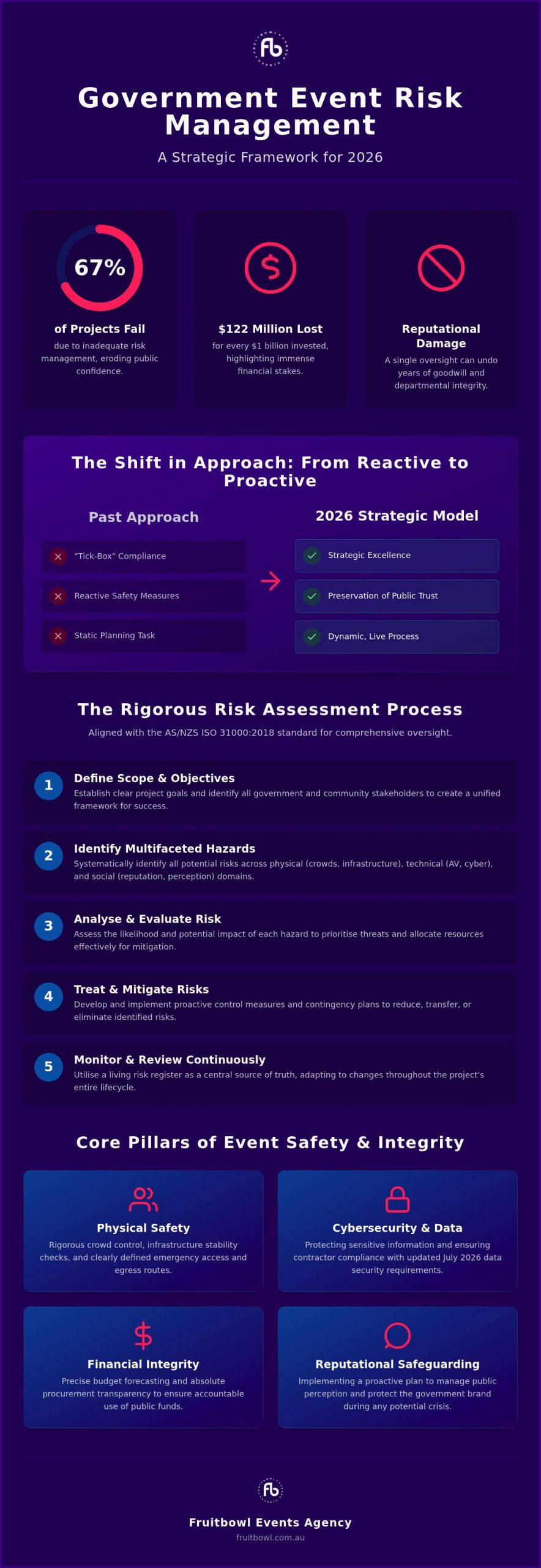
Did you know that inadequate risk management contributes to 67 per cent of failed projects, costing organisations an estimated $122 million for every $1 billion invested? For those tasked with public sector activations, these figures represent more than just financial loss; they represent a potential erosion of public confidence. You likely feel the weight of overwhelming compliance requirements and the constant scrutiny of diverse stakeholders. It’s a high-stakes environment. The fear of reputational damage to your department remains a persistent concern.
We understand that your objective is a seamless, incident-free delivery that reflects the integrity of your organisation. This comprehensive guide to government event risk management in 2026 provides the strategic framework you need to maintain order and clarity. You’ll learn how to master the complexities of public sector safety while ensuring full regulatory compliance through disciplined oversight. We will outline a methodical approach to managing these variables, including the latest security technology costs and the recent July 2026 updates regarding cybersecurity certification requirements. By following this roadmap, you can transform logistical challenges into a demonstration of expert supervision and enhanced public trust.
Key Takeaways
- Align your strategy with current AS/NZS ISO 31000:2018 standards to master the complexities of government event risk management while meeting 2026 safety and data security requirements.
- Protect your department’s reputational integrity by identifying perception risks and implementing a proactive plan to safeguard the government brand during public crises.
- Follow a rigorous step-by-step assessment process to define project scope and identify multifaceted hazards across physical, technical, and social domains.
- Reduce the logistical burden on internal teams by partnering with experienced specialists who integrate creative ambition with technical precision and safety.
- Transition from basic regulatory compliance to a strategic framework that prioritises the preservation of public trust through meticulous logistical foresight.
The Landscape of Government Event Risk Management in 2026
The current environment for public sector activations has undergone a fundamental shift. Effective government event risk management is no longer defined by simple checklists or reactive safety measures. It’s now understood as the strategic preservation of public trust through meticulous logistical foresight. In 2026, the complexity of public safety has merged with the intricacies of data security, requiring a more sophisticated approach than in previous years. This evolution moves beyond basic hazard identification to a model of proactive strategic oversight, ensuring that every activation aligns with broader community engagement objectives.
Successful delivery relies on the seamless integration of foundational risk management principles into the very fabric of the event’s creative and technical direction. By adopting this end-to-end methodology, departments can bridge the gaps that often lead to operational failure. This holistic view ensures that risks are managed as dynamic, live variables rather than static planning tasks.
The High Stakes of Public Sector Activations
Public sector events carry a unique level of accountability. Every dollar of public spend is under intense scrutiny, and the outcomes are directly linked to the reputation of the department involved. A well-executed festival or brand activation can build immense community trust, while a single oversight can erode years of goodwill. Managing these stakes requires a deep understanding of the complex hierarchy of government stakeholders, from local residents and businesses to ministerial offices. Each group has distinct expectations that must be balanced within a secure, results-oriented framework.
Regulatory Compliance vs. Strategic Excellence
While Work Health and Safety (WHS) standards provide a necessary baseline, achieving strategic excellence requires looking beyond the minimum legal requirements. A “tick-box” approach to compliance often fails to address critical operational gaps that arise during high-pressure situations. In 2026, planners must also account for shifting regulatory environments, such as the July 2026 suspension of CMMC Phase 2 third-party certifications, which impacts how contractors handle sensitive information. Aligning a government event risk management plan with departmental policy ensures that safety protocols aren’t just met, but are used to enhance the overall quality and reliability of the project.
- Prioritising public safety as a core pillar of the creative vision.
- Ensuring all technical and AV components meet rigorous security standards.
- Maintaining a “safe pair of hands” approach through disciplined execution.
Implementing a Robust Risk Management Framework
To achieve a seamless activation, the primary step involves establishing a structured framework that guides every decision. In 2026, the benchmark for government event risk management remains the AS/NZS ISO 31000:2018 standard. This standard provides a logical methodology for identifying, analysing, and treating risks across diverse environments. An event risk framework is a living document that evolves from the initial concept through to the final bump-out. By adopting this methodical approach, planners can ensure that safety is never an afterthought, but a core component of the project’s architecture.
Clarity is essential for success. We must establish clear lines of responsibility and reporting structures from the outset. This ensures that every team member knows their specific role in a crisis, preventing the confusion that often leads to project failure. A detailed risk register should track these responsibilities across the entire project lifecycle, from pre-production to post-event debriefing. This document acts as a central source of truth, providing the order and clarity required for high-stakes environments.
The Core Pillars of Event Safety
Physical safety remains paramount in any public activation. This includes rigorous crowd control measures, infrastructure stability, and clear emergency access routes. To enhance site monitoring and security through sustainable technology, you can discover Jobcam and their solar-powered surveillance towers. Resources such as the CISA guidance on Securing Public Gatherings offer valuable frameworks for mitigating physical threats in high-density areas. Beyond the physical, financial risk management requires precise budget forecasting and absolute procurement transparency to satisfy public spend audits. Technical risk involves more than just AV failures; it encompasses power redundancy and digital security, especially as hybrid activations become more complex.
Meticulous record-keeping is the backbone of government accountability. Every incident report and near-miss log serves as vital evidence during post-event audits. It’s not just about meeting a requirement. It’s about demonstrating a commitment to quality and safety. Contractor management is equally critical. You must ensure all partners provide current insurance and safety credentials before they set foot on site. This level of due diligence creates a “safe pair of hands” environment for everyone involved. For departments seeking to organise high-impact activations with this level of precision, integrating these documents into a central, accessible repository is a non-negotiable step in reducing operational gaps.
Balancing Operational Safety with Reputational Integrity
Operational safety and reputational integrity are inextricably linked in the public sector. While physical hazards demand immediate attention, the long-term impact of a poorly managed perception risk can be far more damaging to a department’s standing. Strategic government event risk management requires an integrated approach where the communication team is not merely an observer but a core component of the operational response. When execution is seamless, it serves as the most effective barrier against reputational erosion, demonstrating a level of competence that reinforces public trust.
Logistical precision must be paired with an acute awareness of the social and political environment. A failure in technical delivery or a lapse in crowd management isn’t just a safety issue; it’s a headline that can overshadow the event’s intended outcomes. By embedding reputational safeguards into the initial planning phase, agencies can move beyond reactive damage control toward a model of disciplined preservation. This creates a sense of security for stakeholders, knowing that every potential outcome has been considered by a seasoned expert.
Mitigating Public Perception Risks
Identifying risks that could lead to negative public perception involves more than just assessing physical site safety. Planners must account for potential community backlash or protest scenarios that could disrupt the activation. In 2026, inclusivity and accessibility are non-negotiable standards. Any perceived social exclusion can quickly escalate into a public crisis. Managing social media sentiment in real-time allows teams to address concerns before they gain momentum. This proactive oversight ensures that the narrative remains focused on the event’s success rather than its shortcomings.
Crisis Communication and Stakeholder Liaison
Establishing a clear chain of command for public statements is a fundamental requirement for maintaining order during a disruption. Utilising a standardised framework like the National Incident Management System (NIMS) ensures that coordination between government bodies and private partners is consistent and efficient. This systematic approach allows for the rapid deployment of pre-approved messaging, which is essential for managing common event disruptions without causing panic. It reflects a highly organised progression where communication flows logically and purposefully.
Transparency remains the most critical tool for maintaining public trust. When stakeholders are kept informed through clear, factual updates, the department is seen as a reliable and composed authority. Preparing these communication channels in advance reduces the friction often associated with high-stakes environments, ensuring that even in a crisis, the government body is perceived as being firmly in control of the process. This level of preparation reflects a sophisticated strategist’s mindset, where every detail is managed with seasoned expertise to provide a frictionless experience.
The Step-by-Step Risk Assessment Process for Public Events
A disciplined approach to government event risk management relies on a sequential, repeatable process. It isn’t enough to simply list potential issues; you must follow a logical progression that moves from broad context to specific mitigation. This methodical cycle ensures that no detail is overlooked, providing the security and order required for high-stakes activations in 2026. By treating risk assessment as a rigorous technical exercise, departments can provide a frictionless experience for both stakeholders and the public.
The process begins by establishing the context and scope of the activation, defining exactly what the event aims to achieve within its regulatory environment. Once the boundaries are set, we identify hazards across physical, technical, and social domains to capture a complete picture of the landscape. We then analyse the likelihood and consequence of each identified risk to determine its overall level. This data allows for the development and implementation of targeted control measures. Finally, the process requires continuous monitoring and review throughout the event delivery to ensure that the risk register remains a live, accurate reflection of the environment.
Hazard Identification and Analysis
Effective hazard identification starts on the ground with detailed site inspections. These inspections help identify geographic and venue-specific risks that might not be apparent on a floor plan. For large-scale public festivals, analysing crowd dynamics is a critical requirement to prevent congestion and ensure safe movement. We also evaluate the impact of external environmental factors, such as extreme weather patterns, which can shift rapidly and require immediate operational adjustments. This thorough analysis ensures that every potential variable is accounted for before the first guest arrives.
Developing Effective Control Measures
Once risks are identified, we apply the hierarchy of controls to manage them effectively. This involves prioritising the elimination of a hazard where possible, followed by substitution or engineering controls to reduce the remaining risk. Training staff and volunteers on specific risk protocols is essential to ensure that the human element of the event remains as disciplined as the technical one. For critical technical elements, such as power supply and AV systems, we ensure redundant systems are in place to prevent a single point of failure from disrupting the activation.
If you require a “safe pair of hands” to manage your next government activation, our seasoned team integrates this rigorous assessment process into every project to ensure a seamless, incident-free delivery.
Ensuring Seamless Delivery Through Professional Risk Oversight
Partnering with a specialised agency significantly reduces the administrative and operational burden on internal government teams. In the high-stakes environment of 2026, the complexity of public sector requirements demands more than just a generalist approach. By engaging an expert partner, departments benefit from a “safe pair of hands” that has navigated the intricate landscape of public festivals and activations for over 28 years. This depth of experience is invaluable when managing unforeseen challenges that could otherwise compromise the success of a mission. Seasoned strategists understand that every detail, from vendor procurement to site layout, must be handled with meticulous care.
Professional oversight ensures that every technical rider and creative element is filtered through a lens of disciplined safety. It’s about bridging the gap between an ambitious creative vision and the logistical precision required to execute it safely. When risk management is integrated into the end-to-end delivery, the result is a frictionless experience that prioritises public safety and enhances departmental reputation. This allows internal staff to focus on high-level stakeholder expectations while the technical details are managed by experts who prioritise safety and precision at every turn.
Technical Direction and AV Safety
Managing complex staging and lighting infrastructure requires a high level of technical literacy. It’s critical that all infrastructure is secured and that technical teams operate under strict safety protocols. Ensuring that AV management for events aligns with current WHS standards is a non-negotiable requirement for any public activation. This technical oversight prevents common failures such as power overloads or structural instabilities, which can lead to significant safety incidents and reputational damage. A professional production service will vet all technical components to ensure they meet the specific demands of the venue and the activation’s goals, often incorporating precision testing with equipment calibrated by zenithinstruments.com.au to ensure total reliability.
The benefits of end-to-end management extend from the initial concept through to the final execution. A comprehensive approach ensures that government event risk management is a core pillar of the project’s architecture rather than a secondary consideration. We find that strategic government event planning must incorporate risk at every level to be truly effective. This methodology ensures that your activation is remembered for its success and community impact rather than any logistical failings. By entrusting the delivery to a partner with a proven history of managing high-impact activations, you secure a results-oriented outcome that meets all regulatory and community expectations.
Securing Public Trust Through Disciplined Execution
Mastering government event risk management in 2026 requires more than a standard compliance checklist. It demands a sophisticated integration of technical precision, creative ambition, and unwavering safety standards. By shifting from reactive checks to a proactive strategic framework, departments ensure every activation strengthens community confidence. Success relies on meticulous logistical foresight and the seamless coordination of multifaceted stakeholders across the entire project lifecycle. This methodical approach transforms potential vulnerabilities into a demonstration of departmental competence.
To achieve this level of order and clarity, partnering with a seasoned expert is essential. Fruitbowl Events Agency provides over 28 years of expertise in high-stakes activations, offering end-to-end strategic planning and comprehensive technical direction. We act as a safe pair of hands for national public sector projects, ensuring your mission’s objectives are met without friction. Contact Fruitbowl Events Agency to secure your next government activation and deliver an incident-free experience that reflects the integrity of your organisation. Your next public project deserves the security of expert supervision.
Frequently Asked Questions
What are the most common risks in government event management?
The most prevalent risks include physical hazards like crowd congestion, technical failures in AV infrastructure, and financial accountability gaps. In 2026, cybersecurity and data protection have also become critical, particularly for hybrid activations handling sensitive information. Strategic government event risk management must also account for reputational threats, where any perceived lack of inclusivity or accessibility can lead to immediate public backlash. Balancing these multifaceted variables requires a disciplined approach to both logistical precision and community sentiment.
How does ISO 31000 apply to public sector event planning?
AS/NZS ISO 31000:2018 provides the structured methodology required to identify, analyse, and treat risks within a public sector context. It moves planning away from simple checklists toward a model of continuous improvement and strategic oversight. By applying these principles, departments can establish a consistent language for risk across all stakeholders. This ensures that every decision, from venue selection to technical direction, is backed by a rigorous assessment of potential consequences and likelihoods.
Who is legally responsible for risk management at a public event?
Legal responsibility typically rests with the Person Conducting a Business or Undertaking (PCBU), which is often the government department or agency hosting the activation. However, this is a shared duty under Work Health and Safety legislation. All contractors, venue managers, and event partners have a concurrent obligation to ensure the safety of workers and the public. Clear contracts and detailed safety inductions are essential to define these boundaries and maintain a secure environment.
What is the difference between a risk assessment and an emergency plan?
A risk assessment is a proactive document used to identify and mitigate hazards before they occur. In contrast, an emergency plan outlines the specific reactive procedures to follow if an incident, such as a fire or medical emergency, actually takes place. While the risk assessment aims to prevent the incident, the emergency plan ensures a composed and coordinated response. Both are essential components of a comprehensive government event risk management strategy to protect public safety.
How often should a government event risk register be updated?
A risk register should be treated as a living document that is updated at every major project milestone. Initial entries occur during the concept phase, with further refinements made following site inspections and vendor appointments. During the activation itself, the register should be reviewed daily to account for changing variables like weather or crowd behaviour. This methodical approach ensures that the document remains an accurate reflection of the live operational environment.
What role does technical production play in event risk management?
Technical production provides the physical and digital infrastructure that supports an event’s safety and reliability. This includes managing staging stability, secure electrical distribution, and AV redundancy to prevent single points of failure. In 2026, this role also encompasses securing virtual platforms against unauthorised access. By integrating technical direction with risk oversight, planners ensure that high-impact creative elements don’t compromise the underlying safety protocols or the stability of the activation.
How can reputational risk be measured and mitigated for a department?
Reputational risk is mitigated through seamless execution and a robust crisis communication plan. While harder to quantify than physical risks, it can be measured through real-time social media sentiment analysis and post-event community feedback. A department’s brand is protected when the public perceives the event as well-organised, inclusive, and transparent. Preparing pre-approved messaging for potential disruptions allows the organisation to remain composed and in control of the narrative, even during unforeseen challenges.
What insurance coverage is mandatory for government-funded activations?
Government-funded activations typically require a minimum of $20 million in Public Liability insurance to cover potential injury or property damage. Additionally, Professional Indemnity insurance is necessary for agencies providing strategic advice or technical direction. Workers’ Compensation is mandatory for all staff on-site, while specialised cover for equipment or weather-related cancellation may be required depending on the project’s scale. Always verify specific departmental requirements, as these can vary based on the event’s classification.
Did you know that inadequate risk management contributes to 67 per cent of failed projects, costing organisations an estimated $122 million for every $1 billion invested? For those tasked with public sector activations, these figures represent more than just financial loss; they represent a potential erosion of public confidence. You likely feel the weight of overwhelming compliance requirements and the constant scrutiny of diverse stakeholders. It’s a high-stakes environment. The fear of reputational damage to your department remains a persistent concern.
We understand that your objective is a seamless, incident-free delivery that reflects the integrity of your organisation. This comprehensive guide to government event risk management in 2026 provides the strategic framework you need to maintain order and clarity. You’ll learn how to master the complexities of public sector safety while ensuring full regulatory compliance through disciplined oversight. We will outline a methodical approach to managing these variables, including the latest security technology costs and the recent July 2026 updates regarding cybersecurity certification requirements. By following this roadmap, you can transform logistical challenges into a demonstration of expert supervision and enhanced public trust.
Key Takeaways
- Align your strategy with current AS/NZS ISO 31000:2018 standards to master the complexities of government event risk management while meeting 2026 safety and data security requirements.
- Protect your department’s reputational integrity by identifying perception risks and implementing a proactive plan to safeguard the government brand during public crises.
- Follow a rigorous step-by-step assessment process to define project scope and identify multifaceted hazards across physical, technical, and social domains.
- Reduce the logistical burden on internal teams by partnering with experienced specialists who integrate creative ambition with technical precision and safety.
- Transition from basic regulatory compliance to a strategic framework that prioritises the preservation of public trust through meticulous logistical foresight.
The Landscape of Government Event Risk Management in 2026
The current environment for public sector activations has undergone a fundamental shift. Effective government event risk management is no longer defined by simple checklists or reactive safety measures. It’s now understood as the strategic preservation of public trust through meticulous logistical foresight. In 2026, the complexity of public safety has merged with the intricacies of data security, requiring a more sophisticated approach than in previous years. This evolution moves beyond basic hazard identification to a model of proactive strategic oversight, ensuring that every activation aligns with broader community engagement objectives.
Successful delivery relies on the seamless integration of foundational risk management principles into the very fabric of the event’s creative and technical direction. By adopting this end-to-end methodology, departments can bridge the gaps that often lead to operational failure. This holistic view ensures that risks are managed as dynamic, live variables rather than static planning tasks.
The High Stakes of Public Sector Activations
Public sector events carry a unique level of accountability. Every dollar of public spend is under intense scrutiny, and the outcomes are directly linked to the reputation of the department involved. A well-executed festival or brand activation can build immense community trust, while a single oversight can erode years of goodwill. Managing these stakes requires a deep understanding of the complex hierarchy of government stakeholders, from local residents and businesses to ministerial offices. Each group has distinct expectations that must be balanced within a secure, results-oriented framework.
Regulatory Compliance vs. Strategic Excellence
While Work Health and Safety (WHS) standards provide a necessary baseline, achieving strategic excellence requires looking beyond the minimum legal requirements. A “tick-box” approach to compliance often fails to address critical operational gaps that arise during high-pressure situations. In 2026, planners must also account for shifting regulatory environments, such as the July 2026 suspension of CMMC Phase 2 third-party certifications, which impacts how contractors handle sensitive information. Aligning a government event risk management plan with departmental policy ensures that safety protocols aren’t just met, but are used to enhance the overall quality and reliability of the project.
- Prioritising public safety as a core pillar of the creative vision.
- Ensuring all technical and AV components meet rigorous security standards.
- Maintaining a “safe pair of hands” approach through disciplined execution.
Implementing a Robust Risk Management Framework
To achieve a seamless activation, the primary step involves establishing a structured framework that guides every decision. In 2026, the benchmark for government event risk management remains the AS/NZS ISO 31000:2018 standard. This standard provides a logical methodology for identifying, analysing, and treating risks across diverse environments. An event risk framework is a living document that evolves from the initial concept through to the final bump-out. By adopting this methodical approach, planners can ensure that safety is never an afterthought, but a core component of the project’s architecture.
Clarity is essential for success. We must establish clear lines of responsibility and reporting structures from the outset. This ensures that every team member knows their specific role in a crisis, preventing the confusion that often leads to project failure. A detailed risk register should track these responsibilities across the entire project lifecycle, from pre-production to post-event debriefing. This document acts as a central source of truth, providing the order and clarity required for high-stakes environments.
The Core Pillars of Event Safety
Physical safety remains paramount in any public activation. This includes rigorous crowd control measures, infrastructure stability, and clear emergency access routes. Resources such as the CISA guidance on Securing Public Gatherings offer valuable frameworks for mitigating physical threats in high-density areas. Beyond the physical, financial risk management requires precise budget forecasting and absolute procurement transparency to satisfy public spend audits. Technical risk involves more than just AV failures; it encompasses power redundancy and digital security, especially as hybrid activations become more complex.
Documentation and Record Keeping
Meticulous record-keeping is the backbone of government accountability. Every incident report and near-miss log serves as vital evidence during post-event audits. It’s not just about meeting a requirement. It’s about demonstrating a commitment to quality and safety. Contractor management is equally critical. You must ensure all partners provide current insurance and safety credentials before they set foot on site. This level of due diligence creates a “safe pair of hands” environment for everyone involved. For departments seeking to organise high-impact activations with this level of precision, integrating these documents into a central, accessible repository is a non-negotiable step in reducing operational gaps.
Balancing Operational Safety with Reputational Integrity
Operational safety and reputational integrity are inextricably linked in the public sector. While physical hazards demand immediate attention, the long-term impact of a poorly managed perception risk can be far more damaging to a department’s standing. Strategic government event risk management requires an integrated approach where the communication team is not merely an observer but a core component of the operational response. When execution is seamless, it serves as the most effective barrier against reputational erosion, demonstrating a level of competence that reinforces public trust.
Logistical precision must be paired with an acute awareness of the social and political environment. A failure in technical delivery or a lapse in crowd management isn’t just a safety issue; it’s a headline that can overshadow the event’s intended outcomes. By embedding reputational safeguards into the initial planning phase, agencies can move beyond reactive damage control toward a model of disciplined preservation. This creates a sense of security for stakeholders, knowing that every potential outcome has been considered by a seasoned expert.
Mitigating Public Perception Risks
Identifying risks that could lead to negative public perception involves more than just assessing physical site safety. Planners must account for potential community backlash or protest scenarios that could disrupt the activation. In 2026, inclusivity and accessibility are non-negotiable standards. Any perceived social exclusion can quickly escalate into a public crisis. Managing social media sentiment in real-time allows teams to address concerns before they gain momentum. This proactive oversight ensures that the narrative remains focused on the event’s success rather than its shortcomings.
Crisis Communication and Stakeholder Liaison
Establishing a clear chain of command for public statements is a fundamental requirement for maintaining order during a disruption. Utilising a standardised framework like the National Incident Management System (NIMS) ensures that coordination between government bodies and private partners is consistent and efficient. This systematic approach allows for the rapid deployment of pre-approved messaging, which is essential for managing common event disruptions without causing panic. It reflects a highly organised progression where communication flows logically and purposefully.
Transparency remains the most critical tool for maintaining public trust. When stakeholders are kept informed through clear, factual updates, the department is seen as a reliable and composed authority. Preparing these communication channels in advance reduces the friction often associated with high-stakes environments, ensuring that even in a crisis, the government body is perceived as being firmly in control of the process. This level of preparation reflects a sophisticated strategist’s mindset, where every detail is managed with seasoned expertise to provide a frictionless experience.
The Step-by-Step Risk Assessment Process for Public Events
A disciplined approach to government event risk management relies on a sequential, repeatable process. It isn’t enough to simply list potential issues; you must follow a logical progression that moves from broad context to specific mitigation. This methodical cycle ensures that no detail is overlooked, providing the security and order required for high-stakes activations in 2026. By treating risk assessment as a rigorous technical exercise, departments can provide a frictionless experience for both stakeholders and the public.
The process begins by establishing the context and scope of the activation, defining exactly what the event aims to achieve within its regulatory environment. Once the boundaries are set, we identify hazards across physical, technical, and social domains to capture a complete picture of the landscape. We then analyse the likelihood and consequence of each identified risk to determine its overall level. This data allows for the development and implementation of targeted control measures. Finally, the process requires continuous monitoring and review throughout the event delivery to ensure that the risk register remains a live, accurate reflection of the environment.
Hazard Identification and Analysis
Effective hazard identification starts on the ground with detailed site inspections. These inspections help identify geographic and venue-specific risks that might not be apparent on a floor plan. For large-scale public festivals, analysing crowd dynamics is a critical requirement to prevent congestion and ensure safe movement. We also evaluate the impact of external environmental factors, such as extreme weather patterns, which can shift rapidly and require immediate operational adjustments. This thorough analysis ensures that every potential variable is accounted for before the first guest arrives.
Developing Effective Control Measures
Once risks are identified, we apply the hierarchy of controls to manage them effectively. This involves prioritising the elimination of a hazard where possible, followed by substitution or engineering controls to reduce the remaining risk. Training staff and volunteers on specific risk protocols is essential to ensure that the human element of the event remains as disciplined as the technical one. For critical technical elements, such as power supply and AV systems, we ensure redundant systems are in place to prevent a single point of failure from disrupting the activation.
If you require a “safe pair of hands” to manage your next government activation, our seasoned team integrates this rigorous assessment process into every project to ensure a seamless, incident-free delivery.
Ensuring Seamless Delivery Through Professional Risk Oversight
Partnering with a specialised agency significantly reduces the administrative and operational burden on internal government teams. In the high-stakes environment of 2026, the complexity of public sector requirements demands more than just a generalist approach. By engaging an expert partner, departments benefit from a “safe pair of hands” that has navigated the intricate landscape of public festivals and activations for over 28 years. This depth of experience is invaluable when managing unforeseen challenges that could otherwise compromise the success of a mission. Seasoned strategists understand that every detail, from vendor procurement to site layout, must be handled with meticulous care.
Professional oversight ensures that every technical rider and creative element is filtered through a lens of disciplined safety. It’s about bridging the gap between an ambitious creative vision and the logistical precision required to execute it safely. When risk management is integrated into the end-to-end delivery, the result is a frictionless experience that prioritises public safety and enhances departmental reputation. This allows internal staff to focus on high-level stakeholder expectations while the technical details are managed by experts who prioritise safety and precision at every turn.
Technical Direction and AV Safety
Managing complex staging and lighting infrastructure requires a high level of technical literacy. It’s critical that all infrastructure is secured and that technical teams operate under strict safety protocols. Ensuring that AV management for events aligns with current WHS standards is a non-negotiable requirement for any public activation. This technical oversight prevents common failures such as power overloads or structural instabilities, which can lead to significant safety incidents and reputational damage. A professional production service will vet all technical components to ensure they meet the specific demands of the venue and the activation’s goals.
Partnering for Success in Government Events
The benefits of end-to-end management extend from the initial concept through to the final execution. A comprehensive approach ensures that government event risk management is a core pillar of the project’s architecture rather than a secondary consideration. We find that strategic government event planning must incorporate risk at every level to be truly effective. This methodology ensures that your activation is remembered for its success and community impact rather than any logistical failings. By entrusting the delivery to a partner with a proven history of managing high-impact activations, you secure a results-oriented outcome that meets all regulatory and community expectations.
Securing Public Trust Through Disciplined Execution
Mastering government event risk management in 2026 requires more than a standard compliance checklist. It demands a sophisticated integration of technical precision, creative ambition, and unwavering safety standards. By shifting from reactive checks to a proactive strategic framework, departments ensure every activation strengthens community confidence. Success relies on meticulous logistical foresight and the seamless coordination of multifaceted stakeholders across the entire project lifecycle. This methodical approach transforms potential vulnerabilities into a demonstration of departmental competence.
To achieve this level of order and clarity, partnering with a seasoned expert is essential. Fruitbowl Events Agency provides over 28 years of expertise in high-stakes activations, offering end-to-end strategic planning and comprehensive technical direction. We act as a safe pair of hands for national public sector projects, ensuring your mission’s objectives are met without friction. Contact Fruitbowl Events Agency to secure your next government activation and deliver an incident-free experience that reflects the integrity of your organisation. Your next public project deserves the security of expert supervision.
Frequently Asked Questions
What are the most common risks in government event management?
The most prevalent risks include physical hazards like crowd congestion, technical failures in AV infrastructure, and financial accountability gaps. In 2026, cybersecurity and data protection have also become critical, particularly for hybrid activations handling sensitive information. Strategic government event risk management must also account for reputational threats, where any perceived lack of inclusivity or accessibility can lead to immediate public backlash. Balancing these multifaceted variables requires a disciplined approach to both logistical precision and community sentiment.
How does ISO 31000 apply to public sector event planning?
AS/NZS ISO 31000:2018 provides the structured methodology required to identify, analyse, and treat risks within a public sector context. It moves planning away from simple checklists toward a model of continuous improvement and strategic oversight. By applying these principles, departments can establish a consistent language for risk across all stakeholders. This ensures that every decision, from venue selection to technical direction, is backed by a rigorous assessment of potential consequences and likelihoods.
Who is legally responsible for risk management at a public event?
Legal responsibility typically rests with the Person Conducting a Business or Undertaking (PCBU), which is often the government department or agency hosting the activation. However, this is a shared duty under Work Health and Safety legislation. All contractors, venue managers, and event partners have a concurrent obligation to ensure the safety of workers and the public. Clear contracts and detailed safety inductions are essential to define these boundaries and maintain a secure environment.
What is the difference between a risk assessment and an emergency plan?
A risk assessment is a proactive document used to identify and mitigate hazards before they occur. In contrast, an emergency plan outlines the specific reactive procedures to follow if an incident, such as a fire or medical emergency, actually takes place. While the risk assessment aims to prevent the incident, the emergency plan ensures a composed and coordinated response. Both are essential components of a comprehensive government event risk management strategy to protect public safety.
How often should a government event risk register be updated?
A risk register should be treated as a living document that is updated at every major project milestone. Initial entries occur during the concept phase, with further refinements made following site inspections and vendor appointments. During the activation itself, the register should be reviewed daily to account for changing variables like weather or crowd behaviour. This methodical approach ensures that the document remains an accurate reflection of the live operational environment.
What role does technical production play in event risk management?
Technical production provides the physical and digital infrastructure that supports an event’s safety and reliability. This includes managing staging stability, secure electrical distribution, and AV redundancy to prevent single points of failure. In 2026, this role also encompasses securing virtual platforms against unauthorised access. By integrating technical direction with risk oversight, planners ensure that high-impact creative elements don’t compromise the underlying safety protocols or the stability of the activation.
How can reputational risk be measured and mitigated for a department?
Reputational risk is mitigated through seamless execution and a robust crisis communication plan. While harder to quantify than physical risks, it can be measured through real-time social media sentiment analysis and post-event community feedback. A department’s brand is protected when the public perceives the event as well-organised, inclusive, and transparent. Preparing pre-approved messaging for potential disruptions allows the organisation to remain composed and in control of the narrative, even during unforeseen challenges.
What insurance coverage is mandatory for government-funded activations?
Government-funded activations typically require a minimum of $20 million in Public Liability insurance to cover potential injury or property damage. Additionally, Professional Indemnity insurance is necessary for agencies providing strategic advice or technical direction. Workers’ Compensation is mandatory for all staff on-site, while specialised cover for equipment or weather-related cancellation may be required depending on the project’s scale. Always verify specific departmental requirements, as these can vary based on the event’s classification.
OUR BLOG
Event Insights & Expertise
Our blog is your go-to resource for all things events. From expert insights and the latest industry trends to practical planning tips, we share everything you need to deliver standout experiences.
Contact Us