A single seating error or an overlooked form of address can transform a high-stakes government activation from a diplomatic success into a front-page political liability. You already know that government event protocol management is less about the celebration and more about the precision of the invisible architecture that supports our public institutions. It’s a high-pressure environment where the expectations of multiple stakeholders often collide with rigid official requirements. When the reputation of a department or a minister is on the line, there’s no room for logistical ambiguity or procedural oversight.
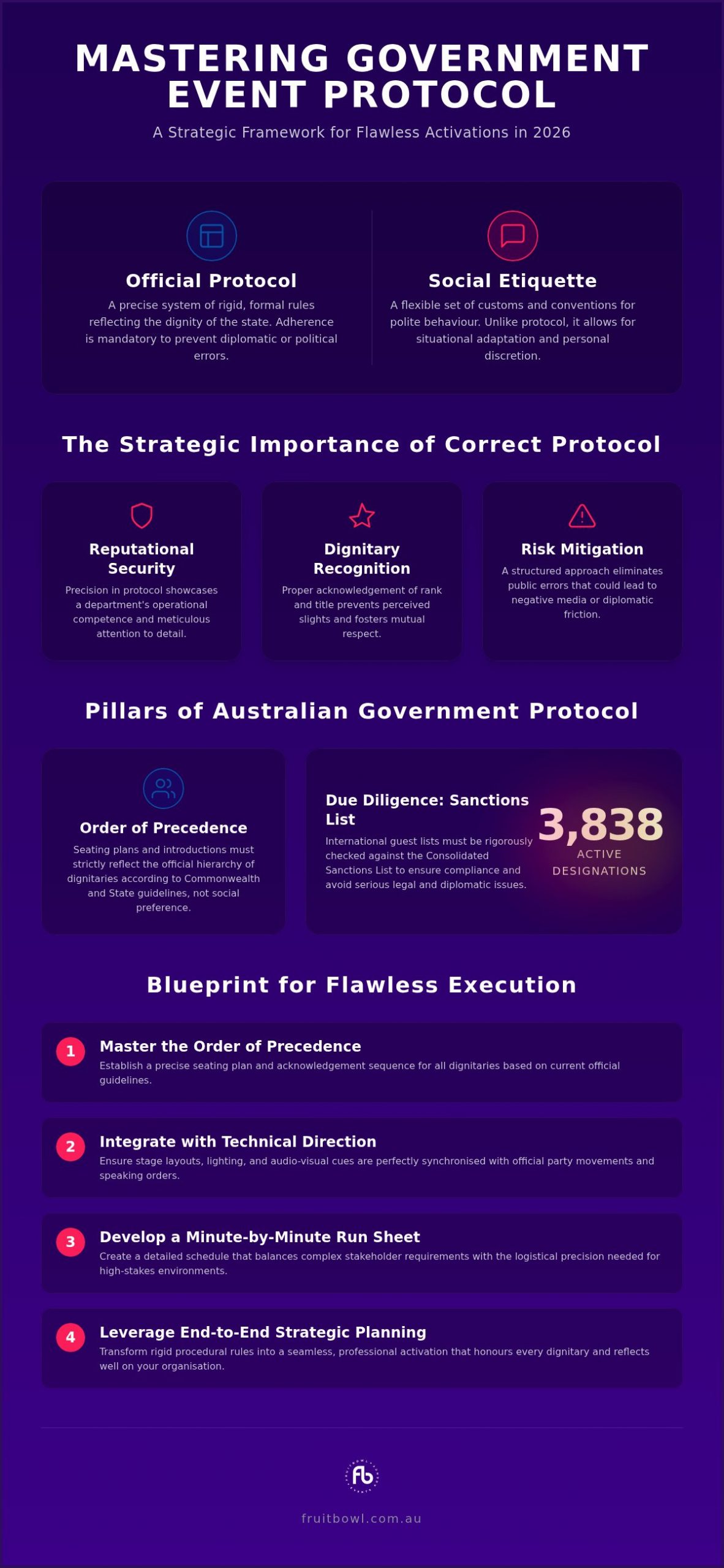
This guide provides a comprehensive strategic framework for delivering flawless results in 2026. You’ll learn how to master the complexities of official protocol, from the latest Australian Order of Precedence to the rigorous requirements of the Australian Sanctions Office. We’ll also address the critical need for due diligence regarding the 3,838 active designations on the Consolidated Sanctions List to ensure your international guest list remains compliant. By the end of this article, you’ll have the tools to deliver a seamless activation that honours every dignitary correctly while achieving your department’s creative objectives with absolute confidence.
Key Takeaways
- Distinguish between general social etiquette and the rigid mandates of official protocol to safeguard your department from political embarrassment.
- Establish a precise seating plan and acknowledgement sequence by mastering the current Australian Order of Precedence for all invited dignitaries.
- Integrate government event protocol management into your technical direction to ensure stage layouts and AV cues align perfectly with official party movements.
- Develop a minute-by-minute run sheet that balances complex stakeholder requirements with the logistical precision required for high-stakes environments.
- Leverage end-to-end strategic planning to transform rigid procedural rules into a seamless, professional activation that reflects well on your organisation.
Defining Government Event Protocol Management in 2026
Protocol is the formal architecture of any official engagement. It isn’t merely a set of suggestions; it’s a precise system of rules that governs everything from seating to speech order. Unlike social etiquette, which is often flexible, government event protocol management relies on rigid mandates that reflect the dignity of the state. In 2026, successful activations must balance these traditional standards with the complexities of modern, digital-first engagement. This means ensuring that the formal atmosphere remains intact even when broadcasting to a global audience or incorporating interactive technology. The protocol officer serves as the central point of alignment, ensuring every detail adheres to the principles of diplomatic protocol while meeting contemporary communication goals. This role is increasingly about strategic oversight, acting as a “safe pair of hands” that guarantees order in high-stakes environments.
The Strategic Importance of Correct Protocol
Adhering to correct protocol is a fundamental exercise in reputation management. It safeguards the hosting department against political fallout and ensures that the focus remains on the event’s objectives. When dignitaries feel appropriately recognised, it fosters a sense of mutual respect and professionalism. This meticulousness is critical in 2026, where the speed of social media can amplify a single protocol error within minutes. Professional management ensures that the department presents an unflappable image of expertise.
- Reputational Security: Precision in protocol reflects a department’s operational competence and attention to detail.
- Dignitary Recognition: Proper acknowledgement of rank and title prevents perceived slights that can damage long-term relationships.
- Risk Mitigation: A structured approach eliminates the chance of public errors that could lead to negative media coverage or diplomatic friction.
Key Stakeholders in Public Activations
Complex activations involve a web of stakeholders, each with distinct priorities. Identifying the lead agency and its specific mandates is the first step toward logistical clarity. Effective government event protocol management requires bridging the gap between the strategic vision of political offices and the practical execution of administrative staff. Early engagement prevents last-minute changes that could jeopardise the event’s precision and ensures all moving parts integrate seamlessly on the day.
- Lead Agencies: These organisations define the primary objectives and provide the necessary funding and authority for the activation.
- Supporting Departments: These groups offer technical, security, or regional expertise to bolster the event’s success and compliance.
- Stakeholder Liaison: Professional liaison is essential for synchronising the requirements of multiple high-level offices and managing competing expectations.
The Pillars of Australian Government Protocol
Australian government activations require more than just logistical efficiency. They demand a deep understanding of symbolic gestures and hierarchical structures. Effective government event protocol management ensures these elements are respected without exception, providing a stable foundation for diplomatic and public engagement. From the way a Minister is introduced to the sequence of flags on a stage, every detail serves as a visual representation of the department’s professionalism and respect for tradition. In 2026, maintaining this decorum is essential for projecting a composed and authoritative image to both domestic and international audiences. This standard of excellence also applies to the presentation of all officials; for those requiring discreet garment restoration to maintain a flawless look, you can visit Fitting Room Alterations to ensure your attire is as polished as your protocol.
Order of Precedence and Seating Charts
The Order of Precedence is the hierarchy used to determine the relative importance of officials at an event. Organising seating isn’t about social preference. It’s about reflecting official rank according to established Commonwealth and State guidelines. In high-stakes settings, managing plus-ones and non-official guests requires significant discretion. Non-official guests shouldn’t displace an office-holder in the primary seating sequence or official party. Applying this level of event planning protocol requires a methodical approach to data collection and guest list verification well before the doors open. It’s about creating a frictionless environment where every dignitary feels their position is acknowledged and honoured.
Flag Protocol and National Symbols
Flags are powerful national symbols. Their display isn’t decorative; it’s governed by strict legislation. The hierarchy is clear. The Australian National Flag always takes the position of honour. It’s followed by State flags, then the Australian Aboriginal Flag and the Torres Strait Islander Flag. When displayed on a stage, the National Flag should be on the far left from the audience’s perspective. For multi-day activations, remember that flags shouldn’t be left in darkness unless they’re properly illuminated. If a period of official mourning is declared, half-masting must be executed with precision across all venue entrances and stages to maintain departmental dignity.
Correctly titling a Minister or a foreign dignitary is non-negotiable. Written invitations and spoken introductions must match official styles of address exactly. Similarly, distinguishing between a Welcome to Country, delivered by a Traditional Owner, and an Acknowledgement of Country is a core requirement for modern Australian events. These procedures must be integrated into the technical run sheet to ensure no errors occur during the opening sequence. For departments managing complex guest lists, partnering with an agency that specialises in government activations provides the necessary security to focus on policy outcomes while the logistical precision remains under expert supervision.
Integrating Protocol with Technical Direction and AV
Successful government event protocol management requires a seamless bridge between the formal programme and the technical execution. Technical direction isn’t a separate entity; it’s the vehicle that delivers the protocol. A stage layout that fails to account for the physical movement of an official party can lead to awkward pauses or bottlenecks that undermine the dignity of the occasion. In 2026, technical precision also extends to the media’s needs. Lighting must be designed specifically to ensure dignitaries are clearly visible for photography and broadcast without the harsh shadows common in standard venue setups. Managing technical riders for high-level keynote speakers involves more than just equipment lists. It requires an understanding of how their specific requirements fit within the broader departmental mandates.
Stage Management for Dignitaries
The “march-on” and “march-off” of an official party must be choreographed with precision. This includes ensuring that the path is clear and that the sequence of arrival matches the Order of Precedence established in earlier planning stages. Lectern placement is equally critical. If your speaker list includes dignitaries of varying heights, motorised lecterns or pre-arranged height adjustments are essential to avoid fumbling on stage. Every technical cue, from the lighting state to the volume of the walk-on music, must align perfectly with the formal programme flow. This maintains a steady, professional rhythm that reflects well on the host organisation.
AV Management for High-Stakes Delivery
High-stakes delivery allows no margin for error. Redundancy planning is mandatory for all audio and visual systems, particularly during ministerial addresses or the performance of national anthems. This means having backup microphones, secondary playback systems, and uninterruptible power supplies in place. Effective government event protocol management prioritises these safety nets to prevent technical failures that could cause political embarrassment. For public-facing announcements, managing live-stream protocols ensures that the digital audience experiences the same level of decorum as those in the room. For deeper technical insights, refer to our guide on AV management for events. By integrating these technical layers with protocol requirements, you create a robust environment that supports the mission’s success.
Developing a Comprehensive Protocol Management Plan
A robust plan treats protocol as a strategic asset rather than a secondary checklist. It integrates logistical precision with risk mitigation to ensure the safety and dignity of every attendee. In 2026, this involves a multi-layered approach that synchronises security, media, and technical requirements into a single, cohesive framework. Effective government event protocol management requires looking beyond the immediate schedule to anticipate potential disruptions and establishing clear pathways for every possible scenario. This methodical preparation provides the sense of security needed for high-stakes public engagement.
Risk Management and VIP Security
Assessing the security profile of high-level government attendees is the first step in any activation. This process requires close coordination with police liaisons and private security details—for example, you can explore Unarmed Security Guards for discreet, professional coverage—to establish secure perimeters without creating an atmosphere of restriction. Discreet entry and exit points must be mapped out to allow dignitaries to move efficiently while maintaining the event’s formal flow. Crowd control strategies should be designed to manage public interest while ensuring the official party remains undisturbed. By treating security as a component of the protocol itself, you maintain the event’s prestige while ensuring absolute safety.
The ‘Minute-by-Minute’ run sheet is the foundation of government event protocol management. It breaks the event into sequential, timed segments, providing clarity for every staff member on site. Building in ‘buffer time’ is essential, especially for protocol-heavy segments like arrivals or official acknowledgements, where minor delays are common. Every staff member must be briefed on their specific role in maintaining the protocol, from the way they address a VIP to their positioning during the national anthem. This level of detail ensures that the transition between different sections of the programme feels natural and controlled.
Media management is equally vital for public-facing government activations. Establishing a clear framework for press interaction ensures that the event is captured professionally without compromising security or official protocol. This includes designated media pits and specific windows for photography that don’t interfere with the formal proceedings. For departments requiring a “safe pair of hands” to manage these complexities, our team provides expert oversight for government activations across Australia. This end-to-end management allows you to focus on your department’s strategic objectives while we handle the logistical precision.
Partnering with a Specialist Agency for Flawless Execution
Managing the intricacies of government event protocol management requires more than a simple checklist. It demands a partner who understands the profound weight of public perception and the nuances of diplomatic decorum. It’s about trust. In 2026, the complexity of domestic scrutiny and international relations means that internal teams often face immense pressure to deliver perfection under tight deadlines. Fruitbowl Events Agency provides a “safe pair of hands” by bringing order to these high-stakes environments. We use our seasoned expertise to provide a sense of security, ensuring every detail is under expert supervision. Our approach strikes a sophisticated balance between creative ambition and the logistical precision required by official mandates.
The Value of End-to-End Oversight
Our methodology focuses on reducing the operational burden on internal government communications teams. By providing end-to-end management, we handle everything from initial stakeholder liaison to the final on-site delivery. We leverage 28 years of industry experience to anticipate logistical hurdles before they become public liabilities. This proactive approach ensures that the event reflects well on the department and honours all dignitaries correctly. Integrating our technical direction with your policy goals creates a seamless experience for all attendees. For deeper insights into managing high-stakes public activations, read our guide on strategic government event planning.
Securing Your Event’s Success
Choosing the right partner involves assessing their history with complex government tenders and their ability to navigate multifaceted stakeholder requirements. We focus on ensuring that your brand objectives align perfectly with government compliance standards. This includes professional talent procurement that matches the dignity of the programme and meticulous technical planning. Our national service coverage ensures a consistent standard of excellence across Australia, regardless of the venue or scale. We take quiet pride in our work, but the focus remains firmly on your objectives. To discuss your specific needs for government event protocol management on a national scale, contacting Fruitbowl is the first step toward a flawless activation.
Mastering the Diplomacy of Modern Activations
Effective government event protocol management ensures that every official engagement reflects the dignity and professionalism of the hosting department. By integrating the Australian Order of Precedence with precise technical direction and rigorous risk assessments, you create a robust framework for high-stakes success. These elements work together to safeguard your organisation’s reputation while honouring every dignitary correctly. Achieving this level of logistical precision requires a partner who understands the nuances of official mandates and complex stakeholder requirements.
With over 28 years of experience in high-impact government activations, our team provides the end-to-end oversight needed for a frictionless experience. We act as a steady, reliable partner to bring order to the most challenging environments across Australia. Our comprehensive national service ensures that every detail, from flag protocol to security liaison, is managed with absolute precision. When you’re ready to deliver a flawless official ceremony or public activation, partner with Fruitbowl Events Agency for your next high-stakes government activation. Our commitment to meticulous planning ensures your mission’s success is always in expert hands. We look forward to helping you set a new standard for excellence in 2026.
Frequently Asked Questions
What is the Australian Order of Precedence?
The Australian Order of Precedence is the official hierarchy used to determine the relative seniority of dignitaries at state and federal functions. It dictates seating arrangements, introduction sequences, and the order of arrival for all official guests. Following this list ensures that officials are recognised according to their formal rank, preventing diplomatic slights. In 2026, planners must verify current lists to account for any recent changes in parliamentary or judicial appointments.
How do I correctly display the Australian National Flag at an event?
The Australian National Flag must always take the position of honour, typically on the far left of the stage from the audience’s perspective. If you’re displaying multiple flags, the sequence follows a specific hierarchy: National, State, then Aboriginal and Torres Strait Islander flags. Ensure all flags are in good condition and properly illuminated if the activation continues after sunset. Nighttime display without lighting is considered a breach of official protocol.
What is the difference between a Welcome to Country and an Acknowledgement of Country?
A Welcome to Country is a formal ceremony delivered by a Traditional Owner or Elder of the land where the event occurs. It’s a traditional greeting that grants permission to visitors. An Acknowledgement of Country is a statement made by any individual, including non-Indigenous speakers, to show respect for the Traditional Owners. Both are essential components of government event protocol management and must be scheduled at the very beginning of the programme.
How should I address a Minister or Member of Parliament during an introduction?
Use the official title and full name during the first formal introduction, such as “The Honourable [Name], Minister for [Portfolio]”. For subsequent references, “Minister” or “Mr/Ms [Surname]” is generally acceptable. It’s vital to check if the individual is a member of the Executive Council, which entitles them to the prefix “The Honourable” for life. Precision in these titles reflects the host organisation’s professionalism and respect for the office.
Do I need special security for a government event?
High-level government activations often require specific security measures, including coordination with police and private security details. You must conduct a rigorous risk assessment based on the profile of the dignitaries attending. This includes planning discreet entry points and secure perimeters that don’t disrupt the event’s formal atmosphere. Effective government event protocol management integrates these security layers seamlessly into the overall logistical plan to ensure a safe environment for all guests.
What are the common protocol mistakes to avoid in public activations?
Common errors include seating dignitaries out of order, mispronouncing titles, or failing to follow flag hierarchy. Another frequent mistake is neglecting the minute-by-minute run sheet, which leads to awkward transitions during the official party’s arrival. Overlooking dietary requirements for high-level guests or failing to provide a suitable lectern height can also cause embarrassment. Meticulous planning and stakeholder liaison are the best defences against these logistical and procedural oversights.
How do I manage media presence at a government-sponsored event?
Establish a dedicated media management framework that includes a designated press area and clear photography windows. This prevents journalists from obstructing the view of dignitaries or interfering with the official party’s movement. You should provide a media kit with the correct spelling of all names and titles to ensure accurate reporting. Coordinating with ministerial media advisors ensures that public announcements are broadcast professionally and align with the event’s strategic objectives.
Can an event management agency handle all protocol requirements?
A specialist agency like Fruitbowl Events Agency provides end-to-end management, covering everything from strategic planning to on-site delivery. With over 28 years of experience, we act as a safe pair of hands for complex government activations. We handle the logistical precision, stakeholder liaison, and technical direction, allowing your team to focus on policy outcomes. Our national coverage ensures that your event adheres to all relevant Commonwealth and State protocol mandates.
A single seating error or an overlooked form of address can transform a high-stakes government activation from a diplomatic success into a front-page political liability. You already know that government event protocol management is less about the celebration and more about the precision of the invisible architecture that supports our public institutions. It’s a high-pressure environment where the expectations of multiple stakeholders often collide with rigid official requirements. When the reputation of a department or a minister is on the line, there’s no room for logistical ambiguity or procedural oversight.
This guide provides a comprehensive strategic framework for delivering flawless results in 2026. You’ll learn how to master the complexities of official protocol, from the latest Australian Order of Precedence to the rigorous requirements of the Australian Sanctions Office. We’ll also address the critical need for due diligence regarding the 3,838 active designations on the Consolidated Sanctions List to ensure your international guest list remains compliant. By the end of this article, you’ll have the tools to deliver a seamless activation that honours every dignitary correctly while achieving your department’s creative objectives with absolute confidence.
Key Takeaways
- Distinguish between general social etiquette and the rigid mandates of official protocol to safeguard your department from political embarrassment.
- Establish a precise seating plan and acknowledgement sequence by mastering the current Australian Order of Precedence for all invited dignitaries.
- Integrate government event protocol management into your technical direction to ensure stage layouts and AV cues align perfectly with official party movements.
- Develop a minute-by-minute run sheet that balances complex stakeholder requirements with the logistical precision required for high-stakes environments.
- Leverage end-to-end strategic planning to transform rigid procedural rules into a seamless, professional activation that reflects well on your organisation.
Defining Government Event Protocol Management in 2026
Protocol is the formal architecture of any official engagement. It isn’t merely a set of suggestions; it’s a precise system of rules that governs everything from seating to speech order. Unlike social etiquette, which is often flexible, government event protocol management relies on rigid mandates that reflect the dignity of the state. In 2026, successful activations must balance these traditional standards with the complexities of modern, digital-first engagement. This means ensuring that the formal atmosphere remains intact even when broadcasting to a global audience or incorporating interactive technology. The protocol officer serves as the central point of alignment, ensuring every detail adheres to the principles of diplomatic protocol while meeting contemporary communication goals. This role is increasingly about strategic oversight, acting as a “safe pair of hands” that guarantees order in high-stakes environments.
The Strategic Importance of Correct Protocol
Adhering to correct protocol is a fundamental exercise in reputation management. It safeguards the hosting department against political fallout and ensures that the focus remains on the event’s objectives. When dignitaries feel appropriately recognised, it fosters a sense of mutual respect and professionalism. This meticulousness is critical in 2026, where the speed of social media can amplify a single protocol error within minutes. Professional management ensures that the department presents an unflappable image of expertise.
- Reputational Security: Precision in protocol reflects a department’s operational competence and attention to detail.
- Dignitary Recognition: Proper acknowledgement of rank and title prevents perceived slights that can damage long-term relationships.
- Risk Mitigation: A structured approach eliminates the chance of public errors that could lead to negative media coverage or diplomatic friction.
Key Stakeholders in Public Activations
Complex activations involve a web of stakeholders, each with distinct priorities. Identifying the lead agency and its specific mandates is the first step toward logistical clarity. Effective government event protocol management requires bridging the gap between the strategic vision of political offices and the practical execution of administrative staff. Early engagement prevents last-minute changes that could jeopardise the event’s precision and ensures all moving parts integrate seamlessly on the day.
- Lead Agencies: These organisations define the primary objectives and provide the necessary funding and authority for the activation.
- Supporting Departments: These groups offer technical, security, or regional expertise to bolster the event’s success and compliance.
- Stakeholder Liaison: Professional liaison is essential for synchronising the requirements of multiple high-level offices and managing competing expectations.
The Pillars of Australian Government Protocol
Australian government activations require more than just logistical efficiency. They demand a deep understanding of symbolic gestures and hierarchical structures. Effective government event protocol management ensures these elements are respected without exception, providing a stable foundation for diplomatic and public engagement. From the way a Minister is introduced to the sequence of flags on a stage, every detail serves as a visual representation of the department’s professionalism and respect for tradition. In 2026, maintaining this decorum is essential for projecting a composed and authoritative image to both domestic and international audiences.
Order of Precedence and Seating Charts
The Order of Precedence is the hierarchy used to determine the relative importance of officials at an event. Organising seating isn’t about social preference. It’s about reflecting official rank according to established Commonwealth and State guidelines. In high-stakes settings, managing plus-ones and non-official guests requires significant discretion. Non-official guests shouldn’t displace an office-holder in the primary seating sequence or official party. Applying this level of event planning protocol requires a methodical approach to data collection and guest list verification well before the doors open. It’s about creating a frictionless environment where every dignitary feels their position is acknowledged and honoured.
Flag Protocol and National Symbols
Flags are powerful national symbols. Their display isn’t decorative; it’s governed by strict legislation. The hierarchy is clear. The Australian National Flag always takes the position of honour. It’s followed by State flags, then the Australian Aboriginal Flag and the Torres Strait Islander Flag. When displayed on a stage, the National Flag should be on the far left from the audience’s perspective. For multi-day activations, remember that flags shouldn’t be left in darkness unless they’re properly illuminated. If a period of official mourning is declared, half-masting must be executed with precision across all venue entrances and stages to maintain departmental dignity.
Correctly titling a Minister or a foreign dignitary is non-negotiable. Written invitations and spoken introductions must match official styles of address exactly. Similarly, distinguishing between a Welcome to Country, delivered by a Traditional Owner, and an Acknowledgement of Country is a core requirement for modern Australian events. These procedures must be integrated into the technical run sheet to ensure no errors occur during the opening sequence. For departments managing complex guest lists, partnering with an agency that specialises in government activations provides the necessary security to focus on policy outcomes while the logistical precision remains under expert supervision.
Integrating Protocol with Technical Direction and AV
Successful government event protocol management requires a seamless bridge between the formal programme and the technical execution. Technical direction isn’t a separate entity; it’s the vehicle that delivers the protocol. A stage layout that fails to account for the physical movement of an official party can lead to awkward pauses or bottlenecks that undermine the dignity of the occasion. In 2026, technical precision also extends to the media’s needs. Lighting must be designed specifically to ensure dignitaries are clearly visible for photography and broadcast without the harsh shadows common in standard venue setups. Managing technical riders for high-level keynote speakers involves more than just equipment lists. It requires an understanding of how their specific requirements fit within the broader departmental mandates.
Stage Management for Dignitaries
The “march-on” and “march-off” of an official party must be choreographed with precision. This includes ensuring that the path is clear and that the sequence of arrival matches the Order of Precedence established in earlier planning stages. Lectern placement is equally critical. If your speaker list includes dignitaries of varying heights, motorised lecterns or pre-arranged height adjustments are essential to avoid fumbling on stage. Every technical cue, from the lighting state to the volume of the walk-on music, must align perfectly with the formal programme flow. This maintains a steady, professional rhythm that reflects well on the host organisation.
AV Management for High-Stakes Delivery
High-stakes delivery allows no margin for error. Redundancy planning is mandatory for all audio and visual systems, particularly during ministerial addresses or the performance of national anthems. This means having backup microphones, secondary playback systems, and uninterruptible power supplies in place. Effective government event protocol management prioritises these safety nets to prevent technical failures that could cause political embarrassment. For public-facing announcements, managing live-stream protocols ensures that the digital audience experiences the same level of decorum as those in the room. For deeper technical insights, refer to our guide on AV management for events. By integrating these technical layers with protocol requirements, you create a robust environment that supports the mission’s success.
Developing a Comprehensive Protocol Management Plan
A robust plan treats protocol as a strategic asset rather than a secondary checklist. It integrates logistical precision with risk mitigation to ensure the safety and dignity of every attendee. In 2026, this involves a multi-layered approach that synchronises security, media, and technical requirements into a single, cohesive framework. Effective government event protocol management requires looking beyond the immediate schedule to anticipate potential disruptions and establishing clear pathways for every possible scenario. This methodical preparation provides the sense of security needed for high-stakes public engagement.
Risk Management and VIP Security
Assessing the security profile of high-level government attendees is the first step in any activation. This process requires close coordination with police liaisons and private security details to establish secure perimeters without creating an atmosphere of restriction. Discreet entry and exit points must be mapped out to allow dignitaries to move efficiently while maintaining the event’s formal flow. Crowd control strategies should be designed to manage public interest while ensuring the official party remains undisturbed. By treating security as a component of the protocol itself, you maintain the event’s prestige while ensuring absolute safety.
The Run Sheet: Logistical Precision
The ‘Minute-by-Minute’ run sheet is the foundation of government event protocol management. It breaks the event into sequential, timed segments, providing clarity for every staff member on site. Building in ‘buffer time’ is essential, especially for protocol-heavy segments like arrivals or official acknowledgements, where minor delays are common. Every staff member must be briefed on their specific role in maintaining the protocol, from the way they address a VIP to their positioning during the national anthem. This level of detail ensures that the transition between different sections of the programme feels natural and controlled.
Media management is equally vital for public-facing government activations. Establishing a clear framework for press interaction ensures that the event is captured professionally without compromising security or official protocol. This includes designated media pits and specific windows for photography that don’t interfere with the formal proceedings. For departments requiring a “safe pair of hands” to manage these complexities, our team provides expert oversight for government activations across Australia. This end-to-end management allows you to focus on your department’s strategic objectives while we handle the logistical precision.
Partnering with a Specialist Agency for Flawless Execution
Managing the intricacies of government event protocol management requires more than a simple checklist. It demands a partner who understands the profound weight of public perception and the nuances of diplomatic decorum. It’s about trust. In 2026, the complexity of domestic scrutiny and international relations means that internal teams often face immense pressure to deliver perfection under tight deadlines. Fruitbowl Events Agency provides a “safe pair of hands” by bringing order to these high-stakes environments. We use our seasoned expertise to provide a sense of security, ensuring every detail is under expert supervision. Our approach strikes a sophisticated balance between creative ambition and the logistical precision required by official mandates.
The Value of End-to-End Oversight
Our methodology focuses on reducing the operational burden on internal government communications teams. By providing end-to-end management, we handle everything from initial stakeholder liaison to the final on-site delivery. We leverage 28 years of industry experience to anticipate logistical hurdles before they become public liabilities. This proactive approach ensures that the event reflects well on the department and honours all dignitaries correctly. Integrating our technical direction with your policy goals creates a seamless experience for all attendees. For deeper insights into managing high-stakes public activations, read our guide on strategic government event planning.
Securing Your Event’s Success
Choosing the right partner involves assessing their history with complex government tenders and their ability to navigate multifaceted stakeholder requirements. We focus on ensuring that your brand objectives align perfectly with government compliance standards. This includes professional talent procurement that matches the dignity of the programme and meticulous technical planning. Our national service coverage ensures a consistent standard of excellence across Australia, regardless of the venue or scale. We take quiet pride in our work, but the focus remains firmly on your objectives. To discuss your specific needs for government event protocol management on a national scale, contacting Fruitbowl is the first step toward a flawless activation.
Mastering the Diplomacy of Modern Activations
Effective government event protocol management ensures that every official engagement reflects the dignity and professionalism of the hosting department. By integrating the Australian Order of Precedence with precise technical direction and rigorous risk assessments, you create a robust framework for high-stakes success. These elements work together to safeguard your organisation’s reputation while honouring every dignitary correctly. Achieving this level of logistical precision requires a partner who understands the nuances of official mandates and complex stakeholder requirements.
With over 28 years of experience in high-impact government activations, our team provides the end-to-end oversight needed for a frictionless experience. We act as a steady, reliable partner to bring order to the most challenging environments across Australia. Our comprehensive national service ensures that every detail, from flag protocol to security liaison, is managed with absolute precision. When you’re ready to deliver a flawless official ceremony or public activation, partner with Fruitbowl Events Agency for your next high-stakes government activation. Our commitment to meticulous planning ensures your mission’s success is always in expert hands. We look forward to helping you set a new standard for excellence in 2026.
Frequently Asked Questions
What is the Australian Order of Precedence?
The Australian Order of Precedence is the official hierarchy used to determine the relative seniority of dignitaries at state and federal functions. It dictates seating arrangements, introduction sequences, and the order of arrival for all official guests. Following this list ensures that officials are recognised according to their formal rank, preventing diplomatic slights. In 2026, planners must verify current lists to account for any recent changes in parliamentary or judicial appointments.
How do I correctly display the Australian National Flag at an event?
The Australian National Flag must always take the position of honour, typically on the far left of the stage from the audience’s perspective. If you’re displaying multiple flags, the sequence follows a specific hierarchy: National, State, then Aboriginal and Torres Strait Islander flags. Ensure all flags are in good condition and properly illuminated if the activation continues after sunset. Nighttime display without lighting is considered a breach of official protocol.
What is the difference between a Welcome to Country and an Acknowledgement of Country?
A Welcome to Country is a formal ceremony delivered by a Traditional Owner or Elder of the land where the event occurs. It’s a traditional greeting that grants permission to visitors. An Acknowledgement of Country is a statement made by any individual, including non-Indigenous speakers, to show respect for the Traditional Owners. Both are essential components of government event protocol management and must be scheduled at the very beginning of the programme.
How should I address a Minister or Member of Parliament during an introduction?
Use the official title and full name during the first formal introduction, such as “The Honourable [Name], Minister for [Portfolio]”. For subsequent references, “Minister” or “Mr/Ms [Surname]” is generally acceptable. It’s vital to check if the individual is a member of the Executive Council, which entitles them to the prefix “The Honourable” for life. Precision in these titles reflects the host organisation’s professionalism and respect for the office.
Do I need special security for a government event?
High-level government activations often require specific security measures, including coordination with police and private security details. You must conduct a rigorous risk assessment based on the profile of the dignitaries attending. This includes planning discreet entry points and secure perimeters that don’t disrupt the event’s formal atmosphere. Effective government event protocol management integrates these security layers seamlessly into the overall logistical plan to ensure a safe environment for all guests.
What are the common protocol mistakes to avoid in public activations?
Common errors include seating dignitaries out of order, mispronouncing titles, or failing to follow flag hierarchy. Another frequent mistake is neglecting the minute-by-minute run sheet, which leads to awkward transitions during the official party’s arrival. Overlooking dietary requirements for high-level guests or failing to provide a suitable lectern height can also cause embarrassment. Meticulous planning and stakeholder liaison are the best defences against these logistical and procedural oversights.
How do I manage media presence at a government-sponsored event?
Establish a dedicated media management framework that includes a designated press area and clear photography windows. This prevents journalists from obstructing the view of dignitaries or interfering with the official party’s movement. You should provide a media kit with the correct spelling of all names and titles to ensure accurate reporting. Coordinating with ministerial media advisors ensures that public announcements are broadcast professionally and align with the event’s strategic objectives.
Can an event management agency handle all protocol requirements?
A specialist agency like Fruitbowl Events Agency provides end-to-end management, covering everything from strategic planning to on-site delivery. With over 28 years of experience, we act as a safe pair of hands for complex government activations. We handle the logistical precision, stakeholder liaison, and technical direction, allowing your team to focus on policy outcomes. Our national coverage ensures that your event adheres to all relevant Commonwealth and State protocol mandates.
OUR BLOG
Event Insights & Expertise
Our blog is your go-to resource for all things events. From expert insights and the latest industry trends to practical planning tips, we share everything you need to deliver standout experiences.
Contact Us