Festival Production Planning for Site, Stages and Safety

A safe festival depends on production planning that treats security and safety as core operational requirements, not last-minute checks. A comprehensive safety plan covers risk management and crowd control, while the security plan addresses crowd, food, weather, structural and electrical safety. These decisions must align with the site layout, programme and production systems.

It’s easy to focus first on stages, artists and the running order. But decisions about access, audience movement, weather contingencies and emergency response shape how those elements work on the day. Festival production planning brings these moving parts together so teams can anticipate risks and coordinate their response.

This guide explains how site conditions affect stage placement, what to include in weather contingencies and artist advancing, and how schedules and changeovers support a controlled event. It also covers practical considerations for security, crowd movement and operational communication, giving you a clear framework for planning a festival in Australia.

Key Takeaways

  • Use a scaled site map to coordinate stages, audience movement, accessible routes, emergency egress and operational areas.
  • Set weather-response procedures before equipment arrives, including who can pause, delay or resume performances.
  • Advance artist riders early so technical, logistical and hospitality requirements can be integrated into the production plan.
  • Build realistic changeovers into the running order and avoid clashes between popular acts on different stages.
  • Connect risk assessment, crowd control, communications and access arrangements in one coordinated safety plan.

Stage placement and site conditions

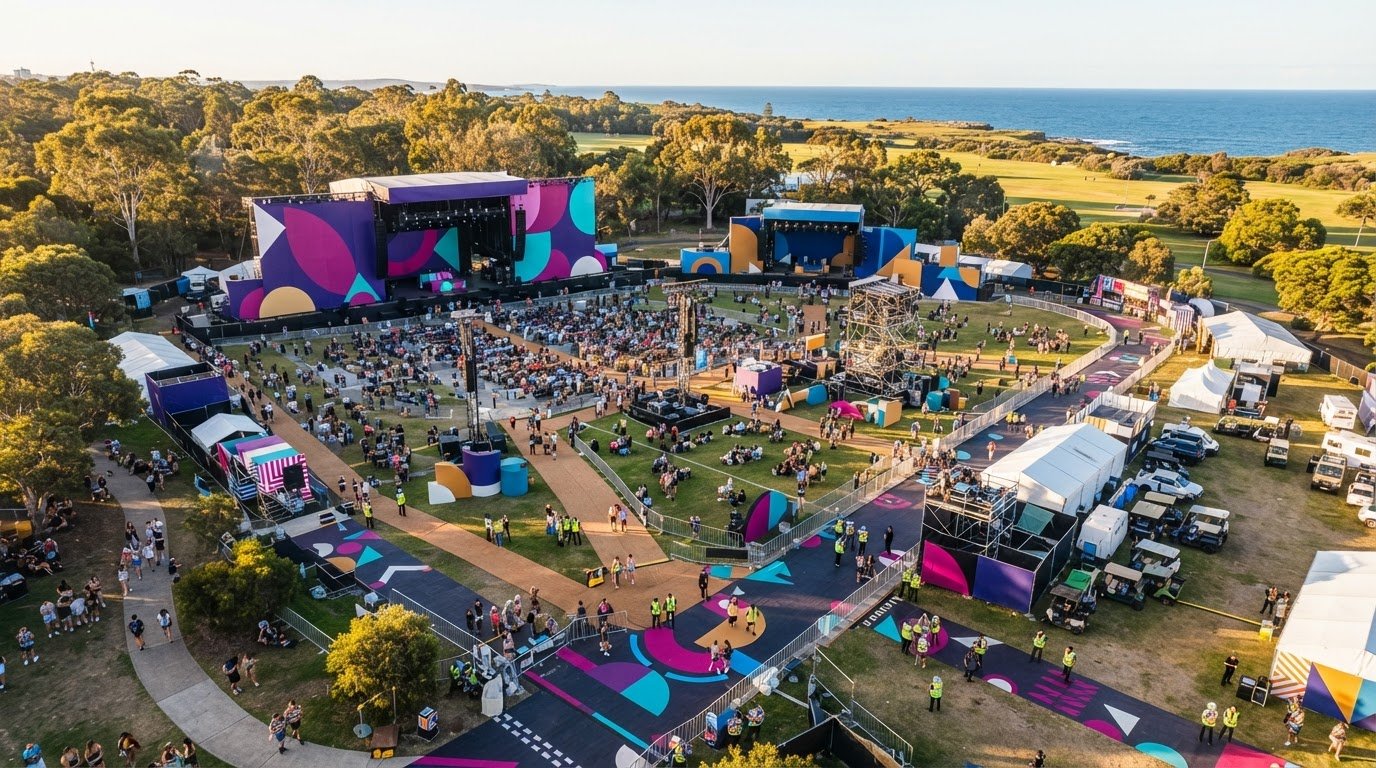
Effective festival production planning starts with a scaled site plan that connects stage placement to audience movement and safe operations. Map entrances, exits, emergency egress, accessible routes, vendor areas, medical stations and restrooms. Then assess audience capacity, sightlines, terrain, nearby structures and distances between event areas. These details reveal where crowds may gather and whether production, services and emergency access can operate without crossing paths.

Place each stage according to performance type, audience size, access and site conditions. A typical festival band stage should be at least 24×16 feet, while the final design also depends on roof requirements, trim height and local rules. At Heartbeat of the Hunter, an amphitheatre slope supported clear sightlines, but soft ground complicated trailer-stage positioning. This shows why a site walk should assess audience views and ground conditions together.

Covered stages and marquees can provide shelter, but their placement must work with the overall layout. Account for wind exposure, available infrastructure, lighting visibility and access for artists and crew. Lighting design should reflect rigging limits, power availability, weather exposure and operator sightlines. A marquee that blocks a lighting position or narrows an access route can compromise the entire setup.

Coordinate ticketing, vendors, sponsors and staffing through one site layout and operating plan. Mark ticket-scanning and entry areas, vendor positions, sponsor activations, staff access and crew routes so every team knows its location and responsibilities. Give stage managers clear communication channels and authority over performance readiness, transitions and operational updates.

For multiple stages, coordinate schedules, sound direction, shared equipment, crew movement and artist changeovers. Avoid scheduling popular acts in direct competition if audience movement between stages could cause congestion. Where practical, direct stages away from one another and account for sound spill beyond the event footprint. Position Front of House facing the main stage, with clear access for sound and lighting operators.

The festival production planning process should overlay technical needs onto the map. Show cable paths, generator locations, power distribution and backstage access before the layout is fixed. Festival generators should be placed at least 100 feet from the stage to reduce engine noise in microphones. Check long cable runs, uneven ground and limited infrastructure during the site review. This joined-up plan gives production, vendors and operations teams a shared reference before load-in begins.

Weather contingencies and compressed build timelines

Weather can affect site access, equipment setup and the running order. A workable contingency sets out actions, decision-makers and communication procedures before conditions disrupt the event.

Planning for Weather Disruptions

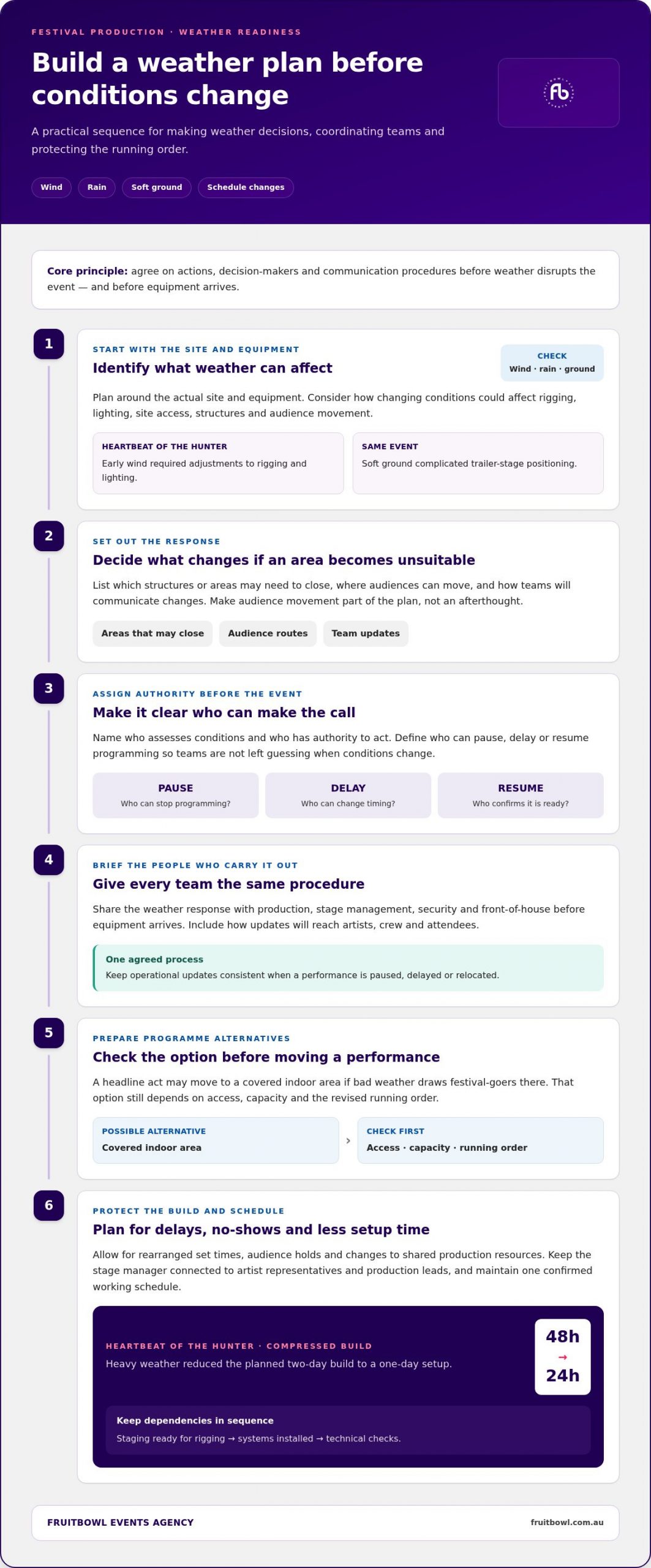
A weather contingency is a pre-agreed response to changing conditions, including who can pause, delay or resume programming. It matters because wind, rain and soft ground can affect rigging, lighting, access and audience movement. At Heartbeat of the Hunter, early wind required adjustments to rigging and lighting, while soft ground complicated trailer-stage positioning.

Build the plan around the actual site and equipment, rather than relying on a general wet-weather statement. Identify which structures or areas may need to close, where audiences can move, and how teams will communicate changes. Decide who assesses conditions and who has authority to act. Share the procedure with production, stage management, security and front-of-house teams before equipment arrives.

Consider how programming will change if an outdoor area becomes unsuitable. A headline act may move to a covered indoor area if bad weather draws festival-goers there. That option still depends on access, capacity and the revised running order. Establish a clear process for telling artists, crew and attendees about a pause, delay or relocation.

Managing Delays and No-Shows

A delay and no-show contingency sets out how the programme changes when an artist or key crew member cannot meet the schedule. It matters because an unexpected gap can affect audience flow, other stages and shared production resources. Stage managers should know which decisions they can make and how quickly updates must reach other teams.

Build flexibility into the show plan, with options for rearranging set times or safely holding an audience while the team resolves an issue. For a multi-stage concert, consider whether another performance can move without creating a clash or disrupting changeovers. Keep the stage manager connected to artist representatives and production leads so revised timings are communicated consistently.

Link these arrangements to weather procedures. A weather delay may affect artist arrival, access to backstage areas or the time available for setup. Explain how teams will record changes and confirm the current schedule. This gives crew and performers one working version, rather than competing updates.

Compressed Build Timelines

A compressed build timeline is a shorter setup window that requires production tasks to be prioritised and coordinated. It matters because weather can remove access time before the event opens. At Heartbeat of the Hunter, heavy weather reduced the planned two-day build to a one-day setup. The planned 48-hour production build had to be completed in half the time.

Map dependencies before load-in: staging must be ready for rigging, and technical checks depend on installed systems. Identify essential tasks, sequence crew access and keep a shared progress record. A final site walkthrough should confirm that equipment and operational areas are ready before opening. Don’t skip safety checks if setup time is shortened.

Determine permit requirements when the site is selected, since Australian festivals may need council event permits, traffic management approvals, liquor licensing or food safety approvals. Keep weather procedures aligned with the event’s permit and insurance planning, so the documented operating approach reflects potential changes. For a coordinated festival production plan, connect site, schedule and contingency decisions from the outset.

Artist advancing and technical requirements

Artist advancing coordinates technical, logistical and hospitality details with performers, vendors and crew before festival day. It turns each booking into an operational plan by connecting the artist’s rider with the venue, production schedule and available systems. A rider outlines technical, hospitality and performance requirements. Reviewing it early helps identify conflicts between an artist’s needs and the site setup.

Where possible, book entertainment six to nine months before the festival. That lead time supports availability and gives performers time to contribute to event marketing. Programming should reflect expected crowd patterns, stage capacity and the character of each performance. A headline act may suit a peak attendance period, such as late afternoon or early evening, while support acts can be scheduled around audience movement.

Begin advancing arrangements with artists about one month before the festival. Confirm performance time, set length, arrival and departure preferences, backstage access and the practical details in each rider. Share agreed timings with stage management and relevant production crew. This gives teams a common reference for arrival, setup, sound checks and performance readiness.

Turn technical requirements into a workable stage plan. Review each rider for sound, lighting, staging and equipment needs, then identify systems performers can share. A line check before the show confirms that instruments and microphones are connected and functioning. Schedule it alongside setup and artist access so it doesn’t compete with another act’s stage time or crew movement.

Arrival and departure arrangements matter at venues with restricted access, long travel routes or separate backstage areas. Record the artist’s preferred arrival window and any departure constraints, then coordinate them with vehicle access, accreditation and the running order. For regional festivals, travel timing can affect sound checks and readiness. Keep the stage manager informed if an arrival change could affect the programme.

Build transitions into the schedule rather than treating them as spare time. Australian festival act changeovers should allow at least 20-30 minutes. The required work may include clearing one setup, placing the next artist’s equipment and completing checks. Where performers share equipment, document the arrangement in advance and assign responsibility for each transition task.

Set lengths should reflect each act’s role, with headline performances running longer than support sets. For a multi-stage festival, compare popular acts’ timings to avoid competing peaks and difficult audience movement. Confirm the final schedule with artists and stage managers, then circulate updates through one agreed communication process. This connects programming, technical preparation and the event-day running order.
Festival Production Planning for Site, Stages and Safety

Day-of production timelines and changeovers

A production timeline connects advance preparation with the sequence of work on site. For an outdoor festival, it should track bookings, permits, staging, technical checks and event-day milestones.

Production Timeline and Milestones

A production timeline is the shared schedule for decisions, setup and delivery. It matters because each milestone affects the next team’s work. Begin initial festival planning 8-12 months before the event, then align entertainment bookings, site arrangements and production contracts. Book entertainment six to nine months before the festival where possible, allowing programming and promotion to develop together.

As the event approaches, track deadlines for site approvals and permits alongside production arrangements. Secure production contracts for sound, lighting, LED walls, staging and power at least 4-6 weeks before the event. Record each milestone, its owner and any task that depends on it. This makes slippage visible before it affects load-in or the opening schedule.

Day-Of Changeovers

A changeover is the planned transition between one act’s setup and the next performance. It matters because delays can affect stage readiness, audience movement and timing across other stages. Australian festival schedules should allow at least 20-30 minutes between acts. Use the interval for equipment movement, connection checks and clearing the performance area.

Give the stage manager a running order showing set times, changeover windows and the person responsible for each task. If acts share equipment, document what stays in place and what must move. At multi-stage sites, coordinate those movements with crew access and simultaneous performances so a busy stage route doesn’t interrupt another team’s work.

Make the event-day schedule operational, not just a list of performance times. Include load-in, staging, technical checks, artist calls, doors, set starts and breakdown. A line check confirms that instruments and microphones are connected and functioning before a performance. Schedule it as a distinct milestone, with enough separation from audience entry to keep technical work controlled.

For outdoor events, specify how timing changes will be communicated. Stage management should pass approved updates to production and relevant artist representatives, then ensure teams use the revised schedule. Keep the current running order accessible at the stage and production positions. This prevents an outdated version from guiding a changeover or artist call.

Before opening, complete a final site walkthrough to confirm staging and operational areas are ready. If a build delay affects the run sheet, prioritise essential checks before doors rather than compressing every task indiscriminately. After the final performance, follow the agreed breakdown sequence, with crews clear on equipment removal and site access.

Festival security and safety planning

A music festival safety plan must connect crowd management with the site’s physical and operational risks. Start developing a comprehensive security plan three months before the event. Set out responsibilities, communication routes and incident procedures, then align them with the festival site layout and event schedule.

Capacity is the maximum number of attendees allowed, determined by safety regulations and venue size. Use that limit to plan entry arrangements, audience movement and the placement of operational areas. A risk assessment identifies potential hazards and measures to address them. Consider crowd behaviour, food operations, changing weather, structures and electrical systems across the entire site.

Develop the risk management plan alongside a crowd control management plan. They should work together, rather than treating crowd movement as separate from other hazards. For example, a queue blocking an access route can affect both audience flow and emergency response. Identify pinch points, busy areas and routes between stages, then assign teams to monitor and manage them.

Map safety-critical infrastructure, including power, water, fencing and sanitation. Show where each system sits in relation to public areas, backstage zones and access routes. Electrical and structural risks need clear controls and responsible teams. Food areas also require oversight within the wider security plan, especially where queues or service activity affect nearby audience circulation.

  • Access: Use credentials for staff, artists, media and vendors, with passes controlling entry to designated areas.
  • Communication: Coordinate teams through radio networks and a command centre, so incident information reaches the people making decisions.
  • Weather: Link changing-condition procedures to the security plan, including who communicates a pause or site change.
  • Capacity: Keep entry monitoring connected to the permitted event capacity and the areas open to attendees.

Turn the plans into clear operating instructions before opening. Brief teams on their locations, reporting lines and actions during incidents. A command centre can coordinate information from security, production and site operations, while radio procedures help teams share updates without relying on informal messages. Revisit the plan during a site walkthrough, checking that mapped routes and controlled areas match the actual setup.

For festivals with several stages, coordinate security and crowd-control arrangements with performance schedules. A popular act can change audience movement, so teams need to understand where activity may build and how access remains managed. Integrating security with the wider Festivals & Public Events planning helps organisers align logistics, infrastructure and event operations in one plan.

Fruitbowl Events Agency: Corporate Events

Fruitbowl Events Agency helps organisers bring complex event requirements together in one coordinated plan. For a festival, this means aligning site logistics, entertainment programming and on-site delivery so operational decisions support the event’s objectives.

Turn to Fruitbowl Events Agency for event management for a public festival, corporate event, conference or government activation. The team provides end-to-end solutions, from strategic planning and logistics to entertainment programming and delivery. This joined-up approach helps keep creative decisions connected to the practical requirements of the event.

To discuss your event plans, contact Fruitbowl Events Agency.

Shape the next stage of your event

Your next step is to give every decision-maker a shared direction for bringing the event’s creative ambition to life. Align the purpose, audience experience and key priorities before plans progress. That gives production choices a clear reference point and helps teams respond consistently as the event develops.

Effective festival production planning connects operational detail with the experience you want people to have. Fruitbowl Events Agency supports organisers with Festivals & Public Events, alongside Corporate Events and Conferences & Seminars. If you’re preparing a festival or another complex event, contact Fruitbowl Events Agency to discuss how planning and delivery can work together.

Discuss your event plans with Fruitbowl Events Agency, and take the next step towards a well-coordinated event.

Frequently Asked Questions

What are the main steps in planning a festival?

Begin by defining the festival’s purpose, audience and programme, then assess a suitable site and its capacity. Build the budget around the event scope, identify approval needs, and align bookings with production requirements. Next, establish responsibilities for operations, safety and communications. For example, a food festival needs its vendor plan, audience circulation and food safety approvals considered together, rather than handled as separate workstreams.

What is a festival production timeline and checklist?

A production timeline maps key decisions, deadlines and delivery tasks against the event date. A practical checklist records each task’s owner, due date, dependencies and current status. Include approvals, artist and vendor information, ticketing arrangements, production documents, staffing, site readiness and post-event actions. A shared tracker helps teams spot a delayed approval or missing artist detail before it affects dependent tasks.

How do you create a festival budget and estimate costs in Australia?

Build the budget from the event scope, then group costs by site, infrastructure, production, staffing, artist requirements, security, marketing and operations. Use best-case, base-case and worst-case scenarios to understand how attendance or supplier changes affect the plan. Festival financial models should include a contingency of 10%-20%. Review assumptions against confirmed requirements, and update the forecast as decisions and commitments change.

What permits and licences are required to run a festival in Australia?

Requirements depend on the site and planned activities. Australian festival planning can involve council event permits, liquor licensing, road closure or traffic management permits, and food safety approvals. Noise, alcohol and crowd management can also involve official approvals. Create an approvals register listing each relevant activity, responsible person, submission status and decision deadline. A festival serving alcohol and closing a road, for example, needs both requirements addressed.

What are the Australian state and local council rules for outdoor events?

Outdoor event requirements depend on the state or territory, local council, site and activities. Council event permits, noise approvals, traffic arrangements, liquor licensing and food safety approvals may all be relevant. Identify the authority responsible for the chosen site, then map each planned activity to its approval pathway. A public park event and a road-based festival can involve different site and traffic considerations.

How do you choose a festival site and plan the layout, stages and infrastructure?

Compare candidate sites against audience capacity, access, terrain, sightlines, existing infrastructure and the event programme. Then assess whether the grounds can accommodate stages, vendors, sanitation, power, emergency routes and accessible movement. For example, natural slopes can support viewing, but soft ground can complicate vehicle and stage positioning. A scaled map lets teams assess these connections before settling on the layout.

What are the requirements for festival crowd management, security and emergency plans?

Plan around the event’s capacity, hazards, audience movement and emergency response arrangements. A risk assessment identifies potential hazards and corresponding controls; a crowd management plan addresses how people enter, move through and leave the site. Set out team responsibilities, radio communications, escalation procedures and access controls. For a multi-stage festival, map how programme peaks could affect pathways, queues and access to operational areas.

How do you plan festival sound, lighting, power and audiovisual production?

Start with a technical schedule listing each stage’s sound, lighting, video and power requirements. Calculate the demand of each system, allow headroom and coordinate safe power distribution. Then plan cable paths, generator locations, backup power and load balancing. Assess sound direction and spill beyond the site, alongside lighting visibility and operator positions. For outdoor video, consider screen size, trim height, wind rating and audience sightlines.

A safe festival depends on production planning that treats security and safety as core operational requirements, not last-minute checks. A comprehensive safety plan covers risk management and crowd control, while the security plan addresses crowd, food, weather, structural and electrical safety. These decisions must align with the site layout, programme and production systems.

It’s easy to focus first on stages, artists and the running order. But decisions about access, audience movement, weather contingencies and emergency response shape how those elements work on the day. Festival production planning brings these moving parts together so teams can anticipate risks and coordinate their response.

This guide explains how site conditions affect stage placement, what to include in weather contingencies and artist advancing, and how schedules and changeovers support a controlled event. It also covers practical considerations for security, crowd movement and operational communication, giving you a clear framework for planning a festival in Australia.

Key Takeaways

  • Use a scaled site map to coordinate stages, audience movement, accessible routes, emergency egress and operational areas.
  • Set weather-response procedures before equipment arrives, including who can pause, delay or resume performances.
  • Advance artist riders early so technical, logistical and hospitality requirements can be integrated into the production plan.
  • Build realistic changeovers into the running order and avoid clashes between popular acts on different stages.
  • Connect risk assessment, crowd control, communications and access arrangements in one coordinated safety plan.

Stage placement and site conditions

Effective festival production planning starts with a scaled site plan that connects stage placement to audience movement and safe operations. Map entrances, exits, emergency egress, accessible routes, vendor areas, medical stations and restrooms. Then assess audience capacity, sightlines, terrain, nearby structures and distances between event areas. These details reveal where crowds may gather and whether production, services and emergency access can operate without crossing paths.

Place each stage according to performance type, audience size, access and site conditions. A typical festival band stage should be at least 24×16 feet, while the final design also depends on roof requirements, trim height and local rules. At Heartbeat of the Hunter, an amphitheatre slope supported clear sightlines, but soft ground complicated trailer-stage positioning. This shows why a site walk should assess audience views and ground conditions together.

Covered stages and marquees can provide shelter, but their placement must work with the overall layout. Account for wind exposure, available infrastructure, lighting visibility and access for artists and crew. Lighting design should reflect rigging limits, power availability, weather exposure and operator sightlines. A marquee that blocks a lighting position or narrows an access route can compromise the entire setup.

Coordinate ticketing, vendors, sponsors and staffing through one site layout and operating plan. Mark ticket-scanning and entry areas, vendor positions, sponsor activations, staff access and crew routes so every team knows its location and responsibilities. Give stage managers clear communication channels and authority over performance readiness, transitions and operational updates.

For multiple stages, coordinate schedules, sound direction, shared equipment, crew movement and artist changeovers. Avoid scheduling popular acts in direct competition if audience movement between stages could cause congestion. Where practical, direct stages away from one another and account for sound spill beyond the event footprint. Position Front of House facing the main stage, with clear access for sound and lighting operators.

The festival production planning process should overlay technical needs onto the map. Show cable paths, generator locations, power distribution and backstage access before the layout is fixed. Festival generators should be placed at least 100 feet from the stage to reduce engine noise in microphones. Check long cable runs, uneven ground and limited infrastructure during the site review. This joined-up plan gives production, vendors and operations teams a shared reference before load-in begins.

Weather contingencies and compressed build timelines

Weather can affect site access, equipment setup and the running order. A workable contingency sets out actions, decision-makers and communication procedures before conditions disrupt the event.

Planning for Weather Disruptions

A weather contingency is a pre-agreed response to changing conditions, including who can pause, delay or resume programming. It matters because wind, rain and soft ground can affect rigging, lighting, access and audience movement. At Heartbeat of the Hunter, early wind required adjustments to rigging and lighting, while soft ground complicated trailer-stage positioning.

Build the plan around the actual site and equipment, rather than relying on a general wet-weather statement. Identify which structures or areas may need to close, where audiences can move, and how teams will communicate changes. Decide who assesses conditions and who has authority to act. Share the procedure with production, stage management, security and front-of-house teams before equipment arrives.

Consider how programming will change if an outdoor area becomes unsuitable. A headline act may move to a covered indoor area if bad weather draws festival-goers there. That option still depends on access, capacity and the revised running order. Establish a clear process for telling artists, crew and attendees about a pause, delay or relocation.

Managing Delays and No-Shows

A delay and no-show contingency sets out how the programme changes when an artist or key crew member cannot meet the schedule. It matters because an unexpected gap can affect audience flow, other stages and shared production resources. Stage managers should know which decisions they can make and how quickly updates must reach other teams.

Build flexibility into the show plan, with options for rearranging set times or safely holding an audience while the team resolves an issue. For a multi-stage concert, consider whether another performance can move without creating a clash or disrupting changeovers. Keep the stage manager connected to artist representatives and production leads so revised timings are communicated consistently.

Link these arrangements to weather procedures. A weather delay may affect artist arrival, access to backstage areas or the time available for setup. Explain how teams will record changes and confirm the current schedule. This gives crew and performers one working version, rather than competing updates.

Compressed Build Timelines

A compressed build timeline is a shorter setup window that requires production tasks to be prioritised and coordinated. It matters because weather can remove access time before the event opens. At Heartbeat of the Hunter, heavy weather reduced the planned two-day build to a one-day setup. The planned 48-hour production build had to be completed in half the time.

Map dependencies before load-in: staging must be ready for rigging, and technical checks depend on installed systems. Identify essential tasks, sequence crew access and keep a shared progress record. A final site walkthrough should confirm that equipment and operational areas are ready before opening. Don’t skip safety checks if setup time is shortened.

Determine permit requirements when the site is selected, since Australian festivals may need council event permits, traffic management approvals, liquor licensing or food safety approvals. Keep weather procedures aligned with the event’s permit and insurance planning, so the documented operating approach reflects potential changes. For a coordinated festival production plan, connect site, schedule and contingency decisions from the outset.

Artist advancing and technical requirements

Artist advancing coordinates technical, logistical and hospitality details with performers, vendors and crew before festival day. It turns each booking into an operational plan by connecting the artist’s rider with the venue, production schedule and available systems. A rider outlines technical, hospitality and performance requirements. Reviewing it early helps identify conflicts between an artist’s needs and the site setup.

Where possible, book entertainment six to nine months before the festival. That lead time supports availability and gives performers time to contribute to event marketing. Programming should reflect expected crowd patterns, stage capacity and the character of each performance. A headline act may suit a peak attendance period, such as late afternoon or early evening, while support acts can be scheduled around audience movement.

Begin advancing arrangements with artists about one month before the festival. Confirm performance time, set length, arrival and departure preferences, backstage access and the practical details in each rider. Share agreed timings with stage management and relevant production crew. This gives teams a common reference for arrival, setup, sound checks and performance readiness.

Turn technical requirements into a workable stage plan. Review each rider for sound, lighting, staging and equipment needs, then identify systems performers can share. A line check before the show confirms that instruments and microphones are connected and functioning. Schedule it alongside setup and artist access so it doesn’t compete with another act’s stage time or crew movement.

Arrival and departure arrangements matter at venues with restricted access, long travel routes or separate backstage areas. Record the artist’s preferred arrival window and any departure constraints, then coordinate them with vehicle access, accreditation and the running order. For regional festivals, travel timing can affect sound checks and readiness. Keep the stage manager informed if an arrival change could affect the programme.

Build transitions into the schedule rather than treating them as spare time. Australian festival act changeovers should allow at least 20-30 minutes. The required work may include clearing one setup, placing the next artist’s equipment and completing checks. Where performers share equipment, document the arrangement in advance and assign responsibility for each transition task.

Set lengths should reflect each act’s role, with headline performances running longer than support sets. For a multi-stage festival, compare popular acts’ timings to avoid competing peaks and difficult audience movement. Confirm the final schedule with artists and stage managers, then circulate updates through one agreed communication process. This connects programming, technical preparation and the event-day running order.

Day-of production timelines and changeovers

A production timeline connects advance preparation with the sequence of work on site. For an outdoor festival, it should track bookings, permits, staging, technical checks and event-day milestones.

Production Timeline and Milestones

A production timeline is the shared schedule for decisions, setup and delivery. It matters because each milestone affects the next team’s work. Begin initial festival planning 8-12 months before the event, then align entertainment bookings, site arrangements and production contracts. Book entertainment six to nine months before the festival where possible, allowing programming and promotion to develop together.

As the event approaches, track deadlines for site approvals and permits alongside production arrangements. Secure production contracts for sound, lighting, LED walls, staging and power at least 4-6 weeks before the event. Record each milestone, its owner and any task that depends on it. This makes slippage visible before it affects load-in or the opening schedule.

Day-Of Changeovers

A changeover is the planned transition between one act’s setup and the next performance. It matters because delays can affect stage readiness, audience movement and timing across other stages. Australian festival schedules should allow at least 20-30 minutes between acts. Use the interval for equipment movement, connection checks and clearing the performance area.

Give the stage manager a running order showing set times, changeover windows and the person responsible for each task. If acts share equipment, document what stays in place and what must move. At multi-stage sites, coordinate those movements with crew access and simultaneous performances so a busy stage route doesn’t interrupt another team’s work.

Make the event-day schedule operational, not just a list of performance times. Include load-in, staging, technical checks, artist calls, doors, set starts and breakdown. A line check confirms that instruments and microphones are connected and functioning before a performance. Schedule it as a distinct milestone, with enough separation from audience entry to keep technical work controlled.

For outdoor events, specify how timing changes will be communicated. Stage management should pass approved updates to production and relevant artist representatives, then ensure teams use the revised schedule. Keep the current running order accessible at the stage and production positions. This prevents an outdated version from guiding a changeover or artist call.

Before opening, complete a final site walkthrough to confirm staging and operational areas are ready. If a build delay affects the run sheet, prioritise essential checks before doors rather than compressing every task indiscriminately. After the final performance, follow the agreed breakdown sequence, with crews clear on equipment removal and site access.

Festival security and safety planning

A music festival safety plan must connect crowd management with the site’s physical and operational risks. Start developing a comprehensive security plan three months before the event. Set out responsibilities, communication routes and incident procedures, then align them with the festival site layout and event schedule.

Capacity is the maximum number of attendees allowed, determined by safety regulations and venue size. Use that limit to plan entry arrangements, audience movement and the placement of operational areas. A risk assessment identifies potential hazards and measures to address them. Consider crowd behaviour, food operations, changing weather, structures and electrical systems across the entire site.

Develop the risk management plan alongside a crowd control management plan. They should work together, rather than treating crowd movement as separate from other hazards. For example, a queue blocking an access route can affect both audience flow and emergency response. Identify pinch points, busy areas and routes between stages, then assign teams to monitor and manage them.

Map safety-critical infrastructure, including power, water, fencing and sanitation. Show where each system sits in relation to public areas, backstage zones and access routes. Electrical and structural risks need clear controls and responsible teams. Food areas also require oversight within the wider security plan, especially where queues or service activity affect nearby audience circulation.

  • Access: Use credentials for staff, artists, media and vendors, with passes controlling entry to designated areas.
  • Communication: Coordinate teams through radio networks and a command centre, so incident information reaches the people making decisions.
  • Weather: Link changing-condition procedures to the security plan, including who communicates a pause or site change.
  • Capacity: Keep entry monitoring connected to the permitted event capacity and the areas open to attendees.

Turn the plans into clear operating instructions before opening. Brief teams on their locations, reporting lines and actions during incidents. A command centre can coordinate information from security, production and site operations, while radio procedures help teams share updates without relying on informal messages. Revisit the plan during a site walkthrough, checking that mapped routes and controlled areas match the actual setup.

For festivals with several stages, coordinate security and crowd-control arrangements with performance schedules. A popular act can change audience movement, so teams need to understand where activity may build and how access remains managed. Integrating security with the wider Festivals & Public Events planning helps organisers align logistics, infrastructure and event operations in one plan.

Fruitbowl Events Agency: Corporate Events

Fruitbowl Events Agency helps organisers bring complex event requirements together in one coordinated plan. For a festival, this means aligning site logistics, entertainment programming and on-site delivery so operational decisions support the event’s objectives.

Turn to Fruitbowl Events Agency for event management for a public festival, corporate event, conference or government activation. The team provides end-to-end solutions, from strategic planning and logistics to entertainment programming and delivery. This joined-up approach helps keep creative decisions connected to the practical requirements of the event.

To discuss your event plans, contact Fruitbowl Events Agency.

Shape the next stage of your event

Your next step is to give every decision-maker a shared direction for bringing the event’s creative ambition to life. Align the purpose, audience experience and key priorities before plans progress. That gives production choices a clear reference point and helps teams respond consistently as the event develops.

Effective festival production planning connects operational detail with the experience you want people to have. Fruitbowl Events Agency supports organisers with Festivals & Public Events, alongside Corporate Events and Conferences & Seminars. If you’re preparing a festival or another complex event, contact Fruitbowl Events Agency to discuss how planning and delivery can work together.

Discuss your event plans with Fruitbowl Events Agency, and take the next step towards a well-coordinated event.

Frequently Asked Questions

What are the main steps in planning a festival?

Begin by defining the festival’s purpose, audience and programme, then assess a suitable site and its capacity. Build the budget around the event scope, identify approval needs, and align bookings with production requirements. Next, establish responsibilities for operations, safety and communications. For example, a food festival needs its vendor plan, audience circulation and food safety approvals considered together, rather than handled as separate workstreams.

What is a festival production timeline and checklist?

A production timeline maps key decisions, deadlines and delivery tasks against the event date. A practical checklist records each task’s owner, due date, dependencies and current status. Include approvals, artist and vendor information, ticketing arrangements, production documents, staffing, site readiness and post-event actions. A shared tracker helps teams spot a delayed approval or missing artist detail before it affects dependent tasks.

How do you create a festival budget and estimate costs in Australia?

Build the budget from the event scope, then group costs by site, infrastructure, production, staffing, artist requirements, security, marketing and operations. Use best-case, base-case and worst-case scenarios to understand how attendance or supplier changes affect the plan. Festival financial models should include a contingency of 10%-20%. Review assumptions against confirmed requirements, and update the forecast as decisions and commitments change.

What permits and licences are required to run a festival in Australia?

Requirements depend on the site and planned activities. Australian festival planning can involve council event permits, liquor licensing, road closure or traffic management permits, and food safety approvals. Noise, alcohol and crowd management can also involve official approvals. Create an approvals register listing each relevant activity, responsible person, submission status and decision deadline. A festival serving alcohol and closing a road, for example, needs both requirements addressed.

What are the Australian state and local council rules for outdoor events?

Outdoor event requirements depend on the state or territory, local council, site and activities. Council event permits, noise approvals, traffic arrangements, liquor licensing and food safety approvals may all be relevant. Identify the authority responsible for the chosen site, then map each planned activity to its approval pathway. A public park event and a road-based festival can involve different site and traffic considerations.

How do you choose a festival site and plan the layout, stages and infrastructure?

Compare candidate sites against audience capacity, access, terrain, sightlines, existing infrastructure and the event programme. Then assess whether the grounds can accommodate stages, vendors, sanitation, power, emergency routes and accessible movement. For example, natural slopes can support viewing, but soft ground can complicate vehicle and stage positioning. A scaled map lets teams assess these connections before settling on the layout.

What are the requirements for festival crowd management, security and emergency plans?

Plan around the event’s capacity, hazards, audience movement and emergency response arrangements. A risk assessment identifies potential hazards and corresponding controls; a crowd management plan addresses how people enter, move through and leave the site. Set out team responsibilities, radio communications, escalation procedures and access controls. For a multi-stage festival, map how programme peaks could affect pathways, queues and access to operational areas.

How do you plan festival sound, lighting, power and audiovisual production?

Start with a technical schedule listing each stage’s sound, lighting, video and power requirements. Calculate the demand of each system, allow headroom and coordinate safe power distribution. Then plan cable paths, generator locations, backup power and load balancing. Assess sound direction and spill beyond the site, alongside lighting visibility and operator positions. For outdoor video, consider screen size, trim height, wind rating and audience sightlines.

Back to Articles
Request A Quote

Make an
Enquiry

Untitled design

What Makes Us Different?

True end-to-end solution so you can hand off to us, focus on your priorities and enjoy the event without any stress

Unmatched industry expertise looking after diverse range of high-profile events, cultural festivals & activations

Meticulous attention to every detail and precise execution of events with our streamlined processes

Tailored solutions with bespoke strategies to ensure we align with your brand and objectives

Make an Enquiry

"*" indicates required fields

This field is for validation purposes and should be left unchanged.

"*" indicates required fields

This field is for validation purposes and should be left unchanged.