Event Cost Per Head: How to Split Your Budget by Attendee

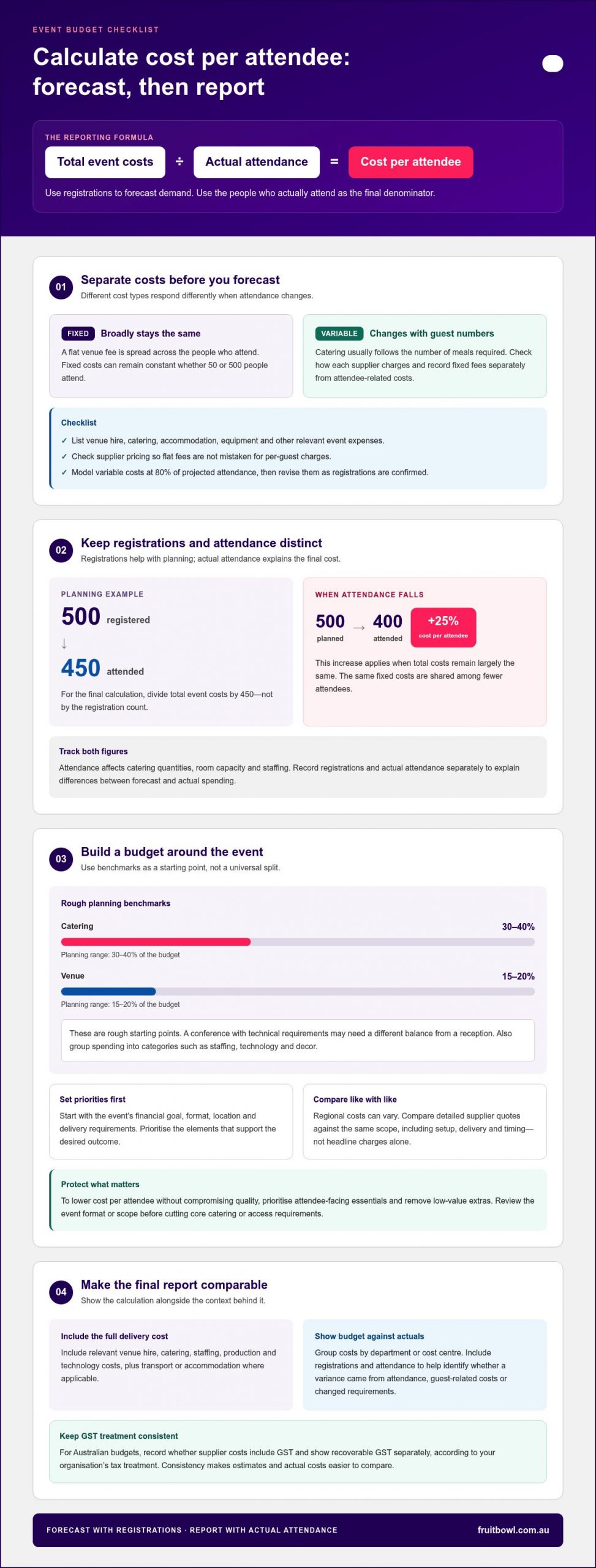
Knowing how to calculate event cost per head starts with one simple formula: divide total event costs by the number of people who actually attend. Registrations help forecast demand, but they aren’t the final attendee count. For example, if 500 people register and 450 attend, use 450 in the calculation.

A clear event budget does more than assign percentages to catering, the venue and production. Fixed costs and attendee-related costs respond differently to changes in attendance. If you base your forecast only on registrations, the final cost per attendee may differ substantially from your estimate.

This guide shows how to separate fixed and variable costs, build a practical event budget and calculate total cost per attendee. You’ll learn when to use registrations for planning, actual attendance for reporting and attendee-related costs to understand what drives the final figure. This gives you a clearer basis for decisions as the event takes shape.

Key Takeaways

  • Separate fixed expenses from guest-dependent costs to see how attendance changes affect the budget.
  • Use registrations to forecast demand, then compare them with actual attendance when reviewing event performance.
  • Allocate budget according to the event format, location and requirements rather than relying on a universal split.
  • Include all relevant event expenses in the final per-guest figure to understand the true cost of delivery.

How do you calculate cost per attendee?

Start by separating fixed event costs from expenses that rise with attendance. This makes it clear which budget lines will change if guest numbers shift.

Fixed and variable event costs

Fixed costs stay broadly constant as attendance changes; variable costs increase or decrease with guest numbers. That difference matters because a fixed venue fee is spread across attendees, while catering usually follows the number of meals required. Fixed costs can remain constant whether 50 or 500 people attend. Separate each category so you can see how attendance affects the total.

Venue, catering and per-guest charges

Venue hire may be a flat fee, while catering is often priced per guest. Check how each supplier charges, then record fixed fees separately from variable costs. Include accommodation, equipment and other relevant event expenses too. This prevents a per-person estimate from hiding costs that stay the same regardless of attendance.

Modelling costs with attendance estimates

An attendance estimate lets you forecast variable costs before registrations are final. Model those costs at 80% of projected attendance, then scale them as registrations are confirmed. For example, estimate meals against the planning figure, then revise the catering total as numbers become clearer. This approach helps expose budget pressure early without treating every cost as attendee-dependent.

Factors affecting cost per attendee

Cost per attendee reflects the total event budget, actual attendance and the balance of fixed and variable expenses. Venue choice, catering format, event duration and accommodation needs can all affect the total. To reduce the figure without compromising quality, prioritise attendee-facing essentials and remove low-value extras. Review the event format or scope before cutting core catering or access requirements.

For Australian budgets, record whether supplier costs include GST and show recoverable GST separately, according to your organisation’s tax treatment. Applying GST consistently makes estimates and actual costs easier to compare.

Actual attendance versus registrations

Use registrations to guide planning, but use actual attendance as the final denominator when reporting cost per attendee. Comparing the two figures shows how changes in attendance affect total event costs.

Attendee numbers and event requirements

Attendance numbers shape requirements such as catering quantities, room capacity and staffing. A registration list of 500 people does not mean 500 attendees will arrive. If 400 attend and total costs remain largely the same, cost per attendee rises by 25% compared with the planned figure. Track registrations and attendance separately to explain the difference between forecast and actual spending.

Break-even attendance and pricing

Break-even attendance is the number of paid attendees needed for ticket revenue to cover event costs. To calculate it, compare fixed expenses with the amount each ticket contributes after attendee-related costs. A corporate event funded through ticket sales may have a different break-even point from one funded internally. Recalculate if costs or ticket prices change to see whether the target remains achievable.

Include all costs attributable to delivering the event, not just obvious guest charges. The total may include venue hire, catering, staffing, production and technology, as well as transport or accommodation where relevant. Apply taxes consistently across budget lines so estimates and actual costs remain comparable.

Calculate the all-in cost per attendee by dividing total event costs by actual attendance. Keep variable costs, such as catering, separate from expenses that remain fixed. If attendance falls, the same fixed costs are shared among fewer people. Report the result alongside registrations and attendance, not in isolation.

For useful spending reports, group costs by department or cost centre and compare budgeted amounts with actual spending. Include attendance results in the same report. That makes it easier to identify whether a variance came from lower attendance, higher guest-related costs or a change in event requirements. For events with complex delivery needs, corporate event planning can bring budget and operational decisions into the same process.
Event Cost Per Head: How to Split Your Budget by Attendee

How do I split an event budget?

Start with the event’s financial goal, then organise the budget by cost category. The right breakdown depends on the format, location and delivery requirements.

Event goals and budget planning

Your financial goals determine what the event budget needs to achieve and which costs to prioritise. A corporate event designed to inform staff may prioritise venue access and presentation requirements, while a ticketed event must also weigh revenue against spending. Set the desired outcome first, then allocate funds to the elements that support it. This helps prevent late additions from displacing essential requirements.

Budget categories and benchmarks

Budget categories group spending into areas such as catering, venue, staffing, technology and decor. A rough planning benchmark allocates 30-40% to catering and 15-20% to the venue. Treat these as starting points, not fixed rules: a conference with technical requirements may need a different balance from a reception. Record each category separately so you can compare estimates and actual charges.

Budget limits and regional price differences

A budget limit sets the available funds; regional differences shape what those funds can cover. Venue access, supplier travel, freight and local demand can affect quotes across metropolitan, regional and remote areas. Compare detailed quotes against the same scope, including setup, delivery and timing, rather than comparing headline charges alone. Supplier charges depend on event format, location, attendance and production needs; exact amounts are set out in quotes for the specific event.

Templates, cost tracking and budget reports

A budget template provides a consistent record of estimated and actual costs, purchase owners, payment status and due dates. Update it as quotes become confirmed and costs change, rather than waiting until the final reporting minute. Share a concise report with category totals, budget variances and attendance results. Exporting that summary gives stakeholders a clear view of where funds were allocated and which decisions need attention.

Calculating total event cost per guest

To calculate the all-in figure, add the event expenses and divide the total by the relevant headcount. Include the costs required to deliver the event, not just catering or ticket-related items.

Create a cost schedule covering venue, catering, staffing, production, technology, transport and accommodation where applicable. Include supplier charges, taxes and contingency consistently so the total reflects the planned scope. Keep ticket revenue separate from expenses: it helps assess funding, but does not reduce the cost of delivering the event.

For a clear calculation, use this structure:

  • Total event cost: add planned expenses and contingency.
  • Cost per guest: divide total event cost by the expected headcount for forecasting, or actual attendance for final reporting.

For example, if your budget includes a venue, catering, staffing and production, leaving out production understates the total, even if ticket income covers that expense. A complete figure lets you compare event formats on the same basis and identify which cost categories have the greatest impact.

Contingency belongs in the calculation because event conditions can change. A predictable indoor event at a familiar venue can use a buffer of at least 10%; an outdoor event, new venue or complex trade coordination calls for a buffer closer to 15%. Include that allowance before dividing, rather than treating it as spending outside the budget.

During planning, estimate costs using expected attendance, then update the figures as registrations and supplier costs develop. At close-out, replace forecasts with actual expenses and attendance. Comparing the two shows whether a variance came from headcount, supplier charges or a change in scope. Keep assumptions visible, especially for shared costs, so someone else can reproduce the calculation.

For complex delivery, plan a corporate event with budget, production and attendee requirements considered together.

Fruitbowl Events Agency: Corporate Events

Fruitbowl Events Agency brings event budgets and delivery requirements together in one coordinated plan. Its corporate event management covers strategic planning, logistics, entertainment programming and on-site delivery, supporting decisions from early budget allocation through to event execution.

Turn to Fruitbowl Events Agency when a corporate event, conference or seminar needs coordinated planning, or when a festival, public event or government activation has complex delivery requirements. Aligning the scope, attendance expectations and operational needs early helps keep budget decisions focused on the event’s objectives.

Contact Fruitbowl Events Agency to discuss your event, or visit fruitbowl.com.au.

Make your next budget a stronger planning tool

Knowing how to calculate event cost per head gives you a useful measure, and applying it to future decisions makes it even more valuable. Use each event’s final figures to refine your assumptions, identify which cost categories need closer attention and make the next budget more responsive to your objectives.

Looking ahead helps align event scope, attendee experience and financial priorities from the start of planning. Fruitbowl Events Agency delivers Corporate Events, Festivals & Public Events, and Conferences & Seminars, coordinating planning and delivery around each event’s requirements.

If you’re preparing an event and want experienced support with its planning and delivery, contact Fruitbowl Events Agency to discuss the next step. A considered budget is a sound foundation for moving your event forward with clarity.

Frequently Asked Questions

Does a smaller guest list always lead to a lower total cost?

No. A smaller guest list can reduce attendance-linked expenses, such as meals and printed materials, but it won’t necessarily reduce fixed commitments like venue hire or production. For example, cutting invitations after confirming a room may leave the venue charge unchanged. Review supplier terms and minimum order quantities before adjusting headcount, then consider whether the revised event format still meets its objectives.

How large should the buffer be?

For a predictable indoor event at a familiar venue, allow a contingency buffer of at least 10% of the budget. A buffer closer to 15% is appropriate for outdoor events, new venues, international guests or coordination involving many trades. Match the allowance to the risks that could affect delivery, such as weather changes, equipment failure or supplier cancellation, and track its use separately from planned spending.

How do you calculate event cost per head?

To work out how to calculate event cost per head, divide total event expenditure by the number of people who attended. Include delivery expenses across the event, not just guest-facing items. For a planning estimate, use projected attendance; for the final report, use actual attendance. Keep the calculation period and tax treatment consistent when comparing events.

How do you calculate cost per head for a free event with no ticket revenue?

Divide total event costs by the actual number of attendees, even if entry is free. Ticket revenue affects how an event is funded, not the cost of delivering it. A community event funded through sponsorship or an organisational budget can still report a cost per attendee. Record funding sources separately so stakeholders can distinguish delivery costs from income and contributions.

Should event cost per head use expected attendees or actual attendance?

Use expected attendance to forecast the budget before the event, then use actual attendance for the final cost-per-head result. This distinction supports operational decisions: expected headcount informs catering and capacity planning, while the final count shows the cost of each attended place. Include both figures in the event report, alongside any scope changes, so you can use forecast accuracy to improve future planning.

How do you account for fixed and variable event costs per person?

For a per-person figure, divide fixed costs by the relevant headcount, then add variable costs for each attendee. This shows how shared commitments contribute to the cost per person. For example, allocate the venue charge across attendees, while catering costs reflect the number of meals ordered. State the headcount used and list any minimum charges separately to keep the calculation transparent.

Knowing how to calculate event cost per head starts with one simple formula: divide total event costs by the number of people who actually attend. Registrations help forecast demand, but they aren’t the final attendee count. For example, if 500 people register and 450 attend, use 450 in the calculation.

A clear event budget does more than assign percentages to catering, the venue and production. Fixed costs and attendee-related costs respond differently to changes in attendance. If you base your forecast only on registrations, the final cost per attendee may differ substantially from your estimate.

This guide shows how to separate fixed and variable costs, build a practical event budget and calculate total cost per attendee. You’ll learn when to use registrations for planning, actual attendance for reporting and attendee-related costs to understand what drives the final figure. This gives you a clearer basis for decisions as the event takes shape.

Key Takeaways

  • Separate fixed expenses from guest-dependent costs to see how attendance changes affect the budget.
  • Use registrations to forecast demand, then compare them with actual attendance when reviewing event performance.
  • Allocate budget according to the event format, location and requirements rather than relying on a universal split.
  • Include all relevant event expenses in the final per-guest figure to understand the true cost of delivery.

How do you calculate cost per attendee?

Start by separating fixed event costs from expenses that rise with attendance. This makes it clear which budget lines will change if guest numbers shift.

Fixed and variable event costs

Fixed costs stay broadly constant as attendance changes; variable costs increase or decrease with guest numbers. That difference matters because a fixed venue fee is spread across attendees, while catering usually follows the number of meals required. Fixed costs can remain constant whether 50 or 500 people attend. Separate each category so you can see how attendance affects the total.

Venue, catering and per-guest charges

Venue hire may be a flat fee, while catering is often priced per guest. Check how each supplier charges, then record fixed fees separately from variable costs. Include accommodation, equipment and other relevant event expenses too. This prevents a per-person estimate from hiding costs that stay the same regardless of attendance.

Modelling costs with attendance estimates

An attendance estimate lets you forecast variable costs before registrations are final. Model those costs at 80% of projected attendance, then scale them as registrations are confirmed. For example, estimate meals against the planning figure, then revise the catering total as numbers become clearer. This approach helps expose budget pressure early without treating every cost as attendee-dependent.

Factors affecting cost per attendee

Cost per attendee reflects the total event budget, actual attendance and the balance of fixed and variable expenses. Venue choice, catering format, event duration and accommodation needs can all affect the total. To reduce the figure without compromising quality, prioritise attendee-facing essentials and remove low-value extras. Review the event format or scope before cutting core catering or access requirements.

For Australian budgets, record whether supplier costs include GST and show recoverable GST separately, according to your organisation’s tax treatment. Applying GST consistently makes estimates and actual costs easier to compare.

Actual attendance versus registrations

Use registrations to guide planning, but use actual attendance as the final denominator when reporting cost per attendee. Comparing the two figures shows how changes in attendance affect total event costs.

Attendee numbers and event requirements

Attendance numbers shape requirements such as catering quantities, room capacity and staffing. A registration list of 500 people does not mean 500 attendees will arrive. If 400 attend and total costs remain largely the same, cost per attendee rises by 25% compared with the planned figure. Track registrations and attendance separately to explain the difference between forecast and actual spending.

Break-even attendance and pricing

Break-even attendance is the number of paid attendees needed for ticket revenue to cover event costs. To calculate it, compare fixed expenses with the amount each ticket contributes after attendee-related costs. A corporate event funded through ticket sales may have a different break-even point from one funded internally. Recalculate if costs or ticket prices change to see whether the target remains achievable.

Include all costs attributable to delivering the event, not just obvious guest charges. The total may include venue hire, catering, staffing, production and technology, as well as transport or accommodation where relevant. Apply taxes consistently across budget lines so estimates and actual costs remain comparable.

Calculate the all-in cost per attendee by dividing total event costs by actual attendance. Keep variable costs, such as catering, separate from expenses that remain fixed. If attendance falls, the same fixed costs are shared among fewer people. Report the result alongside registrations and attendance, not in isolation.

For useful spending reports, group costs by department or cost centre and compare budgeted amounts with actual spending. Include attendance results in the same report. That makes it easier to identify whether a variance came from lower attendance, higher guest-related costs or a change in event requirements. For events with complex delivery needs, corporate event planning can bring budget and operational decisions into the same process.

How do I split an event budget?

Start with the event’s financial goal, then organise the budget by cost category. The right breakdown depends on the format, location and delivery requirements.

Event goals and budget planning

Your financial goals determine what the event budget needs to achieve and which costs to prioritise. A corporate event designed to inform staff may prioritise venue access and presentation requirements, while a ticketed event must also weigh revenue against spending. Set the desired outcome first, then allocate funds to the elements that support it. This helps prevent late additions from displacing essential requirements.

Budget categories and benchmarks

Budget categories group spending into areas such as catering, venue, staffing, technology and decor. A rough planning benchmark allocates 30-40% to catering and 15-20% to the venue. Treat these as starting points, not fixed rules: a conference with technical requirements may need a different balance from a reception. Record each category separately so you can compare estimates and actual charges.

Budget limits and regional price differences

A budget limit sets the available funds; regional differences shape what those funds can cover. Venue access, supplier travel, freight and local demand can affect quotes across metropolitan, regional and remote areas. Compare detailed quotes against the same scope, including setup, delivery and timing, rather than comparing headline charges alone. Supplier charges depend on event format, location, attendance and production needs; exact amounts are set out in quotes for the specific event.

Templates, cost tracking and budget reports

A budget template provides a consistent record of estimated and actual costs, purchase owners, payment status and due dates. Update it as quotes become confirmed and costs change, rather than waiting until the final reporting minute. Share a concise report with category totals, budget variances and attendance results. Exporting that summary gives stakeholders a clear view of where funds were allocated and which decisions need attention.

Calculating total event cost per guest

To calculate the all-in figure, add the event expenses and divide the total by the relevant headcount. Include the costs required to deliver the event, not just catering or ticket-related items.

Create a cost schedule covering venue, catering, staffing, production, technology, transport and accommodation where applicable. Include supplier charges, taxes and contingency consistently so the total reflects the planned scope. Keep ticket revenue separate from expenses: it helps assess funding, but does not reduce the cost of delivering the event.

For a clear calculation, use this structure:

  • Total event cost: add planned expenses and contingency.
  • Cost per guest: divide total event cost by the expected headcount for forecasting, or actual attendance for final reporting.

For example, if your budget includes a venue, catering, staffing and production, leaving out production understates the total, even if ticket income covers that expense. A complete figure lets you compare event formats on the same basis and identify which cost categories have the greatest impact.

Contingency belongs in the calculation because event conditions can change. A predictable indoor event at a familiar venue can use a buffer of at least 10%; an outdoor event, new venue or complex trade coordination calls for a buffer closer to 15%. Include that allowance before dividing, rather than treating it as spending outside the budget.

During planning, estimate costs using expected attendance, then update the figures as registrations and supplier costs develop. At close-out, replace forecasts with actual expenses and attendance. Comparing the two shows whether a variance came from headcount, supplier charges or a change in scope. Keep assumptions visible, especially for shared costs, so someone else can reproduce the calculation.

For complex delivery, plan a corporate event with budget, production and attendee requirements considered together.

Fruitbowl Events Agency: Corporate Events

Fruitbowl Events Agency brings event budgets and delivery requirements together in one coordinated plan. Its corporate event management covers strategic planning, logistics, entertainment programming and on-site delivery, supporting decisions from early budget allocation through to event execution.

Turn to Fruitbowl Events Agency when a corporate event, conference or seminar needs coordinated planning, or when a festival, public event or government activation has complex delivery requirements. Aligning the scope, attendance expectations and operational needs early helps keep budget decisions focused on the event’s objectives.

Contact Fruitbowl Events Agency to discuss your event, or visit fruitbowl.com.au.

Make your next budget a stronger planning tool

Knowing how to calculate event cost per head gives you a useful measure, and applying it to future decisions makes it even more valuable. Use each event’s final figures to refine your assumptions, identify which cost categories need closer attention and make the next budget more responsive to your objectives.

Looking ahead helps align event scope, attendee experience and financial priorities from the start of planning. Fruitbowl Events Agency delivers Corporate Events, Festivals & Public Events, and Conferences & Seminars, coordinating planning and delivery around each event’s requirements.

If you’re preparing an event and want experienced support with its planning and delivery, contact Fruitbowl Events Agency to discuss the next step. A considered budget is a sound foundation for moving your event forward with clarity.

Frequently Asked Questions

Does a smaller guest list always lead to a lower total cost?

No. A smaller guest list can reduce attendance-linked expenses, such as meals and printed materials, but it won’t necessarily reduce fixed commitments like venue hire or production. For example, cutting invitations after confirming a room may leave the venue charge unchanged. Review supplier terms and minimum order quantities before adjusting headcount, then consider whether the revised event format still meets its objectives.

How large should the buffer be?

For a predictable indoor event at a familiar venue, allow a contingency buffer of at least 10% of the budget. A buffer closer to 15% is appropriate for outdoor events, new venues, international guests or coordination involving many trades. Match the allowance to the risks that could affect delivery, such as weather changes, equipment failure or supplier cancellation, and track its use separately from planned spending.

How do you calculate event cost per head?

To work out how to calculate event cost per head, divide total event expenditure by the number of people who attended. Include delivery expenses across the event, not just guest-facing items. For a planning estimate, use projected attendance; for the final report, use actual attendance. Keep the calculation period and tax treatment consistent when comparing events.

How do you calculate cost per head for a free event with no ticket revenue?

Divide total event costs by the actual number of attendees, even if entry is free. Ticket revenue affects how an event is funded, not the cost of delivering it. A community event funded through sponsorship or an organisational budget can still report a cost per attendee. Record funding sources separately so stakeholders can distinguish delivery costs from income and contributions.

Should event cost per head use expected attendees or actual attendance?

Use expected attendance to forecast the budget before the event, then use actual attendance for the final cost-per-head result. This distinction supports operational decisions: expected headcount informs catering and capacity planning, while the final count shows the cost of each attended place. Include both figures in the event report, alongside any scope changes, so you can use forecast accuracy to improve future planning.

How do you account for fixed and variable event costs per person?

For a per-person figure, divide fixed costs by the relevant headcount, then add variable costs for each attendee. This shows how shared commitments contribute to the cost per person. For example, allocate the venue charge across attendees, while catering costs reflect the number of meals ordered. State the headcount used and list any minimum charges separately to keep the calculation transparent.

Back to Articles
Request A Quote

Make an
Enquiry

Untitled design

What Makes Us Different?

True end-to-end solution so you can hand off to us, focus on your priorities and enjoy the event without any stress

Unmatched industry expertise looking after diverse range of high-profile events, cultural festivals & activations

Meticulous attention to every detail and precise execution of events with our streamlined processes

Tailored solutions with bespoke strategies to ensure we align with your brand and objectives

Make an Enquiry

  • This field is for validation purposes and should be left unchanged.
  • This field is for validation purposes and should be left unchanged.