If your event proposal reads like a creative wish list rather than a strategic investment, it’s likely destined for the “no” pile before the first slide is finished. Securing approval for a high-stakes corporate conference or government activation requires more than a vision; it demands a robust event business case template that speaks the language of the boardroom. You’ve likely felt the pressure of strict budgetary constraints or the difficulty of quantifying the intangible benefits that make an event truly special. It’s a common challenge to align departmental expectations when the technical requirements are complex and the risks are real.
We’ll show you how to master the art of event justification by using a professional framework that prioritises logistical precision and strategic oversight. This approach ensures your creative ambition is backed by measurable commercial outcomes. You will learn to build a document that secures funding, aligns with your brand’s core objectives, and provides a clear roadmap for risk management. By the end of this article, you’ll have the tools to present your vision as a strategic necessity, ensuring every stakeholder feels the project is in a safe pair of hands.
Key Takeaways
- Learn why a robust event business case template is the foundation for securing funding for high-stakes corporate and government projects.
- Master the art of the executive summary to capture the attention of busy decision-makers while defining a precise project scope.
- Develop a comprehensive financial model that prioritises measurable commercial outcomes and quantifies intangible benefits like brand sentiment.
- Identify key stakeholders and tailor your register to meet the distinct expectations of finance, marketing, and operations departments.
- Bridge the gap between strategic planning and on-site delivery by aligning your business case with a proven end-to-end management methodology.
Table of Contents
- The Strategic Role of an Event Business Case in 2026
- Core Components of a Professional Event Business Case Template
- Beyond the Budget: Quantifying ROI and Strategic Alignment
- Navigating Stakeholder Approval: Presenting Your Case with Confidence
- Partnering for Execution: From Business Case to Seamless Delivery
The Strategic Role of an Event Business Case in 2026
In 2026, a high-quality event business case template serves as a strategic roadmap for investment rather than a mere administrative requirement. High-stakes corporate events and government activations demand a level of rigour that goes beyond basic logistics. We’ve moved from simple event planning to strategic experience design, where every component must justify its contribution to the commercial or social bottom line. Establishing a “safe pair of hands” mindset from the very first page reassures decision-makers that their vision is backed by disciplined execution and seasoned expertise.
Aligning Event Vision with Organisational Objectives
A successful proposal maps specific event outcomes directly to broader corporate or government KPIs. Whether it’s a multi-day conference or a complex brand activation, the event must function as a catalyst for brand evolution or policy objectives. Developing a formal business case ensures that these links are explicit and measurable across every department. Strategic alignment in an Australian corporate context requires a direct, transparent link between proposed event expenditure and the long-term sustainable growth or social impact objectives of the organisation. This clarity allows stakeholders to see the event as a necessary investment rather than a discretionary cost, providing the reassurance that resources are being deployed with maximum efficiency.
The Consequences of a Weak Business Justification
A weak justification often stems from vague goals and underestimated technical requirements, which can quickly erode stakeholder confidence. When technical precision isn’t established during the proposal phase, project budgets often spiral and delivery dates slip. Using a structured event business case template prevents these issues by forcing a detailed analysis of risks and resource requirements from the outset. This lack of foresight doesn’t just impact the current project; it damages your reputation and jeopardises future funding for critical activations. By demonstrating a comprehensive understanding of the technical landscape early on, you reinforce the “safe pair of hands” reputation that is essential for managing high-stakes environments. Common risks of a poorly articulated case include:
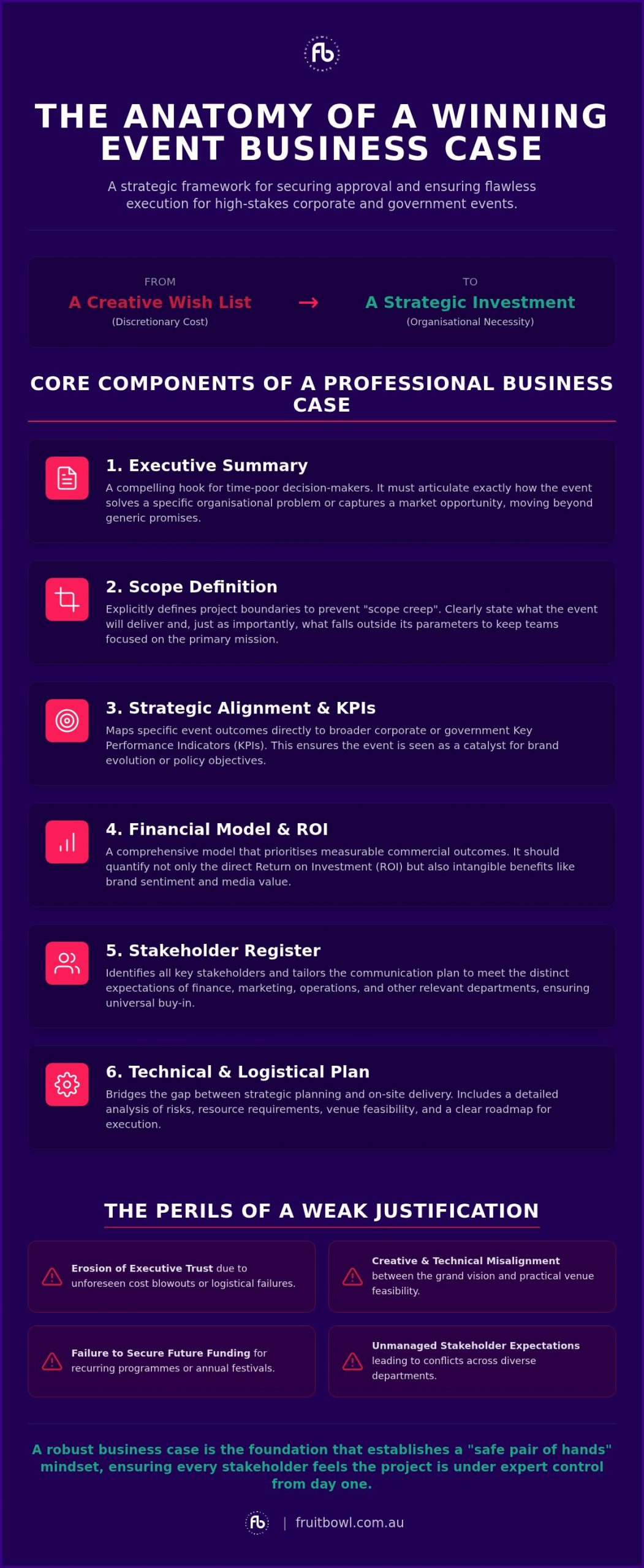
- Erosion of executive trust due to unforeseen cost blowouts or logistical failures.
- Misalignment between the creative vision and the practical technical feasibility of the venue.
- Failure to secure multi-year funding for recurring programmes or annual festivals.
- Difficulty in managing complex stakeholder expectations across diverse departments.
By prioritising clarity and precision from the beginning, you ensure that every stakeholder understands the value of the investment. This structured approach transforms a simple proposal into a robust strategic document that stands up to intense scrutiny.
Core Components of a Professional Event Business Case Template
A professional event business case template requires a foundation of clarity and precision. It begins with an Executive Summary that acts as a compelling hook for time-poor decision-makers. Instead of generic promises, this section must articulate exactly how the activation will solve a specific organisational problem or capture a market opportunity. Defining the scope is equally critical; you must be explicit about what the event will deliver and, just as importantly, what falls outside the project’s boundaries. This prevents “scope creep” and ensures that the technical and creative teams remain focused on the primary mission from the outset.
The Logical Framework: Structure and Flow
A persuasive document follows a methodical progression that mirrors a successful project timeline. By organising sections with maximum clarity, you guide the reader from the high-level strategic “why” to the granular operational “how”. Using parallel phrasing helps describe multifaceted logistical processes, such as securing the venue, managing the talent, and executing the technical build. This symmetry reinforces a sense of thoroughness. It ensures that the transition between the creative vision and the logistical reality feels seamless and controlled. When you present a structured argument, you demonstrate that the project is under expert supervision from its inception.
Technical and Logistical Oversight
In 2026, technical infrastructure is no longer a secondary consideration; it’s a strategic asset. A robust business case must detail the av management for events requirements early to avoid costly revisions later. Staging, lighting, and sound are the vehicles through which your creative theme is delivered. Integrating these elements into the proposal phase allows for a more accurate assessment of measuring event ROI, as technical failures often represent the greatest risk to brand reputation. By accounting for these requirements, you ensure the technical vision is perfectly aligned with the strategic objectives of the event.
Sourcing and coordinating high-impact speakers or performers requires a disciplined approach to talent procurement. Your business case should outline how these choices directly support the event’s goals, whether that’s driving policy change or increasing employee engagement. Managing these moving parts requires a partner who understands the nuances of high-stakes environments. If you’re looking for a team that brings order to this complexity, our specialist event strategists can help you refine your event business case template. This level of meticulous planning ensures your event isn’t just an occurrence, but a measurable commercial success that supports long-term programmes.
Beyond the Budget: Quantifying ROI and Strategic Alignment
Decision-makers in 2026 require more than a balanced spreadsheet to sign off on significant expenditure. They seek a strategic justification that proves an event will deliver a measurable return on investment over the long term. A professional event business case template must bridge the gap between hard costs and the “soft” value of brand equity and stakeholder influence. It’s about demonstrating that the capital allocation isn’t just a cost, but a calculated investment in your organisation’s future market position. By developing a comprehensive financial model that accounts for variables like audience acquisition and post-event lead conversion, you provide the clarity needed to secure executive buy-in.
Data and analytics play a pivotal role in modern reporting, allowing us to track real-time sentiment and engagement during the activation itself. This level of technical oversight allows you to address the most common objection: whether the event is a justifiable use of capital. Instead of relying on anecdotal success, you can present hard data that shows how the event moves the needle on key organisational objectives. This disciplined approach ensures that every dollar spent is aligned with the broader strategic vision of the brand or government department.
Measuring ROI in Corporate and Brand Activations
Quantifying the success of a corporate event goes well beyond ticket sales or attendance numbers. We focus on long-term brand equity and the depth of market engagement. Effective brand activation event planning drives measurable shifts in perception that persist long after the final pack-down. By establishing a feedback loop for continuous reporting, you create a narrative of ongoing value that justifies the initial investment. This methodical process ensures that the event serves as a catalyst for growth, providing a clear roadmap for future activations and multi-year programmes.
Risk Management and Mitigation Strategies
For public festivals and government activations, risk management is a non-negotiable pillar of the event business case template. Nervous stakeholders need to see that you’ve anticipated every potential technical failure or logistical hurdle with a robust contingency plan. Conducting a thorough risk assessment doesn’t just protect the budget; it protects the organisation’s reputation in a high-stakes environment. Implementing a rigorous risk mitigation framework directly correlates to increased project confidence and ensures that stakeholders feel the mission is in a safe pair of hands. This level of meticulous planning brings order and clarity to even the most complex project timelines, ensuring every detail is under expert supervision.
Navigating Stakeholder Approval: Presenting Your Case with Confidence
Securing approval for a high-stakes activation is as much about your personal composure as it is the technical rigour of your event business case template. You must first identify who holds the power and understand what specifically drives their decision-making process. Finance directors prioritise fiscal responsibility and risk mitigation, while marketing executives seek brand elevation and audience engagement. Operations managers, conversely, focus on technical feasibility and logistical precision. Tailoring your message to these distinct registers ensures that your proposal resonates across every department.
The art of the presentation lies in balancing a bold creative vision with a composed, authoritative delivery. You aren’t just selling an event; you’re selling the assurance that the project will be executed without friction. Handling objections with industry-literate expertise is vital. When a stakeholder questions a technical requirement or a budget line item, your response should be grounded in data and seasoned experience. This level of reassurance transforms a potentially adversarial review into a collaborative strategic session.
The “Safe Pair of Hands” Approach
Projecting seasoned expertise during the approval meeting is essential for building trust. We recommend using specific case studies and past performance data to serve as proof of delivery. This isn’t the time for hyperbolic excitement; it’s the time for a professional, grounded style that establishes order and clarity. By referencing our 28 years of industry experience, you can demonstrate a history of navigating complex challenges successfully. If you need assistance refining your pitch, our expert event strategists can provide the seasoned perspective required to navigate complex stakeholder environments and ensure your vision is seen as a secure investment.
Post-Presentation: Managing the Next Steps
The work doesn’t end when you leave the boardroom. Managing the next steps with the same methodical rhythm established in the business case is crucial for maintaining momentum. You should address any follow-up questions with precise, data-backed answers within a predictable timeframe. This responsiveness reinforces the image of a disciplined technician who is in control of the narrative. Once you’ve secured formal sign-off, the transition to the planning phase should be seamless, ensuring that the foundational concepts of the event business case template are integrated into the daily project management workflow. This steady, predictable pulse ensures that every detail remains under expert supervision from approval to on-site delivery.
Partnering for Execution: From Business Case to Seamless Delivery
The most sophisticated event business case template remains a theoretical exercise until it is placed in the hands of a disciplined execution team. Strategic planning provides the foundation, but the transition to on-site delivery is where the true value of your investment is realised. For high-stakes corporate and government activations, the gap between a proposal and a successful outcome is bridged by technical precision and logistical oversight. When you partner with an agency that understands the nuances of complex production, you ensure that the strategic goals defined in your business case are met with clinical accuracy.
Strategic alignment doesn’t end once the budget is approved. It requires a continuous thread of management that connects the initial vision to the final guest experience. By integrating strategic planning with on-site technical direction, we ensure that every decision made during the build reflects the commercial or policy objectives established at the outset. This disciplined approach prevents the dilution of your message and ensures that the event delivers on its strategic promise.
The Value of Expert Strategic Oversight
Professional corporate event management offers more than just extra hands; it provides a layer of expert strategic oversight that reduces the burden on your internal teams. We ensure every detail is under expert supervision throughout the project lifecycle, from the initial talent procurement to the final technical pack-down. This end-to-end methodology allows for the seamless integration of logistics, talent, and production. By maintaining a single point of accountability, we provide the order and clarity necessary to navigate high-pressure environments. Our approach leverages 28 years of industry experience to anticipate challenges before they impact your timeline or budget.
Transitioning to the Delivery Phase
The shift from approval to execution requires a methodical rhythm to ensure the final event reflects the promises made to your stakeholders. Working with a conference management specialist is essential for complex programmes that involve multiple sessions, international talent, and intricate technical builds. This specialist oversight ensures that the technical direction remains aligned with the creative theme established in your initial event business case template. It is this commitment to consistency that preserves your reputation and secures the long-term ROI discussed in previous sections. To ensure your vision is executed with absolute precision, engage Fruitbowl Events for your next high-impact activation. We provide the security and seasoned expertise required to bring your most ambitious complex visions to life.
Securing Your Vision with Strategic Precision
Transforming an ambitious concept into an approved project requires a disciplined approach to documentation and presentation. By utilising a robust event business case template, you ensure that every creative decision is backed by commercial logic and technical feasibility. This methodical preparation allows you to navigate stakeholder scrutiny with confidence, positioning your activation as a strategic necessity rather than a discretionary expense. The transition from a formal approval to a flawless delivery is the final step in proving the value of your strategic foresight.
With over 28 years of strategic event experience, our team provides the end-to-end logistics and production expertise required to bring complex visions to life. We have a proven track record within the government and corporate sectors, acting as a safe pair of hands for high-stakes environments. Partner with Fruitbowl Events for Authoritative Event Delivery and ensure your next project is managed with the meticulous care it deserves. Your vision deserves a framework that guarantees its success.
Frequently Asked Questions
What are the essential sections of an event business case?
The essential sections of an event business case template include a high-level executive summary, a detailed statement of strategic alignment, and a clearly defined project scope. You must also include a comprehensive financial model, a risk mitigation framework, and a summary of technical requirements. These components provide decision-makers with the order and clarity required to assess the investment’s feasibility and its potential to deliver measurable commercial or policy outcomes.
How do I calculate the ROI of a corporate event?
Calculating the ROI of a corporate event requires a dual focus on hard financial data and intangible brand metrics. You should subtract the total cost of investment from the total value generated, including direct revenue, lead acquisition value, and long-term brand equity gains. Using data-driven reporting allows you to quantify shifts in audience sentiment or employee engagement, ensuring the event is viewed as a strategic asset rather than a discretionary expense.
Can I use a business case template for a government activation?
You can certainly use a professional business case framework for a government activation, provided you shift the focus from commercial profit to policy objectives and community impact. The document must demonstrate how the activation supports specific government KPIs and adheres to 2026 compliance standards. This approach provides the reassurance that public funds are being managed with logistical precision and absolute transparency, which is critical for securing departmental sign-off.
How much detail should I include regarding technical production?
You should include enough technical detail to prove the project’s feasibility and ensure budget accuracy. While you don’t need a full technical rider at this stage, outlining requirements for AV management, staging, and lighting is essential for risk mitigation. This level of detail demonstrates that you’ve considered the infrastructure necessary to support the creative vision, reinforcing your position as a safe pair of hands for complex, high-stakes productions.
What is the difference between an event business case and an event plan?
The primary difference lies in their purpose; a business case justifies why the investment should be made, while an event plan details how it will be executed. The business case focuses on strategic alignment and financial viability to secure approval from stakeholders. In contrast, the event plan is a granular operational document used by the production team once funding is granted. Both documents are essential for maintaining a methodical rhythm throughout the project.
How do I address potential risks in the business case without scaring off stakeholders?
Address potential risks by framing them alongside robust mitigation strategies rather than as insurmountable obstacles. Stakeholders are reassured when they see a comprehensive contingency plan that accounts for technical failures or logistical delays. By demonstrating that you have identified and managed these variables, you project a sense of security and expert supervision. This transparency actually builds trust, showing you have the seasoned expertise to handle high-stakes environments with composure.
Should I include talent and entertainment options in the initial business case?
Including talent and entertainment options in your event business case template is beneficial if you link them directly to your strategic goals. You should explain how a specific speaker or performer will drive audience engagement or support the event’s core message. This ensures that entertainment is viewed as a strategic tool for brand activation rather than an unnecessary flourish, helping to justify the associated costs during the initial approval phase.
If your event proposal reads like a creative wish list rather than a strategic investment, it’s likely destined for the “no” pile before the first slide is finished. Securing approval for a high-stakes corporate conference or government activation requires more than a vision; it demands a robust event business case template that speaks the language of the boardroom. You’ve likely felt the pressure of strict budgetary constraints or the difficulty of quantifying the intangible benefits that make an event truly special. It’s a common challenge to align departmental expectations when the technical requirements are complex and the risks are real.
We’ll show you how to master the art of event justification by using a professional framework that prioritises logistical precision and strategic oversight. This approach ensures your creative ambition is backed by measurable commercial outcomes. You will learn to build a document that secures funding, aligns with your brand’s core objectives, and provides a clear roadmap for risk management. By the end of this article, you’ll have the tools to present your vision as a strategic necessity, ensuring every stakeholder feels the project is in a safe pair of hands.
Key Takeaways
- Learn why a robust event business case template is the foundation for securing funding for high-stakes corporate and government projects.
- Master the art of the executive summary to capture the attention of busy decision-makers while defining a precise project scope.
- Develop a comprehensive financial model that prioritises measurable commercial outcomes and quantifies intangible benefits like brand sentiment.
- Identify key stakeholders and tailor your register to meet the distinct expectations of finance, marketing, and operations departments.
- Bridge the gap between strategic planning and on-site delivery by aligning your business case with a proven end-to-end management methodology.
Table of Contents
- The Strategic Role of an Event Business Case in 2026
- Core Components of a Professional Event Business Case Template
- Beyond the Budget: Quantifying ROI and Strategic Alignment
- Navigating Stakeholder Approval: Presenting Your Case with Confidence
- Partnering for Execution: From Business Case to Seamless Delivery
The Strategic Role of an Event Business Case in 2026
In 2026, a high-quality event business case template serves as a strategic roadmap for investment rather than a mere administrative requirement. High-stakes corporate events and government activations demand a level of rigour that goes beyond basic logistics. We’ve moved from simple event planning to strategic experience design, where every component must justify its contribution to the commercial or social bottom line. Establishing a “safe pair of hands” mindset from the very first page reassures decision-makers that their vision is backed by disciplined execution and seasoned expertise.
Aligning Event Vision with Organisational Objectives
A successful proposal maps specific event outcomes directly to broader corporate or government KPIs. Whether it’s a multi-day conference or a complex brand activation, the event must function as a catalyst for brand evolution or policy objectives. Developing a formal business case ensures that these links are explicit and measurable across every department. Strategic alignment in an Australian corporate context requires a direct, transparent link between proposed event expenditure and the long-term sustainable growth or social impact objectives of the organisation. This clarity allows stakeholders to see the event as a necessary investment rather than a discretionary cost, providing the reassurance that resources are being deployed with maximum efficiency.
The Consequences of a Weak Business Justification
A weak justification often stems from vague goals and underestimated technical requirements, which can quickly erode stakeholder confidence. When technical precision isn’t established during the proposal phase, project budgets often spiral and delivery dates slip. Using a structured event business case template prevents these issues by forcing a detailed analysis of risks and resource requirements from the outset. This lack of foresight doesn’t just impact the current project; it damages your reputation and jeopardises future funding for critical activations. By demonstrating a comprehensive understanding of the technical landscape early on, you reinforce the “safe pair of hands” reputation that is essential for managing high-stakes environments. Common risks of a poorly articulated case include:
- Erosion of executive trust due to unforeseen cost blowouts or logistical failures.
- Misalignment between the creative vision and the practical technical feasibility of the venue.
- Failure to secure multi-year funding for recurring programmes or annual festivals.
- Difficulty in managing complex stakeholder expectations across diverse departments.
By prioritising clarity and precision from the beginning, you ensure that every stakeholder understands the value of the investment. This structured approach transforms a simple proposal into a robust strategic document that stands up to intense scrutiny.
Core Components of a Professional Event Business Case Template
A professional event business case template requires a foundation of clarity and precision. It begins with an Executive Summary that acts as a compelling hook for time-poor decision-makers. Instead of generic promises, this section must articulate exactly how the activation will solve a specific organisational problem or capture a market opportunity. Defining the scope is equally critical; you must be explicit about what the event will deliver and, just as importantly, what falls outside the project’s boundaries. This prevents “scope creep” and ensures that the technical and creative teams remain focused on the primary mission from the outset.
The Logical Framework: Structure and Flow
A persuasive document follows a methodical progression that mirrors a successful project timeline. By organising sections with maximum clarity, you guide the reader from the high-level strategic “why” to the granular operational “how”. Using parallel phrasing helps describe multifaceted logistical processes, such as securing the venue, managing the talent, and executing the technical build. This symmetry reinforces a sense of thoroughness. It ensures that the transition between the creative vision and the logistical reality feels seamless and controlled. When you present a structured argument, you demonstrate that the project is under expert supervision from its inception.
Technical and Logistical Oversight
In 2026, technical infrastructure is no longer a secondary consideration; it’s a strategic asset. A robust business case must detail the av management for events requirements early to avoid costly revisions later. Staging, lighting, and sound are the vehicles through which your creative theme is delivered. Integrating these elements into the proposal phase allows for a more accurate assessment of measuring event ROI, as technical failures often represent the greatest risk to brand reputation. By accounting for these requirements, you ensure the technical vision is perfectly aligned with the strategic objectives of the event.
Sourcing and coordinating high-impact speakers or performers requires a disciplined approach to talent procurement. Your business case should outline how these choices directly support the event’s goals, whether that’s driving policy change or increasing employee engagement. Managing these moving parts requires a partner who understands the nuances of high-stakes environments. If you’re looking for a team that brings order to this complexity, our specialist event strategists can help you refine your event business case template. This level of meticulous planning ensures your event isn’t just an occurrence, but a measurable commercial success that supports long-term programmes.
Beyond the Budget: Quantifying ROI and Strategic Alignment
Decision-makers in 2026 require more than a balanced spreadsheet to sign off on significant expenditure. They seek a strategic justification that proves an event will deliver a measurable return on investment over the long term. A professional event business case template must bridge the gap between hard costs and the “soft” value of brand equity and stakeholder influence. It’s about demonstrating that the capital allocation isn’t just a cost, but a calculated investment in your organisation’s future market position. By developing a comprehensive financial model that accounts for variables like audience acquisition and post-event lead conversion, you provide the clarity needed to secure executive buy-in.
Data and analytics play a pivotal role in modern reporting, allowing us to track real-time sentiment and engagement during the activation itself. This level of technical oversight allows you to address the most common objection: whether the event is a justifiable use of capital. Instead of relying on anecdotal success, you can present hard data that shows how the event moves the needle on key organisational objectives. This disciplined approach ensures that every dollar spent is aligned with the broader strategic vision of the brand or government department.
Measuring ROI in Corporate and Brand Activations
Quantifying the success of a corporate event goes well beyond ticket sales or attendance numbers. We focus on long-term brand equity and the depth of market engagement. Effective brand activation event planning drives measurable shifts in perception that persist long after the final pack-down. By establishing a feedback loop for continuous reporting, you create a narrative of ongoing value that justifies the initial investment. This methodical process ensures that the event serves as a catalyst for growth, providing a clear roadmap for future activations and multi-year programmes.
Risk Management and Mitigation Strategies
For public festivals and government activations, risk management is a non-negotiable pillar of the event business case template. Nervous stakeholders need to see that you’ve anticipated every potential technical failure or logistical hurdle with a robust contingency plan. Conducting a thorough risk assessment doesn’t just protect the budget; it protects the organisation’s reputation in a high-stakes environment. Implementing a rigorous risk mitigation framework directly correlates to increased project confidence and ensures that stakeholders feel the mission is in a safe pair of hands. This level of meticulous planning brings order and clarity to even the most complex project timelines, ensuring every detail is under expert supervision.
Navigating Stakeholder Approval: Presenting Your Case with Confidence
Securing approval for a high-stakes activation is as much about your personal composure as it is the technical rigour of your event business case template. You must first identify who holds the power and understand what specifically drives their decision-making process. Finance directors prioritise fiscal responsibility and risk mitigation, while marketing executives seek brand elevation and audience engagement. Operations managers, conversely, focus on technical feasibility and logistical precision. Tailoring your message to these distinct registers ensures that your proposal resonates across every department.
The art of the presentation lies in balancing a bold creative vision with a composed, authoritative delivery. You aren’t just selling an event; you’re selling the assurance that the project will be executed without friction. Handling objections with industry-literate expertise is vital. When a stakeholder questions a technical requirement or a budget line item, your response should be grounded in data and seasoned experience. This level of reassurance transforms a potentially adversarial review into a collaborative strategic session.
The “Safe Pair of Hands” Approach
Projecting seasoned expertise during the approval meeting is essential for building trust. We recommend using specific case studies and past performance data to serve as proof of delivery. This isn’t the time for hyperbolic excitement; it’s the time for a professional, grounded style that establishes order and clarity. By referencing our 28 years of industry experience, you can demonstrate a history of navigating complex challenges successfully. If you need assistance refining your pitch, our expert event strategists can provide the seasoned perspective required to navigate complex stakeholder environments and ensure your vision is seen as a secure investment.
Post-Presentation: Managing the Next Steps
The work doesn’t end when you leave the boardroom. Managing the next steps with the same methodical rhythm established in the business case is crucial for maintaining momentum. You should address any follow-up questions with precise, data-backed answers within a predictable timeframe. This responsiveness reinforces the image of a disciplined technician who is in control of the narrative. Once you’ve secured formal sign-off, the transition to the planning phase should be seamless, ensuring that the foundational concepts of the event business case template are integrated into the daily project management workflow. This steady, predictable pulse ensures that every detail remains under expert supervision from approval to on-site delivery.
Partnering for Execution: From Business Case to Seamless Delivery
The most sophisticated event business case template remains a theoretical exercise until it is placed in the hands of a disciplined execution team. Strategic planning provides the foundation, but the transition to on-site delivery is where the true value of your investment is realised. For high-stakes corporate and government activations, the gap between a proposal and a successful outcome is bridged by technical precision and logistical oversight. When you partner with an agency that understands the nuances of complex production, you ensure that the strategic goals defined in your business case are met with clinical accuracy.
Strategic alignment doesn’t end once the budget is approved. It requires a continuous thread of management that connects the initial vision to the final guest experience. By integrating strategic planning with on-site technical direction, we ensure that every decision made during the build reflects the commercial or policy objectives established at the outset. This disciplined approach prevents the dilution of your message and ensures that the event delivers on its strategic promise.
The Value of Expert Strategic Oversight
Professional corporate event management offers more than just extra hands; it provides a layer of expert strategic oversight that reduces the burden on your internal teams. We ensure every detail is under expert supervision throughout the project lifecycle, from the initial talent procurement to the final technical pack-down. This end-to-end methodology allows for the seamless integration of logistics, talent, and production. By maintaining a single point of accountability, we provide the order and clarity necessary to navigate high-pressure environments. Our approach leverages 28 years of industry experience to anticipate challenges before they impact your timeline or budget.
Transitioning to the Delivery Phase
The shift from approval to execution requires a methodical rhythm to ensure the final event reflects the promises made to your stakeholders. Working with a conference management specialist is essential for complex programmes that involve multiple sessions, international talent, and intricate technical builds. This specialist oversight ensures that the technical direction remains aligned with the creative theme established in your initial event business case template. It is this commitment to consistency that preserves your reputation and secures the long-term ROI discussed in previous sections. To ensure your vision is executed with absolute precision, engage Fruitbowl Events for your next high-impact activation. We provide the security and seasoned expertise required to bring your most ambitious complex visions to life.
Securing Your Vision with Strategic Precision
Transforming an ambitious concept into an approved project requires a disciplined approach to documentation and presentation. By utilising a robust event business case template, you ensure that every creative decision is backed by commercial logic and technical feasibility. This methodical preparation allows you to navigate stakeholder scrutiny with confidence, positioning your activation as a strategic necessity rather than a discretionary expense. The transition from a formal approval to a flawless delivery is the final step in proving the value of your strategic foresight.
With over 28 years of strategic event experience, our team provides the end-to-end logistics and production expertise required to bring complex visions to life. We have a proven track record within the government and corporate sectors, acting as a safe pair of hands for high-stakes environments. Partner with Fruitbowl Events for Authoritative Event Delivery and ensure your next project is managed with the meticulous care it deserves. Your vision deserves a framework that guarantees its success.
Frequently Asked Questions
What are the essential sections of an event business case?
The essential sections of an event business case template include a high-level executive summary, a detailed statement of strategic alignment, and a clearly defined project scope. You must also include a comprehensive financial model, a risk mitigation framework, and a summary of technical requirements. These components provide decision-makers with the order and clarity required to assess the investment’s feasibility and its potential to deliver measurable commercial or policy outcomes.
How do I calculate the ROI of a corporate event?
Calculating the ROI of a corporate event requires a dual focus on hard financial data and intangible brand metrics. You should subtract the total cost of investment from the total value generated, including direct revenue, lead acquisition value, and long-term brand equity gains. Using data-driven reporting allows you to quantify shifts in audience sentiment or employee engagement, ensuring the event is viewed as a strategic asset rather than a discretionary expense.
Can I use a business case template for a government activation?
You can certainly use a professional business case framework for a government activation, provided you shift the focus from commercial profit to policy objectives and community impact. The document must demonstrate how the activation supports specific government KPIs and adheres to 2026 compliance standards. This approach provides the reassurance that public funds are being managed with logistical precision and absolute transparency, which is critical for securing departmental sign-off.
How much detail should I include regarding technical production?
You should include enough technical detail to prove the project’s feasibility and ensure budget accuracy. While you don’t need a full technical rider at this stage, outlining requirements for AV management, staging, and lighting is essential for risk mitigation. This level of detail demonstrates that you’ve considered the infrastructure necessary to support the creative vision, reinforcing your position as a safe pair of hands for complex, high-stakes productions.
What is the difference between an event business case and an event plan?
The primary difference lies in their purpose; a business case justifies why the investment should be made, while an event plan details how it will be executed. The business case focuses on strategic alignment and financial viability to secure approval from stakeholders. In contrast, the event plan is a granular operational document used by the production team once funding is granted. Both documents are essential for maintaining a methodical rhythm throughout the project.
How do I address potential risks in the business case without scaring off stakeholders?
Address potential risks by framing them alongside robust mitigation strategies rather than as insurmountable obstacles. Stakeholders are reassured when they see a comprehensive contingency plan that accounts for technical failures or logistical delays. By demonstrating that you have identified and managed these variables, you project a sense of security and expert supervision. This transparency actually builds trust, showing you have the seasoned expertise to handle high-stakes environments with composure.
Should I include talent and entertainment options in the initial business case?
Including talent and entertainment options in your event business case template is beneficial if you link them directly to your strategic goals. You should explain how a specific speaker or performer will drive audience engagement or support the event’s core message. This ensures that entertainment is viewed as a strategic tool for brand activation rather than an unnecessary flourish, helping to justify the associated costs during the initial approval phase.
OUR BLOG
Event Insights & Expertise
Our blog is your go-to resource for all things events. From expert insights and the latest industry trends to practical planning tips, we share everything you need to deliver standout experiences.
Contact Us