End-to-end event management solutions work best when every decision supports the same event objectives. Bringing planning, production, marketing and on-site delivery together requires clear responsibilities, agreed decision-making and reliable handovers between workstreams.
Gaps between suppliers and uncertainty about what your internal team should own can complicate delivery. The right level of support depends on your goals, event format and operational requirements, not a one-size-fits-all package. This guide explains how an integrated approach connects planning, coordination, promotion, production, safety and delivery, and how to scope complete or partial support around your needs.
You’ll also learn how to align an event partner’s capabilities with your requirements and decide where internal ownership makes sense. Fruitbowl brings 28+ years of event delivery experience to projects for organisations across Australia, helping connect complex requirements with a clear plan.
Key Takeaways
- Identify where planning, production, promotion and on-site delivery need to connect to reduce coordination gaps.
- See how end-to-end event management solutions can link objectives, delivery and post-event review without requiring the same workflow for every event.
- Compare complete management, partial support and internally led delivery to determine where your team needs oversight.
- Use a practical scoping sequence to align event goals, audience needs, format, stakeholders and measures of success.
- Explore how Fruitbowl tailors complete or partial event management to corporate, public, government and brand event requirements across Australia.
What do end-to-end event management solutions cover?
Planning, promotion, production and on-site delivery can involve different people, suppliers and decisions. Without clear connections between them, details can be missed or teams can work towards competing priorities. End-to-end event management solutions bring relevant stages and workstreams into a coordinated scope, with responsibilities shaped around the event rather than assumed to follow one standard template.
End-to-end event management is coordinated support across agreed event stages. In practice, that support can connect strategic planning, event coordination, production and on-site delivery. Start by agreeing the event’s purpose, audience and requirements. Then carry decisions through each workstream so practical choices continue to support the objectives they are meant to serve.
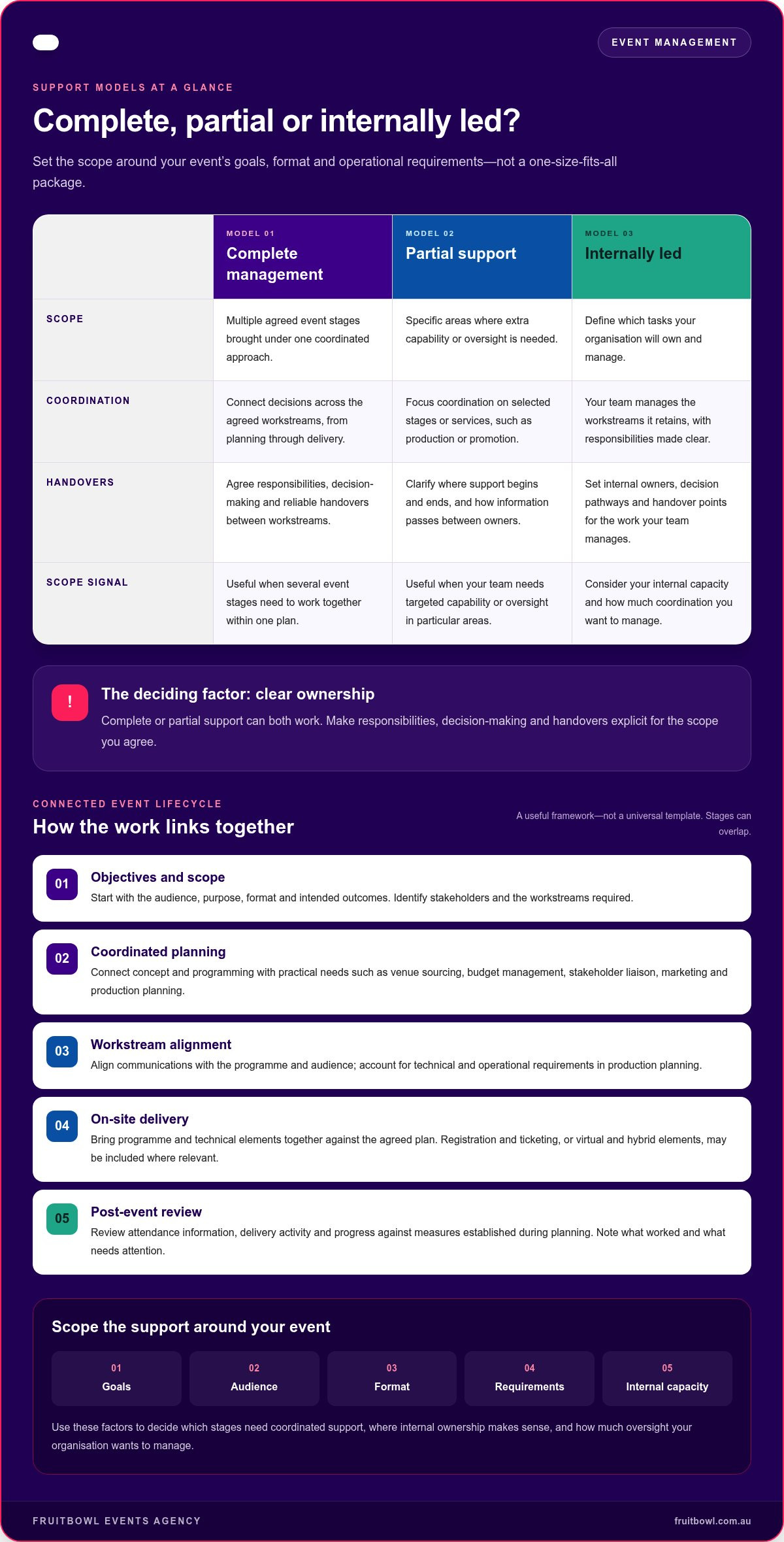
The scope can be complete or partial. Complete management can bring multiple stages under one coordinated approach, while partial management focuses on specific areas where additional capability or oversight is needed. Neither model is automatically right for every organisation. The key is to make responsibilities, handovers and decision-making clear for the project.
These connected event management principles apply throughout preparation and delivery. An integrated solution puts them into practice by linking decisions across the agreed scope, rather than treating each service as an isolated task.
How is end-to-end event management different from a single service?
A single service addresses a defined requirement, such as production or event promotion. Connected support considers how that work relates to other parts of the event. For example, production requirements can affect planning and on-site delivery, while promotional activity needs to reflect the event’s purpose and audience. Coordination makes those dependencies visible early.
Shared objectives give teams a reference point for decisions across workstreams. Everyone can see what each activity needs to contribute, who is responsible and where information must be handed over. The scope can cover the full event lifecycle or selected stages, depending on your internal capacity and the complexity of the project.
Which organisations and event types can use an integrated solution?
Brands, councils, government agencies, corporate clients and community organisations can all benefit from a joined-up approach when an event involves several connected workstreams. The format may be a conference or seminar, a festival, a brand or government activation, or another public event. Each has distinct audiences, objectives and delivery considerations.
For a conference, planning, production and attendee communications may need to align around the programme. A festival or public event may involve coordination across promotion, production, safety and on-site delivery. An activation may need planning and production that support a clear brand purpose. The appropriate scope depends on the work involved, your organisation’s existing resources and how much coordination you want to manage internally.
How end-to-end event management solutions connect the event lifecycle
An event moves through several stages, but the handovers between them are where coordination matters most. An objective shapes the plan; the plan informs production and programming; delivery generates information for the post-event review. This sequence is a useful framework, not a universal template. Stages can overlap, and the workstreams involved depend on the event’s format and scope.
Connected workstreams need clear ownership and shared project objectives so decisions made at one stage support the next. A change to the programme, for example, may affect production requirements, marketing information or registration details. When responsibilities and decision pathways are understood, teams can respond with the broader event plan in view.
From objectives and scope to coordinated planning
Begin with the audience, purpose, format and intended outcomes. These foundations help define the scope, identify stakeholders and clarify which workstreams are required. Coordination can include venue sourcing, budget management and stakeholder liaison. Event Design & Consulting can help shape the concept and approach, while programming, marketing and production planning connect the event experience to practical delivery needs.
Once the scope is set, establish who leads each task, who provides input and when decisions need to be made. Event Marketing Services can align communications with the programme and audience; production planning can account for technical and operational requirements. These connections help teams see how a decision in one area may affect another, rather than managing every task in isolation.
From event delivery to post-event evaluation
On site, coordination brings programme and technical elements together against the agreed plan. Registration & Ticketing can form part of the attendee journey, while Virtual & Hybrid Events can support formats that include remote participation. The relevant components depend on the event. Clear roles help the delivery team manage changes and keep stakeholders informed as activity unfolds.
The lifecycle continues after the event. Analytics, reporting and post-event analysis can help review attendance information, delivery activity and progress against the measures established during planning. This gives stakeholders a structured opportunity to consider what worked, what needs attention and what insights may inform future events. The review is an assessment, not a promise of a particular result.
A practical lifecycle can be viewed as five connected stages:
- Objectives: establish the purpose, audience and intended outcomes.
- Planning: shape the format, scope, stakeholders and workstreams.
- Coordination: align people, decisions, schedules and event requirements.
- Delivery: bring programme, production and attendee elements together.
- Post-event review: analyse available information and record useful learnings.
For organisations assessing how much support to bring into each stage, Fruitbowl’s event management support can be tailored to a complete or partial project scope.
Comparing End-to-End and Partial Event Management
A broader management scope can be valuable, but it may include more support than your organisation needs. The decision is not about choosing the most comprehensive option. It’s about identifying where coordination, capacity or oversight is needed. End-to-end event management solutions can be scoped around the work to be managed, while partial support lets your team retain defined responsibilities.
Use this comparison as a starting point. The boundaries between models are flexible, and the agreed scope should reflect your event and internal resources.
| Delivery model | Scope | Internal workload | Coordination points and oversight |
|---|---|---|---|
| Full-service coordination | Management across multiple agreed event stages and workstreams. | Internal input remains important, while more delivery coordination sits within the agreed external scope. | Fewer separate coordination points for the organisation to manage, with oversight focused on shared objectives, approvals and progress. |
| Partial support | Selected stages or workstreams, with other responsibilities retained internally. | Internal teams continue to lead the areas outside the agreed scope. | Clear handovers are needed between the organisation and event specialists, particularly where workstreams depend on each other. |
| Internally led delivery | Planning and delivery are managed by the organisation’s own team. | Internal workload is higher, as the team coordinates its own responsibilities and relevant suppliers. | Internal ownership is central. The team needs clear processes for decisions, communication and oversight. |
The suitable model depends on objectives, complexity and internal capacity. Consider how strongly tasks depend on one another, how many stakeholders need to contribute and who can oversee delivery, not just the number of tasks. A model can also combine internal ownership with external support for selected areas.
When does complete event management make sense?
Complete management may suit an event with several connected workstreams, multiple stakeholders or delivery dependencies that require consistent coordination. For example, a conference involving programme, production, registration and stakeholder input may need oversight across those areas. A coordinated approach can bring planning and stakeholder liaison together within the agreed scope, while keeping your organisation involved in key decisions and approvals.
When can partial event management be the better fit?
Partial support can suit an organisation with an experienced internal team that wants targeted help with particular stages or workstreams. Your team might retain programme decisions while engaging support for selected coordination or production requirements. Define who owns each task, who approves decisions and how information is handed over to reduce overlap between internal staff and event specialists.
Before delivery begins, record the agreed scope, responsibilities, decision-makers and handover points. This gives everyone a practical reference as work progresses and makes it easier to see whether the chosen level of support matches the event’s requirements.
Scoping End-to-End Event Solutions for Your Organisation
A clear brief turns an event goal into a workable scope. Before engaging support, map what the event needs to achieve, who it needs to serve and what your organisation can manage internally. This gives everyone a practical basis for deciding which workstreams need support, where decisions sit and how success will be assessed. It also helps shape end-to-end event management solutions around your requirements rather than assumptions.
Use this sequence to prepare:
- Define the purpose and outcomes. State why the event is being held and what you want it to achieve. Describe the audience and the outcomes you intend to measure, such as participation, engagement or stakeholder feedback.
- Describe the audience and format. Note who will attend, the event format and any audience needs that may influence the programme, access, communications or technical planning.
- Set the scope. Record the expected scale, known venue, programme requirements and essential delivery elements. Separate fixed requirements from areas where creative recommendations are welcome.
- Map stakeholders and resources. List key stakeholders, existing suppliers or resources, internal owners and decisions that need stakeholder input. Note where responsibilities are already allocated and where ownership is still to be determined.
- Identify delivery considerations and measures. Capture technical needs, accessibility priorities, risk and safety considerations, and relevant compliance requirements. Identify the measures and reporting that will help evaluate the event against its objectives.
Build a brief around objectives, audience and scope
Make the brief specific enough to guide planning while leaving room to develop the approach. For instance, identify essential programme elements and audience requirements, then distinguish them from optional ideas. Include known venue details and delivery constraints where available. A useful brief also shows what your organisation has already arranged, so the proposed scope can build on existing work rather than duplicate it.
Separate confirmed decisions from open questions. This makes it easier to see where stakeholder approval is needed and where event specialists can contribute recommendations. If the format or programme is still being developed, record what is known and what remains flexible.
Set responsibilities, risk priorities and measures
Identify who makes decisions, who approves changes and which tasks remain with your internal team. Briefing notes should capture relevant safety and compliance requirements, including risk assessments and emergency procedures, as part of the event planning. Record accessibility and technical priorities alongside these requirements.
Finally, agree how progress and performance will be reviewed. Choose measures connected to the event’s intended outcomes and specify what information should be reported after delivery. A focused brief gives your organisation and event specialists a shared reference for defining scope, responsibilities and oversight.
Fruitbowl’s event management services can be shaped around the complete or partial scope set out in your brief.
How Fruitbowl delivers end-to-end event management solutions
Fruitbowl delivers events nationally across Australia for corporate, public, community and brand audiences. Event Management is available as complete or partial support, tailored to the project scope. Organisations can bring planning, coordination, production, marketing, safety and on-site delivery together where needed, or focus support on selected parts of the event.
The aim is to connect the agreed workstreams to the event’s objectives, not to add services that don’t serve the brief. A conference may need support across coordination, registration and technical delivery, while another event may require a different combination. The appropriate scope reflects the format, requirements and responsibilities agreed with the organisation.
Which Fruitbowl services can support an integrated event?
Event Management provides the coordinating framework, with Conference Management and Registration & Ticketing supporting programme and attendee requirements. Event Marketing Services can connect communications to the audience, while Entertainment & Programming can help shape the event experience. In-House AV Production, Event Safety & Compliance, and Virtual & Hybrid Events can also contribute where they align with the format and scope.
These capabilities don’t all need to be part of every project. The value lies in selecting and coordinating the relevant elements, with clear responsibilities and handovers. For an in-person conference, registration and AV production may be central considerations. A hybrid event may also require virtual components to be planned alongside the programme and technical requirements. The brief guides the combination.
What experience and delivery approach can readers expect?
Fruitbowl brings 28+ years of event delivery experience, with 2,500+ events delivered for councils, government bodies and major festivals. The team delivers 50+ successful events every year and has 85+ years of combined industry experience. The first figure reflects the agency’s experience; the latter describes the team’s combined industry experience.
That experience supports a professional, collaborative approach. Fruitbowl works with organisations to understand objectives, agree the scope and coordinate relevant capabilities across the project. Responsibilities are shaped around the event, so internal teams can remain involved in the areas they own while receiving support where it’s needed. The focus stays on the brief and the practical connections between planning and delivery.
For organisations preparing an event brief, outlining the purpose, audience, key requirements and internal responsibilities provides a useful starting point for defining scope. The required level of support can then be aligned with the project’s objectives and operational needs.
Fruitbowl’s event management services bring together the support required for your event.
Set your event plan in motion
Turn your event’s purpose into a clear starting brief. You don’t need every detail resolved. Capture the decisions already made, the questions still open and the outcomes that matter most. This gives your team a practical foundation for shaping end-to-end event management solutions around the work ahead.
Consider what you want attendees to experience, which requirements are fixed and where there’s room to refine the approach. With those priorities in view, you can have a focused conversation about the right balance of internal ownership and event support. A considered scope makes the path from initial direction to delivery easier to plan.
Fruitbowl works with organisations to discuss event objectives and shape support around their requirements. Explore Fruitbowl’s event management services to plan the right support for your event.
Frequently Asked Questions
What is included in end-to-end event management solutions?
End-to-end event management solutions can cover the stages and services agreed for a project, with scope shaped by its objectives and operational needs. For example, if an agenda change affects speaker timings, registration information and technical cues, the brief should show who approves the change and how it’s communicated. This illustrates the value of connecting workstreams rather than treating each task separately.
Is end-to-end event management suitable for a small or simple event?
It can be, although a small event may need targeted assistance rather than complete management. Consider whether your team has the time and experience to coordinate essential tasks, manage approvals and oversee delivery. If most arrangements are already in hand, partial support may be a better fit. The decision should reflect the event’s needs and your organisation’s capacity, not its size alone.
Can an event management agency manage only part of an event?
Yes. Partial Event Management allows an organisation to retain selected responsibilities while bringing in support for agreed areas. For example, your team might own internal approvals and speaker decisions, while event specialists coordinate another defined part of delivery. Set out who provides information, who signs off changes and when each handover occurs. That clarity helps prevent tasks from being duplicated or overlooked.
How does an end-to-end event management process work?
It starts by establishing what the event needs to achieve and what support is in scope. From there, responsibilities and relevant workstreams are coordinated through preparation and delivery, followed by a review. The sequence can vary. A useful working document records key decisions, open issues and changes as they arise, giving stakeholders a shared reference and making the post-event assessment more meaningful.
What should an event management brief include?
A useful brief records the purpose, audience, format, intended outcomes and requirements that will shape delivery. It should distinguish firm constraints, such as an approved programme element, from preferences that can be refined. Note existing resources and supplier arrangements, too. This helps identify where new support should complement work already under way and gives stakeholders a clearer basis for approving the scope.
How can an organisation measure whether an event was successful?
Measure success against the event’s purpose, using evidence that reflects the intended outcome. Attendance can show reach, but a participation-focused event may also need a way to assess involvement, while a sponsor activation may call for sponsor reporting. Agree what information will be collected and reviewed before delivery. Afterwards, compare the available data and feedback with the original aims.
OUR BLOG
Event Insights & Expertise
Our blog is your go-to resource for all things events. From expert insights and the latest industry trends to practical planning tips, we share everything you need to deliver standout experiences.
Contact Us