Corporate Event Stage Design: The 2026 Strategic Production Guide

A corporate stage is not merely a platform; it is the physical manifestation of your brand’s authority and the structural foundation for its visual prestige. You likely recognise that a striking aesthetic is only half the battle, as the true success of corporate event stage design melbourne professionals deliver lies in the invisible details. There is often a valid concern regarding technical hitches or the complexities of OH&S and rigging compliance, especially when you are balancing a creative vision against a fixed budget.

This guide helps you master the art of high-impact production through a professional framework that integrates creative ambition with logistical precision. You will learn how to secure a seamless, black-tie finish that enhances your brand’s reputation while maintaining zero technical hitches. We will outline the essential steps for achieving full compliance with Australian structural standards and wind loading requirements, ensuring your next event is as safe as it is sophisticated. From initial concept to the final technical run-through, this strategic guide provides the clarity needed to lead a high-stakes production with absolute confidence.

Key Takeaways

  • Understand how to integrate architecture, AV, and branding into a cohesive focal point that commands audience attention and reinforces brand authority.
  • Navigate the complexities of corporate event stage design melbourne by integrating technical precision with creative vision for a seamless, high-impact finish.
  • Distinguish between modular and custom builds to select the most efficient and scalable framework for your specific brand activation or conference.
  • Ensure rigorous safety compliance through detailed rigging plots and site inspections that meet 2026 Australian structural standards and wind loading requirements.
  • Bridge the gap between creative ambition and technical reality with a specialised technical direction approach that eliminates the risk of live event failures.

What is Corporate Event Stage Design?

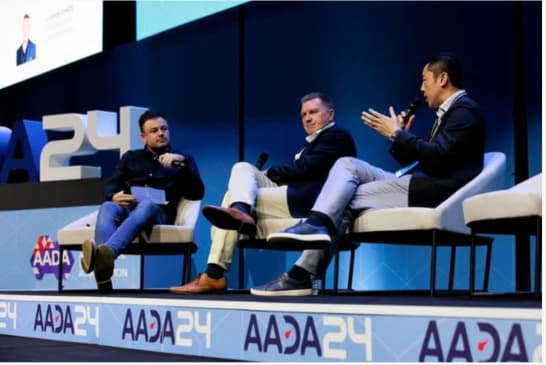
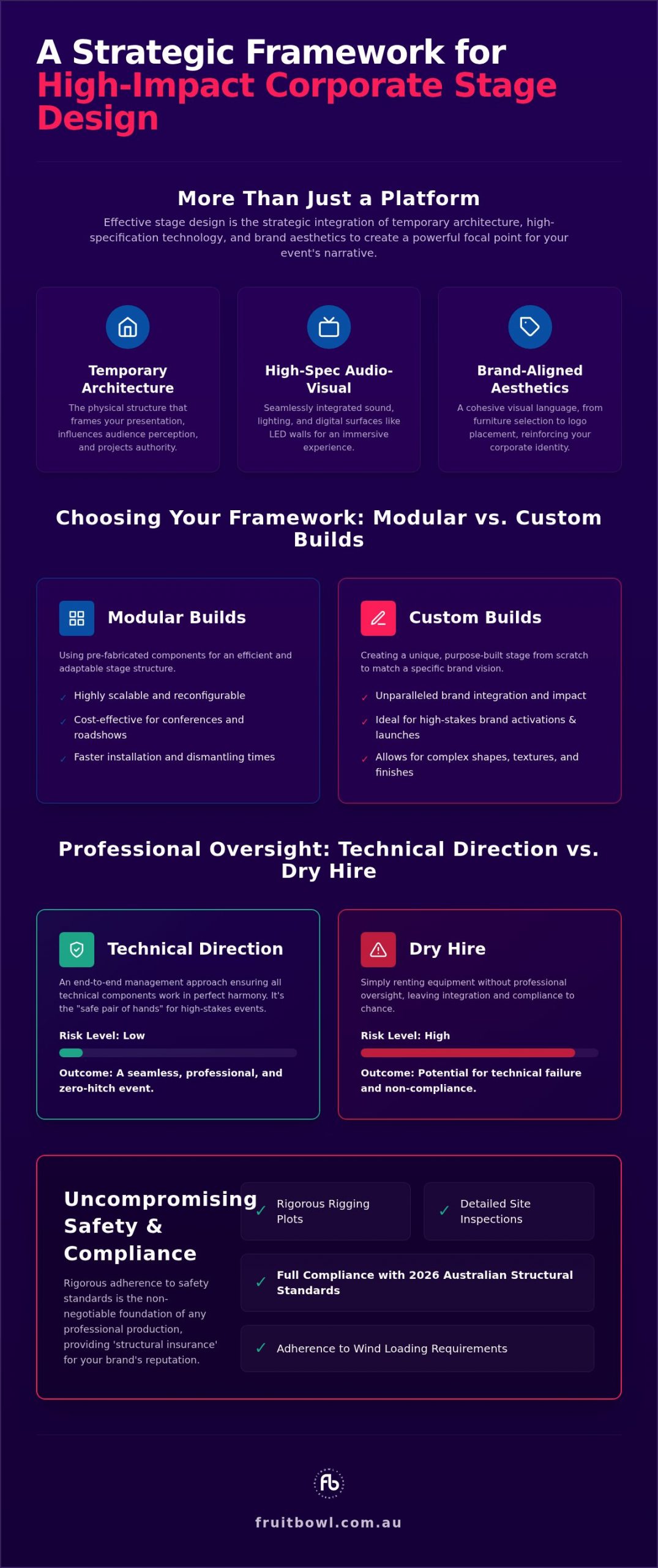
Corporate event stage design melbourne is often misunderstood as the simple provision of a raised platform for speakers. In reality, it represents the strategic integration of temporary architecture, high-specification audio-visual technology, and brand-aligned aesthetics. It functions as the physical foundation for your event’s narrative, ensuring that every keynote and presentation is framed by a structure that projects authority and professional excellence.

The stage serves as the primary focal point of audience engagement and the most significant vector for brand messaging. In 2026, the industry has seen a definitive transition from traditional, static platforms toward immersive, digital-first environments. These setups utilise high-resolution LED walls and dynamic lighting to create “structural insurance” for your visual prestige. This concept provides the peace of mind that comes from knowing the technical and aesthetic elements are supported by rigorous engineering, preventing the diminished brand perception associated with amateur setups.

The Role of Scenography in Corporate Environments

Scenography involves more than just decorating a space; it’s about influencing the psychological state of the attendee through spatial arrangement. While functional staging simply provides visibility, experiential design uses depth, texture, and light to foster a specific emotional response from the audience. This meticulous approach to the environment is a core component of the strategic framework for high-impact delivery. By controlling the sightlines and the physical flow of the room, you ensure your message isn’t just heard, but resonates within a carefully curated atmosphere.

Why Technical Direction Outperforms Simple Equipment Hire

Many organisations fall into the trap of “dry hire,” which involves renting equipment without professional oversight. This approach carries significant risks, including technical failure and non-compliance with Australian safety standards. Effective corporate event stage design melbourne requires more than just a list of hardware; it requires a disciplined methodology that integrates various moving parts into a singular, reliable system.

A technical director manages the complex interplay between sound, lighting, and structural integrity. Understanding Stagecraft fundamentals is essential for this role, as it ensures that every piece of technology works in harmony rather than in isolation. Since 1996, Fruitbowl has prioritised this end-to-end management style. We provide a “safe pair of hands” that handles everything from rigging plots to on-site delivery, ensuring a frictionless experience for stakeholders who cannot afford a single technical hitch during a high-stakes activation.

Essential Elements of High-Impact Stage Scenography

The physical architecture of a stage serves as the canvas for your brand’s narrative. Achieving a high-impact result requires a disciplined approach to every visual and auditory component. This involves more than simply placing a lectern on a riser; it requires the seamless integration of branding, furniture, and technology to maintain a consistent corporate register. Incorporating corporate logos must be handled with care to avoid cluttering the visual field, ensuring the brand remains present but not overbearing. Many planners now look toward innovative stage design trends to create depth through custom backdrops and tiered seating arrangements that reflect a sophisticated professional image.

Selecting furniture that aligns with your brand’s aesthetic is equally vital. Whether it is a minimalist lectern for a keynote or plush lounge seating for a panel discussion, every item on stage must feel intentional. When these elements are combined with precision, the stage becomes a powerful tool for communication. If you are looking to elevate your next production, Fruitbowl provides the strategic oversight needed to ensure every detail is executed to the highest standard.

Integrating Digital Surfaces and LED Technology

Digital surfaces have become the cornerstone of modern corporate event stage design melbourne. High-resolution LED video walls offer a level of brightness and clarity that traditional projection often cannot match, especially in venues with significant ambient light. When selecting these surfaces, you must consider pixel pitch and viewing distances. A pitch that is too large will result in visible pixels for front-row delegates, undermining the prestige of the presentation. For a deeper dive into the technical specifications required for these systems, refer to our guide on AV management for events. Integrating these screens into the physical stage build, rather than treating them as standalone items, creates a unified architectural look.

Lighting as a Narrative Tool

Lighting is the most effective tool for directing audience focus and setting the emotional tone of a conference. Key lighting ensures that speakers are clearly visible and look professional on camera, while mood lighting during intervals can shift the energy of the room. If your event is being recorded or live-streamed, flicker-free lighting is a non-negotiable technical requirement to avoid visual interference. Using colour and intensity strategically allows you to guide the attendee’s journey throughout the day, moving from high-energy sessions to reflective workshops with ease. This level of control ensures that the audience’s attention remains exactly where you intend it to be.

Modular vs. Custom Stage Builds: Evaluating Your Framework

Selecting the right framework for your event is a balance between creative ambition and logistical reality. In the context of corporate event stage design melbourne, the choice typically falls between modular systems and bespoke custom builds. Each serves a distinct purpose within a strategic production plan. Modular systems offer a reliable, cost-effective foundation for standard conference halls, while custom builds provide the architectural freedom required for high-impact brand activations. Precision is paramount. Access dictates design.

Successful execution begins with a rigorous assessment of site constraints. You must account for ceiling heights to accommodate lighting rigs and floor loading limits to support heavy technical infrastructure. Access points are equally critical; a grand design is useless if the components cannot fit through the venue’s loading dock. These details are the backbone of a frictionless event delivery. We ensure every structural element is vetted before the first truck arrives on site.

A professional result is defined by what the audience does not see. We prioritise “black-tie” finishes, which include seamless carpet installation, precision skirting, and invisible cable management. These elements ensure the stage looks like a permanent installation rather than a temporary structure. This level of detail reinforces the brand’s authority and provides a polished environment for high-stakes presentations.

When to Invest in a Custom Built Stage

Bespoke builds are necessary when the event requires a unique physical presence, such as a major government activation or a flagship product launch. We use 3D rendering during the pre-production phase to provide a precise visualisation of the environment. This allows for the integration of non-traditional AV placements, such as curved LED surfaces or recessed lighting channels, that go beyond the capabilities of standard decking. Custom builds transform a venue into a tailored brand experience that modular systems simply cannot replicate.

The Versatility of Modular Systems

Modular decking is the workhorse of the industry, valued for its speed and scalability. It is particularly effective for multi-use venues where “bump-in” and “bump-out” times are limited. Since 1996, Fruitbowl has refined the logistics of national rollouts, using modular systems to maintain high standards across various locations. This versatility ensures that even with a standard framework, the final result remains sophisticated and secure. It is the ideal solution for varied audience sizes where efficiency and reliability are the primary objectives.
Corporate Event Stage Design: The 2026 Strategic Production Guide

Managing Technical Logistics and Safety Compliance

A successful production is built on a foundation of logistical precision. When transitioning from the creative phase to physical execution, the focus shifts to technical logistics and safety compliance. This process is governed by a strict five-step methodology that ensures every structural element is secure and every technical requirement is met. For complex corporate event stage design melbourne, safety is not merely a checklist; it is a structural narrative that protects your brand and your audience.

  • Step 1: Conduct a comprehensive site inspection to identify structural constraints, such as floor loading limits or restricted ceiling access.
  • Step 2: Develop detailed rigging plots and weight-loading calculations to ensure the venue’s infrastructure can support your visual ambitions.
  • Step 3: Verify that all equipment meets current Australian Safety Standards (AS), including tagged and tested electrical components.
  • Step 4: Coordinate with venue management regarding power distribution and cable paths to maintain a clean, trip-free environment.
  • Step 5: Execute a supervised bump-in with certified riggers and technicians who understand the nuances of high-stakes environments.

Adhering to this framework eliminates the anxiety of technical failure. If you require an expert team to manage these complexities, contact Fruitbowl for professional technical direction.

Rigging Safety and Structural Integrity

Rigging is the most critical technical aspect of any large-scale stage build, particularly when suspended LED walls or heavy lighting arrays are involved. Our approach prioritises the use of certified riggers who operate under strict Safe Work Method Statements (SWMS). These documents are essential for high-risk construction work and provide a clear roadmap for safe execution. Since 1996, we have maintained a reputation as a “safe pair of hands” by ensuring every overhead component is double-checked and structurally sound. This meticulous planning is what allows us to deliver complex designs without compromising on-site safety.

Australian Standards and OH&S Compliance

National requirements for temporary event structures are rigorous, demanding full compliance with the Occupational Health and Safety Act. For complex or non-standard builds, we engage structural engineers to sign off on the design before the event begins. This certification is vital for insurance and liability coverage, as any deviation from Australian Standards can void your protection. By integrating these compliance measures into the initial design phase, we ensure that your brand activation or conference meets every legal obligation while maintaining its aesthetic prestige. This disciplined oversight provides the security needed for high-stakes corporate environments.

Seamless Execution: Integrating Technical Direction and Creative Vision

The final phase of any production is the most critical, as it requires the perfect alignment of marketing objectives and technical execution. Bridging the gap between a creative vision and technical reality is a delicate process that demands a deep understanding of what’s possible within a specific venue. In the context of corporate event stage design melbourne, this integration ensures that the brand’s message is delivered without distraction. A dedicated on-site production manager acts as the central point of contact, translating complex technical data into a seamless experience for stakeholders.

Show-calling is the heartbeat of a live event. It involves the precise coordination of lighting, audio, and visual cues to match the speaker’s delivery. When a keynote speaker moves to a new slide, the lighting should subtly shift and the audio levels must remain consistent. We prioritise reducing friction for presenters by providing professional lectern setups and comfort monitors. These tools allow speakers to focus on their message rather than worrying about the technology supporting them. It’s this attention to detail that elevates a standard presentation into a polished, black-tie event.

Pre-Production: The Roadmap to Success

Success on show day is determined weeks in advance. We manage stakeholder liaison throughout the project lifecycle, ensuring that every department is aligned with the “run of show” document. Technical rehearsals and speaker briefings are essential components of this roadmap. They provide an opportunity to refine cues and ensure that everyone, from the CEO to the lighting technician, understands their role. This disciplined approach to pre-production is what allows us to manage high-stakes conferences with absolute clarity and precision.

On-Site Delivery and Troubleshooting

Live environments are inherently unpredictable, which is why an unflappable production team is a vital asset. Since 1996, Fruitbowl has acted as a “safe pair of hands” for government activations and major corporate events. Our seasoned expertise in corporate event stage design melbourne allows us to anticipate needs before they become issues. Contingency planning accounts for every potential technical malfunction, from signal loss to power interruptions. Having a professional team on-site means that if a challenge arises, it’s resolved quietly and efficiently before the audience even notices. This commitment to seamless delivery is what defines a truly professional production.

Master the Future of Corporate Event Production

Mastering corporate event stage design melbourne requires more than a creative eye; it demands a disciplined integration of structural engineering and technical precision. By prioritising safety compliance and selecting the appropriate framework for your venue, you ensure your brand’s authority remains unchallenged throughout the live event. We’ve explored how the transition from traditional platforms to immersive environments creates a foundation for visual prestige that resonates with every attendee. This strategic approach eliminates the risk of failure and focuses on seamless, high-impact delivery.

Fruitbowl brings over 28 years of elite event management experience to every project. As a trusted partner for government and national corporate activations, we specialise in the complex technical direction and logistics that high-stakes environments demand. We provide the order and clarity needed to navigate multifaceted processes, ensuring your vision is executed with absolute certainty. Our team acts as a safe pair of hands, managing every detail from the initial rigging plot to the final show-call.

Partner with Fruitbowl for your next high-impact corporate event to secure a frictionless production that meets the highest Australian standards. Your next activation deserves the security and sophistication of a seasoned expert.

Frequently Asked Questions

How much does a professional corporate stage design cost?

The investment for a professional stage design is determined by the project’s scale and the complexity of the integrated technology. Factors such as bespoke architecture, high-resolution LED surfaces, and the level of technical direction required will all influence the final budget. A comprehensive assessment of your site and brand objectives is necessary to provide an accurate estimate for your specific requirements.

What are the essential safety standards for event rigging in Australia?

Rigging safety in Australia is governed by the Occupational Health and Safety Act 2004 and the OHS Regulations 2017. Every high-risk task requires a completed Safe Work Method Statement (SWMS) before work commences. All equipment must be tagged, tested, and compliant with relevant Australian Standards to ensure structural integrity and personnel safety at all times.

How long does it take to bump-in a custom corporate stage?

A custom corporate stage usually requires a bump-in window of 12 to 24 hours. This duration allows for the meticulous assembly of bespoke architecture and the calibration of integrated technology. While modular systems are much faster to deploy, custom builds demand this extra time to ensure every detail meets the black-tie standard of a professional activation.

Can I integrate my own branding into a modular stage setup?

You can certainly integrate brand identity into a modular setup using custom fascias, high-resolution digital backdrops, and tailored furniture. This approach allows for a sophisticated corporate event stage design melbourne result while maintaining the scalability of modular decking. It’s an efficient way to achieve visual prestige without the timeline requirements of a bespoke build.

Do I need a structural engineer for my event stage?

You’ll need a structural engineer whenever a stage build involves complex, non-standard architecture or carries significant overhead loads. They provide the formal sign-off required for insurance purposes and council event permits. This certification acts as a final layer of security, confirming that the structure is safe for performers and audience members alike.

What is the best stage height for an audience of 500 people?

The optimal stage height for an audience of 500 people is typically between 900mm and 1200mm. This elevation ensures that delegates at the rear of the room maintain clear sightlines to the speakers. It’s vital to cross-reference this height with the venue’s ceiling clearance to avoid obstructing lighting rigs or projection surfaces.

How do LED video walls affect stage design and weight loading?

LED video walls introduce substantial weight loading requirements that dictate the structural design of the stage. These systems require precise rigging plots and weight-loading calculations to ensure the venue’s infrastructure can support the array. Their inclusion in corporate event stage design melbourne necessitates a strategic plan for power distribution and cable management to maintain a clean, professional finish.

What is the difference between a production manager and a technical director?

A production manager handles the overarching project logistics, budget management, and stakeholder liaison throughout the event lifecycle. In contrast, a technical director is responsible for the engineering and execution of the AV, lighting, and sound systems. While their roles overlap, the technical director provides the specialised oversight needed to manage complex high-stakes environments.

A corporate stage is not merely a platform; it is the physical manifestation of your brand’s authority and the structural foundation for its visual prestige. You likely recognise that a striking aesthetic is only half the battle, as the true success of corporate event stage design melbourne professionals deliver lies in the invisible details. There is often a valid concern regarding technical hitches or the complexities of OH&S and rigging compliance, especially when you are balancing a creative vision against a fixed budget.

This guide helps you master the art of high-impact production through a professional framework that integrates creative ambition with logistical precision. You will learn how to secure a seamless, black-tie finish that enhances your brand’s reputation while maintaining zero technical hitches. We will outline the essential steps for achieving full compliance with Australian structural standards and wind loading requirements, ensuring your next event is as safe as it is sophisticated. From initial concept to the final technical run-through, this strategic guide provides the clarity needed to lead a high-stakes production with absolute confidence.

Key Takeaways

  • Understand how to integrate architecture, AV, and branding into a cohesive focal point that commands audience attention and reinforces brand authority.
  • Navigate the complexities of corporate event stage design melbourne by integrating technical precision with creative vision for a seamless, high-impact finish.
  • Distinguish between modular and custom builds to select the most efficient and scalable framework for your specific brand activation or conference.
  • Ensure rigorous safety compliance through detailed rigging plots and site inspections that meet 2026 Australian structural standards and wind loading requirements.
  • Bridge the gap between creative ambition and technical reality with a specialised technical direction approach that eliminates the risk of live event failures.

What is Corporate Event Stage Design?

Corporate event stage design melbourne is often misunderstood as the simple provision of a raised platform for speakers. In reality, it represents the strategic integration of temporary architecture, high-specification audio-visual technology, and brand-aligned aesthetics. It functions as the physical foundation for your event’s narrative, ensuring that every keynote and presentation is framed by a structure that projects authority and professional excellence.

The stage serves as the primary focal point of audience engagement and the most significant vector for brand messaging. In 2026, the industry has seen a definitive transition from traditional, static platforms toward immersive, digital-first environments. These setups utilise high-resolution LED walls and dynamic lighting to create “structural insurance” for your visual prestige. This concept provides the peace of mind that comes from knowing the technical and aesthetic elements are supported by rigorous engineering, preventing the diminished brand perception associated with amateur setups.

The Role of Scenography in Corporate Environments

Scenography involves more than just decorating a space; it’s about influencing the psychological state of the attendee through spatial arrangement. While functional staging simply provides visibility, experiential design uses depth, texture, and light to foster a specific emotional response from the audience. This meticulous approach to the environment is a core component of the strategic framework for high-impact delivery. By controlling the sightlines and the physical flow of the room, you ensure your message isn’t just heard, but resonates within a carefully curated atmosphere.

Why Technical Direction Outperforms Simple Equipment Hire

Many organisations fall into the trap of “dry hire,” which involves renting equipment without professional oversight. This approach carries significant risks, including technical failure and non-compliance with Australian safety standards. Effective corporate event stage design melbourne requires more than just a list of hardware; it requires a disciplined methodology that integrates various moving parts into a singular, reliable system.

A technical director manages the complex interplay between sound, lighting, and structural integrity. Understanding Stagecraft fundamentals is essential for this role, as it ensures that every piece of technology works in harmony rather than in isolation. Since 1996, Fruitbowl has prioritised this end-to-end management style. We provide a “safe pair of hands” that handles everything from rigging plots to on-site delivery, ensuring a frictionless experience for stakeholders who cannot afford a single technical hitch during a high-stakes activation.

Essential Elements of High-Impact Stage Scenography

The physical architecture of a stage serves as the canvas for your brand’s narrative. Achieving a high-impact result requires a disciplined approach to every visual and auditory component. This involves more than simply placing a lectern on a riser; it requires the seamless integration of branding, furniture, and technology to maintain a consistent corporate register. Incorporating corporate logos must be handled with care to avoid cluttering the visual field, ensuring the brand remains present but not overbearing. Many planners now look toward innovative stage design trends to create depth through custom backdrops and tiered seating arrangements that reflect a sophisticated professional image.

Selecting furniture that aligns with your brand’s aesthetic is equally vital. Whether it is a minimalist lectern for a keynote or plush lounge seating for a panel discussion, every item on stage must feel intentional. When these elements are combined with precision, the stage becomes a powerful tool for communication. If you are looking to elevate your next production, Fruitbowl provides the strategic oversight needed to ensure every detail is executed to the highest standard.

Integrating Digital Surfaces and LED Technology

Digital surfaces have become the cornerstone of modern corporate event stage design melbourne. High-resolution LED video walls offer a level of brightness and clarity that traditional projection often cannot match, especially in venues with significant ambient light. When selecting these surfaces, you must consider pixel pitch and viewing distances. A pitch that is too large will result in visible pixels for front-row delegates, undermining the prestige of the presentation. For a deeper dive into the technical specifications required for these systems, refer to our guide on AV management for events. Integrating these screens into the physical stage build, rather than treating them as standalone items, creates a unified architectural look.

Lighting as a Narrative Tool

Lighting is the most effective tool for directing audience focus and setting the emotional tone of a conference. Key lighting ensures that speakers are clearly visible and look professional on camera, while mood lighting during intervals can shift the energy of the room. If your event is being recorded or live-streamed, flicker-free lighting is a non-negotiable technical requirement to avoid visual interference. Using colour and intensity strategically allows you to guide the attendee’s journey throughout the day, moving from high-energy sessions to reflective workshops with ease. This level of control ensures that the audience’s attention remains exactly where you intend it to be.

Modular vs. Custom Stage Builds: Evaluating Your Framework

Selecting the right framework for your event is a balance between creative ambition and logistical reality. In the context of corporate event stage design melbourne, the choice typically falls between modular systems and bespoke custom builds. Each serves a distinct purpose within a strategic production plan. Modular systems offer a reliable, cost-effective foundation for standard conference halls, while custom builds provide the architectural freedom required for high-impact brand activations. Precision is paramount. Access dictates design.

Successful execution begins with a rigorous assessment of site constraints. You must account for ceiling heights to accommodate lighting rigs and floor loading limits to support heavy technical infrastructure. Access points are equally critical; a grand design is useless if the components cannot fit through the venue’s loading dock. These details are the backbone of a frictionless event delivery. We ensure every structural element is vetted before the first truck arrives on site.

A professional result is defined by what the audience does not see. We prioritise “black-tie” finishes, which include seamless carpet installation, precision skirting, and invisible cable management. These elements ensure the stage looks like a permanent installation rather than a temporary structure. This level of detail reinforces the brand’s authority and provides a polished environment for high-stakes presentations.

When to Invest in a Custom Built Stage

Bespoke builds are necessary when the event requires a unique physical presence, such as a major government activation or a flagship product launch. We use 3D rendering during the pre-production phase to provide a precise visualisation of the environment. This allows for the integration of non-traditional AV placements, such as curved LED surfaces or recessed lighting channels, that go beyond the capabilities of standard decking. Custom builds transform a venue into a tailored brand experience that modular systems simply cannot replicate.

The Versatility of Modular Systems

Modular decking is the workhorse of the industry, valued for its speed and scalability. It is particularly effective for multi-use venues where “bump-in” and “bump-out” times are limited. Since 1996, Fruitbowl has refined the logistics of national rollouts, using modular systems to maintain high standards across various locations. This versatility ensures that even with a standard framework, the final result remains sophisticated and secure. It is the ideal solution for varied audience sizes where efficiency and reliability are the primary objectives.

Managing Technical Logistics and Safety Compliance

A successful production is built on a foundation of logistical precision. When transitioning from the creative phase to physical execution, the focus shifts to technical logistics and safety compliance. This process is governed by a strict five-step methodology that ensures every structural element is secure and every technical requirement is met. For complex corporate event stage design melbourne, safety is not merely a checklist; it is a structural narrative that protects your brand and your audience.

  • Step 1: Conduct a comprehensive site inspection to identify structural constraints, such as floor loading limits or restricted ceiling access.
  • Step 2: Develop detailed rigging plots and weight-loading calculations to ensure the venue’s infrastructure can support your visual ambitions.
  • Step 3: Verify that all equipment meets current Australian Safety Standards (AS), including tagged and tested electrical components.
  • Step 4: Coordinate with venue management regarding power distribution and cable paths to maintain a clean, trip-free environment.
  • Step 5: Execute a supervised bump-in with certified riggers and technicians who understand the nuances of high-stakes environments.

Adhering to this framework eliminates the anxiety of technical failure. If you require an expert team to manage these complexities, contact Fruitbowl for professional technical direction.

Rigging Safety and Structural Integrity

Rigging is the most critical technical aspect of any large-scale stage build, particularly when suspended LED walls or heavy lighting arrays are involved. Our approach prioritises the use of certified riggers who operate under strict Safe Work Method Statements (SWMS). These documents are essential for high-risk construction work and provide a clear roadmap for safe execution. Since 1996, we have maintained a reputation as a “safe pair of hands” by ensuring every overhead component is double-checked and structurally sound. This meticulous planning is what allows us to deliver complex designs without compromising on-site safety.

Australian Standards and OH&S Compliance

National requirements for temporary event structures are rigorous, demanding full compliance with the Occupational Health and Safety Act. For complex or non-standard builds, we engage structural engineers to sign off on the design before the event begins. This certification is vital for insurance and liability coverage, as any deviation from Australian Standards can void your protection. By integrating these compliance measures into the initial design phase, we ensure that your brand activation or conference meets every legal obligation while maintaining its aesthetic prestige. This disciplined oversight provides the security needed for high-stakes corporate environments.

Seamless Execution: Integrating Technical Direction and Creative Vision

The final phase of any production is the most critical, as it requires the perfect alignment of marketing objectives and technical execution. Bridging the gap between a creative vision and technical reality is a delicate process that demands a deep understanding of what’s possible within a specific venue. In the context of corporate event stage design melbourne, this integration ensures that the brand’s message is delivered without distraction. A dedicated on-site production manager acts as the central point of contact, translating complex technical data into a seamless experience for stakeholders.

Show-calling is the heartbeat of a live event. It involves the precise coordination of lighting, audio, and visual cues to match the speaker’s delivery. When a keynote speaker moves to a new slide, the lighting should subtly shift and the audio levels must remain consistent. We prioritise reducing friction for presenters by providing professional lectern setups and comfort monitors. These tools allow speakers to focus on their message rather than worrying about the technology supporting them. It’s this attention to detail that elevates a standard presentation into a polished, black-tie event.

Pre-Production: The Roadmap to Success

Success on show day is determined weeks in advance. We manage stakeholder liaison throughout the project lifecycle, ensuring that every department is aligned with the “run of show” document. Technical rehearsals and speaker briefings are essential components of this roadmap. They provide an opportunity to refine cues and ensure that everyone, from the CEO to the lighting technician, understands their role. This disciplined approach to pre-production is what allows us to manage high-stakes conferences with absolute clarity and precision.

On-Site Delivery and Troubleshooting

Live environments are inherently unpredictable, which is why an unflappable production team is a vital asset. Since 1996, Fruitbowl has acted as a “safe pair of hands” for government activations and major corporate events. Our seasoned expertise in corporate event stage design melbourne allows us to anticipate needs before they become issues. Contingency planning accounts for every potential technical malfunction, from signal loss to power interruptions. Having a professional team on-site means that if a challenge arises, it’s resolved quietly and efficiently before the audience even notices. This commitment to seamless delivery is what defines a truly professional production.

Master the Future of Corporate Event Production

Mastering corporate event stage design melbourne requires more than a creative eye; it demands a disciplined integration of structural engineering and technical precision. By prioritising safety compliance and selecting the appropriate framework for your venue, you ensure your brand’s authority remains unchallenged throughout the live event. We’ve explored how the transition from traditional platforms to immersive environments creates a foundation for visual prestige that resonates with every attendee. This strategic approach eliminates the risk of failure and focuses on seamless, high-impact delivery.

Fruitbowl brings over 28 years of elite event management experience to every project. As a trusted partner for government and national corporate activations, we specialise in the complex technical direction and logistics that high-stakes environments demand. We provide the order and clarity needed to navigate multifaceted processes, ensuring your vision is executed with absolute certainty. Our team acts as a safe pair of hands, managing every detail from the initial rigging plot to the final show-call.

Partner with Fruitbowl for your next high-impact corporate event to secure a frictionless production that meets the highest Australian standards. Your next activation deserves the security and sophistication of a seasoned expert.

Frequently Asked Questions

How much does a professional corporate stage design cost?

The investment for a professional stage design is determined by the project’s scale and the complexity of the integrated technology. Factors such as bespoke architecture, high-resolution LED surfaces, and the level of technical direction required will all influence the final budget. A comprehensive assessment of your site and brand objectives is necessary to provide an accurate estimate for your specific requirements.

What are the essential safety standards for event rigging in Australia?

Rigging safety in Australia is governed by the Occupational Health and Safety Act 2004 and the OHS Regulations 2017. Every high-risk task requires a completed Safe Work Method Statement (SWMS) before work commences. All equipment must be tagged, tested, and compliant with relevant Australian Standards to ensure structural integrity and personnel safety at all times.

How long does it take to bump-in a custom corporate stage?

A custom corporate stage usually requires a bump-in window of 12 to 24 hours. This duration allows for the meticulous assembly of bespoke architecture and the calibration of integrated technology. While modular systems are much faster to deploy, custom builds demand this extra time to ensure every detail meets the black-tie standard of a professional activation.

Can I integrate my own branding into a modular stage setup?

You can certainly integrate brand identity into a modular setup using custom fascias, high-resolution digital backdrops, and tailored furniture. This approach allows for a sophisticated corporate event stage design melbourne result while maintaining the scalability of modular decking. It’s an efficient way to achieve visual prestige without the timeline requirements of a bespoke build.

Do I need a structural engineer for my event stage?

You’ll need a structural engineer whenever a stage build involves complex, non-standard architecture or carries significant overhead loads. They provide the formal sign-off required for insurance purposes and council event permits. This certification acts as a final layer of security, confirming that the structure is safe for performers and audience members alike.

What is the best stage height for an audience of 500 people?

The optimal stage height for an audience of 500 people is typically between 900mm and 1200mm. This elevation ensures that delegates at the rear of the room maintain clear sightlines to the speakers. It’s vital to cross-reference this height with the venue’s ceiling clearance to avoid obstructing lighting rigs or projection surfaces.

How do LED video walls affect stage design and weight loading?

LED video walls introduce substantial weight loading requirements that dictate the structural design of the stage. These systems require precise rigging plots and weight-loading calculations to ensure the venue’s infrastructure can support the array. Their inclusion in corporate event stage design melbourne necessitates a strategic plan for power distribution and cable management to maintain a clean, professional finish.

What is the difference between a production manager and a technical director?

A production manager handles the overarching project logistics, budget management, and stakeholder liaison throughout the event lifecycle. In contrast, a technical director is responsible for the engineering and execution of the AV, lighting, and sound systems. While their roles overlap, the technical director provides the specialised oversight needed to manage complex high-stakes environments.

Back to Articles
Request A Quote

Make an
Enquiry

Untitled design

What Makes Us Different?

True end-to-end solution so you can hand off to us, focus on your priorities and enjoy the event without any stress

Unmatched industry expertise looking after diverse range of high-profile events, cultural festivals & activations

Meticulous attention to every detail and precise execution of events with our streamlined processes

Tailored solutions with bespoke strategies to ensure we align with your brand and objectives

Make an Enquiry

"*" indicates required fields

This field is for validation purposes and should be left unchanged.

"*" indicates required fields

This field is for validation purposes and should be left unchanged.