Corporate Event Planning Pitfalls: Navigating High-Stakes Logistics in 2026

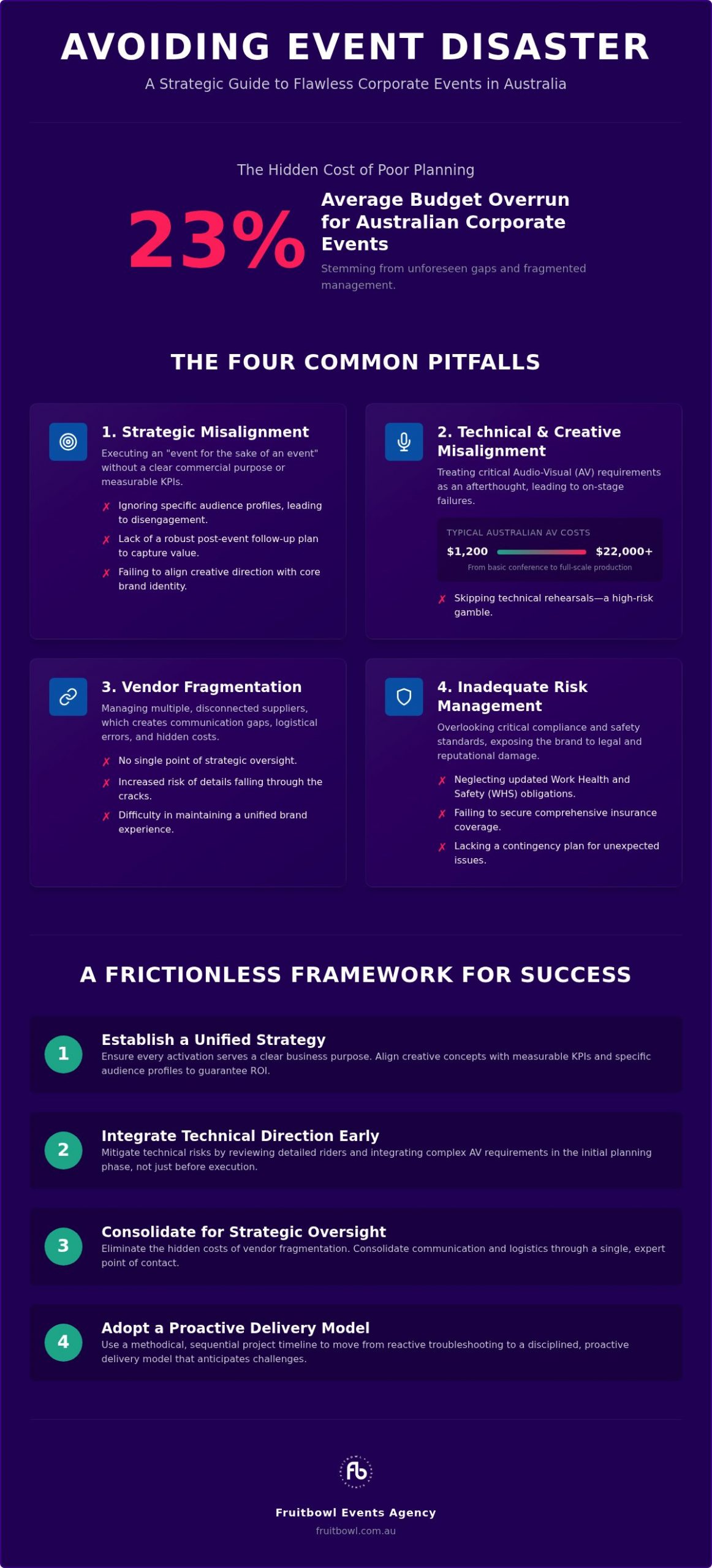
Recent industry data reveals that corporate events in Australia exceed their initial budgets by an average of 23 per cent, a figure that often stems from unforeseen logistical gaps and fragmented vendor management. In a high-stakes environment where every detail reflects your brand’s reputation, a single oversight can lead to public technical glitches or significant financial blowouts. Navigating these common corporate event planning pitfalls requires more than just basic coordination; it demands a sophisticated alignment of creative ambition and technical precision.

You likely recognise the immense pressure of delivering a flawless activation while managing the strict requirements of updated WHS obligations and the expectations of your board. It’s a complex balancing act where the fear of failure is often compounded by the difficulty of managing multiple moving parts. This article provides the strategic oversight needed to identify and bypass the errors that compromise Australian corporate events. We will explore how to maintain predictable budgets, integrate diverse suppliers into a unified team, and ensure your event achieves its objectives with absolute composure. By the end of this guide, you’ll have the clarity to transform high-stakes logistics into a seamless, brand-aligned experience.

Key Takeaways

  • Ensure every activation serves a clear business purpose by aligning creative concepts with measurable KPIs and specific audience profiles.
  • Mitigate technical risks by reviewing detailed riders and integrating complex AV requirements early in the planning phase to prevent execution failures.
  • Identify and bypass the most common corporate event planning pitfalls by prioritising national safety standards and securing comprehensive insurance coverage.
  • Eliminate the hidden costs of vendor fragmentation by consolidating communication and logistics through a single point of strategic oversight.
  • Adopt a methodical, sequential project timeline to transition from reactive troubleshooting to a proactive and disciplined delivery model.

Beyond the Run Sheet: Why Strategic Misalignment Sinks Corporate Events

A detailed run sheet is a logistical necessity, but it shouldn’t be mistaken for a strategic blueprint. One of the most pervasive corporate event planning pitfalls is the tendency to execute an “event for the sake of an event” without establishing clear Key Performance Indicators (KPIs). When an activation lacks a defined commercial purpose, the result is often a polished but hollow experience that fails to deliver a return on investment. Professional event management requires the application of rigorous project management principles to ensure that every tactical decision supports a broader business objective.

Success isn’t measured merely by the absence of technical glitches; it’s defined by how effectively the program engages its specific audience. When planners ignore the unique professional profile of their guests, disengagement is inevitable. Similarly, overcomplicating the agenda with back-to-back presentations often comes at the expense of networking. In a high-stakes corporate environment, the informal connections made between sessions are frequently as valuable as the content delivered on stage. Finally, a strategy is incomplete if it doesn’t include a robust follow-up plan. The momentum generated during a brand activation must be captured through integrated post-event communications that convert attendee engagement into long-term commercial relationships.

Defining Purpose and Brand Alignment

Every successful activation requires a singular “north star” to guide the decision-making process. This foundational purpose ensures that the creative vision remains a servant to your commercial goals rather than a distraction. It’s vital to avoid the “template trap” where every seminar or gala feels like a carbon copy of the last. By aligning the creative direction with your brand’s specific identity, you move beyond generic delivery and create a memorable experience that resonates with your stakeholders. This methodical approach ensures that your investment translates into tangible brand equity.

Audience-Centric Planning

True strategic oversight involves mapping the entire attendee journey, from the first digital invitation to the final post-event survey. You must tailor the content and the professional register of the event to suit your guests. A government activation requires a different level of protocol and formality than a high-energy brand launch. Identifying potential friction points, such as complex registration processes or poorly timed catering breaks, allows you to engineer a frictionless experience. When you prioritise the attendee’s comfort and engagement, you demonstrate a level of care that reflects positively on your organisation’s reputation.

Technical and Creative Misalignment: The Invisible Project Killer

Creative vision is only as strong as the technical framework supporting it. A common oversight in corporate event planning pitfalls is treating Audio-Visual (AV) requirements as a secondary consideration rather than a primary driver of the experience. When the creative intent of a brand activation isn’t aligned with the venue’s technical capabilities, the results range from minor awkwardness to catastrophic failure. Basic conference AV setups in Sydney and other Australian hubs typically range from $1,200 to $3,500, while full-scale production for major events can reach $22,000. Under-investing or failing to plan for this scale of logistics often leads to poorly integrated lighting and sound that actively undermines the presenter’s message.

Skipping technical rehearsals is a high-risk gamble that rarely pays off. Without a dedicated “day-of” walk-through, you risk discovering compatibility issues between digital assets and venue hardware when the room is already full. It’s essential to establish a rigorous AV management for events framework that treats the technical run sheet with the same reverence as the creative script. This ensures that every cue is met with precision, protecting the brand from the embarrassment of technical glitches.

The Role of Technical Direction

A technical director acts as the vital interface between creative visionaries and the technical crew. They ensure that every asset, from a high-resolution video file to a physical stage prop, is compatible with the environment. This role is about more than just troubleshooting; it’s about strategic oversight. By managing the technical direction, they provide a sense of security, ensuring that the transition between speakers is frictionless and that the brand’s visual integrity is maintained throughout the activation. This level of supervision is what separates a standard meeting from a high-impact corporate event.

Talent and Entertainment Pitfalls

Booking high-profile speakers or performers involves more than just a signature on a contract. One of the most significant corporate event planning pitfalls is failing to review technical riders before the booking is finalised. These riders often contain non-negotiable requirements for specific sound desks, lighting rigs, or stage dimensions that can blow out a budget if not accounted for early. Navigating these negotiations requires a disciplined approach to contract management. Ensuring your talent is supported by the right infrastructure is a hallmark of strategic event delivery, protecting both your budget and your brand reputation.

Compliance and Risk Management: Navigating the Australian Landscape

Operating within the Australian regulatory environment requires a sophisticated understanding of evolving legal obligations. One of the most critical corporate event planning pitfalls is the failure to treat compliance as a foundational pillar of the project. As of 2026, managing psychosocial hazards, such as attendee stress and staff fatigue, is an explicit and enforceable Work Health and Safety (WHS) requirement. Additionally, incident notification protocols have expanded significantly. They now include mandatory reporting for work-related suicide attempts and worker absences exceeding 15 days. Neglecting these updates doesn’t just risk a logistical breakdown; it exposes your organisation to substantial legal liability.

Financial protection through insurance is equally vital. While basic public liability cover might suffice for small consultancies, large-scale corporate activations typically demand limits of $20 million. Premiums for events up to 500 people often scale based on attendee count, and failing to secure the correct level of coverage is a risk that seasoned planners won’t take. Permit acquisition adds another layer of complexity. For a commercial public event in Queensland during the 2026-27 period, the initial application fee is $833.10. Each additional day carries further costs. Navigating these state-based variations requires a methodical approach to ensure the event proceeds without administrative interference.

Navigating Regulatory Frameworks

Government activations require a particularly rigorous level of oversight to meet national safety and quality benchmarks. Every vendor in the supply chain must be vetted against these standards to ensure the integrity of the project. Engaging in strategic government event planning involves a disciplined methodology where every permit, safety certificate, and contract is centralised and verified. This structured approach ensures that high-stakes public activations remain compliant and secure, regardless of their scale or complexity.

Developing a Robust Risk Management Plan

A comprehensive risk assessment is non-negotiable and must be completed well before venue selection. This plan should establish clear protocols for emergency communication and include detailed contingencies for weather disruptions or technical failures. Addressing these corporate event planning pitfalls early provides an essential layer of security for the organiser. By moving from reactive troubleshooting to proactive risk mitigation, you ensure that the project timeline remains intact even when faced with unforeseen challenges. Having a “safe pair of hands” onsite to manage these variables provides the reassurance that every detail is under expert supervision.
Corporate Event Planning Pitfalls: Navigating High-Stakes Logistics in 2026

Vendor Fragmentation vs. End-to-End Strategic Oversight

Managing a complex activation requires the seamless integration of dozens of moving parts. When an organiser chooses to manage multiple, disconnected service providers, they inadvertently invite logistical friction. This fragmentation is one of the primary corporate event planning pitfalls, as it creates silos where information is lost and accountability is diluted. Communication breakdowns between catering, AV, and venue staff are common when there’s no centralised oversight. If the catering team requires additional power for a satellite kitchen that conflicts with the technical rig’s load, a fragmented team often descends into a “blame game” rather than finding a unified solution.

Addressing these corporate event planning pitfalls through a unified management structure provides a single point of accountability. This ensures that every vendor is working from the same master project timeline, preventing the hidden costs associated with misaligned schedules and overlapping responsibilities. When one entity holds the strategic vision, the logistical precision follows. This provides you with the security that every detail is being monitored by a seasoned partner who understands the interdependencies of a high-stakes environment.

The Problem with Dry Hire and DIY

Choosing dry hire equipment rental often seems like a cost-effective alternative on paper. However, this “do-it-yourself” approach frequently leads to higher technical costs and increased personal stress. Without professional technical support, you’re responsible for the setup, operation, and troubleshooting of complex systems. If a glitch occurs minutes before a keynote, the lack of an onsite technician becomes a critical failure point. Relying on corporate event management services ensures that your technical infrastructure is managed by experts who can anticipate and resolve issues before they impact your guests.

The Value of End-to-End Management

Adopting a holistic methodology ensures brand consistency across every touchpoint of your activation. This end-to-end oversight allows for a unified budget, preventing the “creep” that occurs when multiple vendors charge for overlapping services. With 28 years of industry experience since 1996, a strategic partner leverages deep industry relationships to secure better procurement outcomes and reliable talent. This history of navigating complex environments allows for a frictionless experience where creative ambition is always matched by logistical reality. To ensure your next activation is delivered with this level of precision, you can partner with an end-to-end event agency to secure your brand’s reputation.

Establishing a Frictionless Framework for Event Success

Transitioning from a reactive to a proactive delivery model is the final step in securing your activation’s success. Many organisations fall into the trap of troubleshooting problems as they arise, which creates a cycle of stress and potential failure. By establishing a frictionless framework early, you move beyond the common corporate event planning pitfalls that plague less disciplined projects. A methodical, sequential project timeline acts as a stabilising force. It ensures that foundational logistical concepts are locked in before the creative layers are applied. This structured approach allows you to treat your activation as a strategic asset rather than a line-item expense.

Measuring the success of a high-stakes event requires more than anecdotal feedback. A rigorous post-event evaluation must quantify real Return on Investment (ROI) by comparing outcomes against the singular KPIs established at the start. Whether you’re tracking lead generation, brand sentiment, or delegate engagement, this data provides the clarity needed to refine future strategies. It transforms the event from a one-off moment into a repeatable, scalable business tool that drives long-term growth.

Methodical Execution and Precision

In 2026, the role of a conference logistics coordinator has evolved into that of a sophisticated strategist. They apply a disciplined technical approach to every creative challenge, ensuring that the visual impact never compromises safety or budget. This level of corporate event management requires a deep understanding of how various moving parts interact in real-time. From digital registration apps to complex stage rigs, every element must be synchronised. By prioritising this level of precision, you eliminate the friction points that lead to attendee disengagement and technical glitches.

Securing a Reliable Partner

Choosing a full-service event management agency is about finding a “safe pair of hands” to protect your organisational reputation. You need a partner who offers end-to-end oversight and brings a level of composure that only comes from decades of experience. With 28 years in the industry since 1996, Fruitbowl provides the seasoned expertise required to navigate Australia’s complex regulatory and logistical landscape. This history ensures that every possible challenge has already been encountered and solved, giving you the security to focus on your core business objectives. To ensure your vision is executed with absolute precision, organise your next high-impact corporate event with Fruitbowl.

Securing Your Brand’s Future through Strategic Event Delivery

Navigating the complexities of a modern activation requires more than just a detailed run sheet; it demands a disciplined alignment of creative ambition and logistical precision. By addressing the most common corporate event planning pitfalls, from strategic misalignment to technical fragmentation, you ensure that your brand’s reputation remains protected. Success in 2026 is defined by a methodical approach to compliance, a unified vendor structure, and a relentless focus on the attendee journey. These elements transform a high-stakes environment into a seamless brand moment that delivers measurable results.

With over 28 years of logistical precision since 1996, Fruitbowl provides the end-to-end strategic oversight needed to manage multifaceted projects with absolute composure. Our national delivery across Australia ensures that your mission is executed with the same level of excellence, regardless of the location or scale. You can partner with Fruitbowl for a frictionless corporate event experience and move forward with the confidence that every detail is under expert supervision. Your next activation is an opportunity to set a new standard for excellence, and we’re ready to help you achieve it.

Frequently Asked Questions

What are the most common corporate event planning pitfalls in Australia?

The most common corporate event planning pitfalls include failing to align activations with commercial KPIs and underestimating the complexity of Australian WHS regulations. Strategic misalignment often occurs when an event lacks a singular “north star,” leading to attendee disengagement. Technical fragmentation, where multiple vendors operate without centralised oversight, is another frequent error. These pitfalls are compounded by a lack of rigorous risk assessment, which can lead to technical failures or legal liability during high-stakes national activations.

How do I avoid budget overruns in my corporate event planning?

Avoiding budget overruns requires a disciplined, end-to-end management approach that accounts for every technical and logistical variable. Industry data shows that corporate events in Australia exceed initial budgets by an average of 23 per cent, often due to hidden vendor costs and fragmented procurement. By consolidating all services through a single partner, you eliminate the overlapping fees associated with multiple contracts. Establishing a transparent, sequential project timeline ensures that costs remain predictable and aligned with brand objectives.

Why is technical direction important for a corporate conference?

Technical direction is essential because it provides the interface between creative presenters and the technical crew. A technical director ensures that all digital assets are compatible with the venue’s hardware and that every cue is executed with precision. Without this oversight, you risk technical glitches that can undermine your brand’s authority. This role is vital for managing complex AV setups, which can range from $1,200 for basic conferences to $22,000 for full-scale production for major events.

Can I manage a large-scale festival activation in-house?

While small meetings are manageable in-house, large-scale festival or government activations present significant logistical and legal risks. Managing these events requires navigating a complex web of permits, such as the Queensland commercial event permit which costs $833.10 for the first day. In-house teams often lack the specialised technical direction and the “safe pair of hands” experience needed to manage corporate event planning pitfalls like psychosocial hazards and expanded WHS incident notification requirements effectively. Professional delegation ensures a flawless delivery.

What insurance coverage is required for a national corporate event?

National corporate events typically require a minimum of $10 million in public liability insurance, though $20 million is often the standard for high-stakes activations. This coverage protects against third-party injury or property damage. For events up to 500 people, premiums are often determined by attendee count, starting from approximately $300 for 100 guests. It’s vital to ensure that your policy covers the specific risks associated with your venue and the scale of your planned activities across Australia.

How do I measure the ROI of a brand activation event?

Measuring Return on Investment (ROI) involves comparing post-event data against the specific KPIs established during the strategic planning phase. You should track metrics such as delegate engagement levels, lead generation, and brand sentiment shifts. A rigorous post-event evaluation quantifies these outcomes, allowing you to position the event as a strategic asset. This data-driven approach ensures that your investment provides a clear commercial benefit and informs the strategy for future activations, ensuring every dollar spent serves your objectives.

What is the benefit of using an end-to-end event management agency?

The primary benefit of an end-to-end agency is the centralised accountability that reduces logistical friction. By managing everything from technical direction to talent procurement, an agency ensures brand consistency across every touchpoint. This methodology eliminates the communication breakdowns common in fragmented vendor models. Leveraging decades of industry experience, such as Fruitbowl’s 28 years since 1996, provides the security of an expert partner who can navigate complex regulatory landscapes and maintain a methodical, predictable project pace throughout the planning process.

How far in advance should I start planning a national corporate event?

Planning for a national corporate event should ideally commence six to twelve months in advance, depending on the scale and complexity. This timeline allows for the securement of premium venues, which in Sydney can range from $7,000 to $30,000 for hotel ballrooms. Early planning is also necessary for navigating permit applications and ensuring all technical riders for high-profile talent are reviewed. A methodical, sequential timeline ensures that foundational concepts are established well before the execution phase begins.

Recent industry data reveals that corporate events in Australia exceed their initial budgets by an average of 23 per cent, a figure that often stems from unforeseen logistical gaps and fragmented vendor management. In a high-stakes environment where every detail reflects your brand’s reputation, a single oversight can lead to public technical glitches or significant financial blowouts. Navigating these common corporate event planning pitfalls requires more than just basic coordination; it demands a sophisticated alignment of creative ambition and technical precision.

You likely recognise the immense pressure of delivering a flawless activation while managing the strict requirements of updated WHS obligations and the expectations of your board. It’s a complex balancing act where the fear of failure is often compounded by the difficulty of managing multiple moving parts. This article provides the strategic oversight needed to identify and bypass the errors that compromise Australian corporate events. We will explore how to maintain predictable budgets, integrate diverse suppliers into a unified team, and ensure your event achieves its objectives with absolute composure. By the end of this guide, you’ll have the clarity to transform high-stakes logistics into a seamless, brand-aligned experience.

Key Takeaways

  • Ensure every activation serves a clear business purpose by aligning creative concepts with measurable KPIs and specific audience profiles.
  • Mitigate technical risks by reviewing detailed riders and integrating complex AV requirements early in the planning phase to prevent execution failures.
  • Identify and bypass the most common corporate event planning pitfalls by prioritising national safety standards and securing comprehensive insurance coverage.
  • Eliminate the hidden costs of vendor fragmentation by consolidating communication and logistics through a single point of strategic oversight.
  • Adopt a methodical, sequential project timeline to transition from reactive troubleshooting to a proactive and disciplined delivery model.

Beyond the Run Sheet: Why Strategic Misalignment Sinks Corporate Events

A detailed run sheet is a logistical necessity, but it shouldn’t be mistaken for a strategic blueprint. One of the most pervasive corporate event planning pitfalls is the tendency to execute an “event for the sake of an event” without establishing clear Key Performance Indicators (KPIs). When an activation lacks a defined commercial purpose, the result is often a polished but hollow experience that fails to deliver a return on investment. Professional event management requires the application of rigorous project management principles to ensure that every tactical decision supports a broader business objective.

Success isn’t measured merely by the absence of technical glitches; it’s defined by how effectively the program engages its specific audience. When planners ignore the unique professional profile of their guests, disengagement is inevitable. Similarly, overcomplicating the agenda with back-to-back presentations often comes at the expense of networking. In a high-stakes corporate environment, the informal connections made between sessions are frequently as valuable as the content delivered on stage. Finally, a strategy is incomplete if it doesn’t include a robust follow-up plan. The momentum generated during a brand activation must be captured through integrated post-event communications that convert attendee engagement into long-term commercial relationships.

Defining Purpose and Brand Alignment

Every successful activation requires a singular “north star” to guide the decision-making process. This foundational purpose ensures that the creative vision remains a servant to your commercial goals rather than a distraction. It’s vital to avoid the “template trap” where every seminar or gala feels like a carbon copy of the last. By aligning the creative direction with your brand’s specific identity, you move beyond generic delivery and create a memorable experience that resonates with your stakeholders. This methodical approach ensures that your investment translates into tangible brand equity.

Audience-Centric Planning

True strategic oversight involves mapping the entire attendee journey, from the first digital invitation to the final post-event survey. You must tailor the content and the professional register of the event to suit your guests. A government activation requires a different level of protocol and formality than a high-energy brand launch. Identifying potential friction points, such as complex registration processes or poorly timed catering breaks, allows you to engineer a frictionless experience. When you prioritise the attendee’s comfort and engagement, you demonstrate a level of care that reflects positively on your organisation’s reputation.

Technical and Creative Misalignment: The Invisible Project Killer

Creative vision is only as strong as the technical framework supporting it. A common oversight in corporate event planning pitfalls is treating Audio-Visual (AV) requirements as a secondary consideration rather than a primary driver of the experience. When the creative intent of a brand activation isn’t aligned with the venue’s technical capabilities, the results range from minor awkwardness to catastrophic failure. Basic conference AV setups in Sydney and other Australian hubs typically range from $1,200 to $3,500, while full-scale production for major events can reach $22,000. Under-investing or failing to plan for this scale of logistics often leads to poorly integrated lighting and sound that actively undermines the presenter’s message.

Skipping technical rehearsals is a high-risk gamble that rarely pays off. Without a dedicated “day-of” walk-through, you risk discovering compatibility issues between digital assets and venue hardware when the room is already full. It’s essential to establish a rigorous AV management for events framework that treats the technical run sheet with the same reverence as the creative script. This ensures that every cue is met with precision, protecting the brand from the embarrassment of technical glitches.

The Role of Technical Direction

A technical director acts as the vital interface between creative visionaries and the technical crew. They ensure that every asset, from a high-resolution video file to a physical stage prop, is compatible with the environment. This role is about more than just troubleshooting; it’s about strategic oversight. By managing the technical direction, they provide a sense of security, ensuring that the transition between speakers is frictionless and that the brand’s visual integrity is maintained throughout the activation. This level of supervision is what separates a standard meeting from a high-impact corporate event.

Talent and Entertainment Pitfalls

Booking high-profile speakers or performers involves more than just a signature on a contract. One of the most significant corporate event planning pitfalls is failing to review technical riders before the booking is finalised. These riders often contain non-negotiable requirements for specific sound desks, lighting rigs, or stage dimensions that can blow out a budget if not accounted for early. Navigating these negotiations requires a disciplined approach to contract management. Ensuring your talent is supported by the right infrastructure is a hallmark of strategic event delivery, protecting both your budget and your brand reputation.

Compliance and Risk Management: Navigating the Australian Landscape

Operating within the Australian regulatory environment requires a sophisticated understanding of evolving legal obligations. One of the most critical corporate event planning pitfalls is the failure to treat compliance as a foundational pillar of the project. As of 2026, managing psychosocial hazards, such as attendee stress and staff fatigue, is an explicit and enforceable Work Health and Safety (WHS) requirement. Additionally, incident notification protocols have expanded significantly. They now include mandatory reporting for work-related suicide attempts and worker absences exceeding 15 days. Neglecting these updates doesn’t just risk a logistical breakdown; it exposes your organisation to substantial legal liability.

Financial protection through insurance is equally vital. While basic public liability cover might suffice for small consultancies, large-scale corporate activations typically demand limits of $20 million. Premiums for events up to 500 people often scale based on attendee count, and failing to secure the correct level of coverage is a risk that seasoned planners won’t take. Permit acquisition adds another layer of complexity. For a commercial public event in Queensland during the 2026-27 period, the initial application fee is $833.10. Each additional day carries further costs. Navigating these state-based variations requires a methodical approach to ensure the event proceeds without administrative interference.

Navigating Regulatory Frameworks

Government activations require a particularly rigorous level of oversight to meet national safety and quality benchmarks. Every vendor in the supply chain must be vetted against these standards to ensure the integrity of the project. Engaging in strategic government event planning involves a disciplined methodology where every permit, safety certificate, and contract is centralised and verified. This structured approach ensures that high-stakes public activations remain compliant and secure, regardless of their scale or complexity.

Developing a Robust Risk Management Plan

A comprehensive risk assessment is non-negotiable and must be completed well before venue selection. This plan should establish clear protocols for emergency communication and include detailed contingencies for weather disruptions or technical failures. Addressing these corporate event planning pitfalls early provides an essential layer of security for the organiser. By moving from reactive troubleshooting to proactive risk mitigation, you ensure that the project timeline remains intact even when faced with unforeseen challenges. Having a “safe pair of hands” onsite to manage these variables provides the reassurance that every detail is under expert supervision.

Vendor Fragmentation vs. End-to-End Strategic Oversight

Managing a complex activation requires the seamless integration of dozens of moving parts. When an organiser chooses to manage multiple, disconnected service providers, they inadvertently invite logistical friction. This fragmentation is one of the primary corporate event planning pitfalls, as it creates silos where information is lost and accountability is diluted. Communication breakdowns between catering, AV, and venue staff are common when there’s no centralised oversight. If the catering team requires additional power for a satellite kitchen that conflicts with the technical rig’s load, a fragmented team often descends into a “blame game” rather than finding a unified solution.

Addressing these corporate event planning pitfalls through a unified management structure provides a single point of accountability. This ensures that every vendor is working from the same master project timeline, preventing the hidden costs associated with misaligned schedules and overlapping responsibilities. When one entity holds the strategic vision, the logistical precision follows. This provides you with the security that every detail is being monitored by a seasoned partner who understands the interdependencies of a high-stakes environment.

The Problem with Dry Hire and DIY

Choosing dry hire equipment rental often seems like a cost-effective alternative on paper. However, this “do-it-yourself” approach frequently leads to higher technical costs and increased personal stress. Without professional technical support, you’re responsible for the setup, operation, and troubleshooting of complex systems. If a glitch occurs minutes before a keynote, the lack of an onsite technician becomes a critical failure point. Relying on corporate event management services ensures that your technical infrastructure is managed by experts who can anticipate and resolve issues before they impact your guests.

The Value of End-to-End Management

Adopting a holistic methodology ensures brand consistency across every touchpoint of your activation. This end-to-end oversight allows for a unified budget, preventing the “creep” that occurs when multiple vendors charge for overlapping services. With 28 years of industry experience since 1996, a strategic partner leverages deep industry relationships to secure better procurement outcomes and reliable talent. This history of navigating complex environments allows for a frictionless experience where creative ambition is always matched by logistical reality. To ensure your next activation is delivered with this level of precision, you can partner with an end-to-end event agency to secure your brand’s reputation.

Establishing a Frictionless Framework for Event Success

Transitioning from a reactive to a proactive delivery model is the final step in securing your activation’s success. Many organisations fall into the trap of troubleshooting problems as they arise, which creates a cycle of stress and potential failure. By establishing a frictionless framework early, you move beyond the common corporate event planning pitfalls that plague less disciplined projects. A methodical, sequential project timeline acts as a stabilising force. It ensures that foundational logistical concepts are locked in before the creative layers are applied. This structured approach allows you to treat your activation as a strategic asset rather than a line-item expense.

Measuring the success of a high-stakes event requires more than anecdotal feedback. A rigorous post-event evaluation must quantify real Return on Investment (ROI) by comparing outcomes against the singular KPIs established at the start. Whether you’re tracking lead generation, brand sentiment, or delegate engagement, this data provides the clarity needed to refine future strategies. It transforms the event from a one-off moment into a repeatable, scalable business tool that drives long-term growth.

Methodical Execution and Precision

In 2026, the role of a conference logistics coordinator has evolved into that of a sophisticated strategist. They apply a disciplined technical approach to every creative challenge, ensuring that the visual impact never compromises safety or budget. This level of corporate event management requires a deep understanding of how various moving parts interact in real-time. From digital registration apps to complex stage rigs, every element must be synchronised. By prioritising this level of precision, you eliminate the friction points that lead to attendee disengagement and technical glitches.

Securing a Reliable Partner

Choosing a full-service event management agency is about finding a “safe pair of hands” to protect your organisational reputation. You need a partner who offers end-to-end oversight and brings a level of composure that only comes from decades of experience. With 28 years in the industry since 1996, Fruitbowl provides the seasoned expertise required to navigate Australia’s complex regulatory and logistical landscape. This history ensures that every possible challenge has already been encountered and solved, giving you the security to focus on your core business objectives. To ensure your vision is executed with absolute precision, organise your next high-impact corporate event with Fruitbowl.

Securing Your Brand’s Future through Strategic Event Delivery

Navigating the complexities of a modern activation requires more than just a detailed run sheet; it demands a disciplined alignment of creative ambition and logistical precision. By addressing the most common corporate event planning pitfalls, from strategic misalignment to technical fragmentation, you ensure that your brand’s reputation remains protected. Success in 2026 is defined by a methodical approach to compliance, a unified vendor structure, and a relentless focus on the attendee journey. These elements transform a high-stakes environment into a seamless brand moment that delivers measurable results.

With over 28 years of logistical precision since 1996, Fruitbowl provides the end-to-end strategic oversight needed to manage multifaceted projects with absolute composure. Our national delivery across Australia ensures that your mission is executed with the same level of excellence, regardless of the location or scale. You can partner with Fruitbowl for a frictionless corporate event experience and move forward with the confidence that every detail is under expert supervision. Your next activation is an opportunity to set a new standard for excellence, and we’re ready to help you achieve it.

Frequently Asked Questions

What are the most common corporate event planning pitfalls in Australia?

The most common corporate event planning pitfalls include failing to align activations with commercial KPIs and underestimating the complexity of Australian WHS regulations. Strategic misalignment often occurs when an event lacks a singular “north star,” leading to attendee disengagement. Technical fragmentation, where multiple vendors operate without centralised oversight, is another frequent error. These pitfalls are compounded by a lack of rigorous risk assessment, which can lead to technical failures or legal liability during high-stakes national activations.

How do I avoid budget overruns in my corporate event planning?

Avoiding budget overruns requires a disciplined, end-to-end management approach that accounts for every technical and logistical variable. Industry data shows that corporate events in Australia exceed initial budgets by an average of 23 per cent, often due to hidden vendor costs and fragmented procurement. By consolidating all services through a single partner, you eliminate the overlapping fees associated with multiple contracts. Establishing a transparent, sequential project timeline ensures that costs remain predictable and aligned with brand objectives.

Why is technical direction important for a corporate conference?

Technical direction is essential because it provides the interface between creative presenters and the technical crew. A technical director ensures that all digital assets are compatible with the venue’s hardware and that every cue is executed with precision. Without this oversight, you risk technical glitches that can undermine your brand’s authority. This role is vital for managing complex AV setups, which can range from $1,200 for basic conferences to $22,000 for full-scale production for major events.

Can I manage a large-scale festival activation in-house?

While small meetings are manageable in-house, large-scale festival or government activations present significant logistical and legal risks. Managing these events requires navigating a complex web of permits, such as the Queensland commercial event permit which costs $833.10 for the first day. In-house teams often lack the specialised technical direction and the “safe pair of hands” experience needed to manage corporate event planning pitfalls like psychosocial hazards and expanded WHS incident notification requirements effectively. Professional delegation ensures a flawless delivery.

What insurance coverage is required for a national corporate event?

National corporate events typically require a minimum of $10 million in public liability insurance, though $20 million is often the standard for high-stakes activations. This coverage protects against third-party injury or property damage. For events up to 500 people, premiums are often determined by attendee count, starting from approximately $300 for 100 guests. It’s vital to ensure that your policy covers the specific risks associated with your venue and the scale of your planned activities across Australia.

How do I measure the ROI of a brand activation event?

Measuring Return on Investment (ROI) involves comparing post-event data against the specific KPIs established during the strategic planning phase. You should track metrics such as delegate engagement levels, lead generation, and brand sentiment shifts. A rigorous post-event evaluation quantifies these outcomes, allowing you to position the event as a strategic asset. This data-driven approach ensures that your investment provides a clear commercial benefit and informs the strategy for future activations, ensuring every dollar spent serves your objectives.

What is the benefit of using an end-to-end event management agency?

The primary benefit of an end-to-end agency is the centralised accountability that reduces logistical friction. By managing everything from technical direction to talent procurement, an agency ensures brand consistency across every touchpoint. This methodology eliminates the communication breakdowns common in fragmented vendor models. Leveraging decades of industry experience, such as Fruitbowl’s 28 years since 1996, provides the security of an expert partner who can navigate complex regulatory landscapes and maintain a methodical, predictable project pace throughout the planning process.

How far in advance should I start planning a national corporate event?

Planning for a national corporate event should ideally commence six to twelve months in advance, depending on the scale and complexity. This timeline allows for the securement of premium venues, which in Sydney can range from $7,000 to $30,000 for hotel ballrooms. Early planning is also necessary for navigating permit applications and ensuring all technical riders for high-profile talent are reviewed. A methodical, sequential timeline ensures that foundational concepts are established well before the execution phase begins.

Back to Articles
Request A Quote

Make an
Enquiry

Untitled design

What Makes Us Different?

True end-to-end solution so you can hand off to us, focus on your priorities and enjoy the event without any stress

Unmatched industry expertise looking after diverse range of high-profile events, cultural festivals & activations

Meticulous attention to every detail and precise execution of events with our streamlined processes

Tailored solutions with bespoke strategies to ensure we align with your brand and objectives

Make an Enquiry

"*" indicates required fields

This field is for validation purposes and should be left unchanged.

"*" indicates required fields

This field is for validation purposes and should be left unchanged.