A stakeholder communication plan is built in phases, not sent as a single announcement. Communicating with event stakeholders starts with identifying who is affected, understanding their roles and priorities, then matching each group with the right information, channel and timing. A Power-Interest Matrix can help organisers prioritise engagement and tailor their approach.
It’s easy to assume one clear message will keep everyone aligned. In practice, sponsors, attendees, suppliers, local businesses and event teams need different information, and their needs can change as planning progresses.
This guide explains how to identify stakeholder needs, choose suitable channels and structure communication from early planning through live delivery and post-event review. You’ll have a practical framework for sharing updates, managing changes and keeping event decisions clear and coordinated.
Key Takeaways
- Map stakeholders by their roles, influence and priorities to understand who needs to be involved and what matters to them.
- Choose channels and update timing to suit each stakeholder group, rather than relying on one message for everyone.
- Use active listening to capture concerns, clarify feedback and show how it informs event decisions.
- Plan communication in phases, from early alignment through event delivery and post-event review.
1. How do you identify stakeholder needs?
Start by mapping everyone who can affect, contribute to or be affected by the event. Include the host organisation, internal teams, boards, sponsors, exhibitors, suppliers, artists, volunteers, attendees and venue representatives. Add local businesses, community leaders, councils and emergency services where event activity may affect them. For example, a public festival may need to consider how deliveries or crowds affect nearby traders and access to local amenities.
Next, record each stakeholder’s role, expectations, influence and main concerns. Sponsors may focus on audience reach and positive media coverage; performers need clear schedules; attendees need practical event information. A Power-Interest Matrix groups stakeholders by influence and interest, helping organisers tailor engagement to each group. Stakeholder attitudes can also be assessed across five levels: unaware, resistant, neutral, supportive and leading. These distinctions help organisers decide who needs close involvement and who needs clear updates.
Separate those involved in making an event decision from those who need to be informed afterwards. For a proposed schedule change, identify decision-makers first, then map everyone affected by the approved change. This clarifies who must discuss options and who needs a timely explanation. It also supports transparency when expectations differ or plans change.
To identify needs, use focused meetings, questionnaires, focus groups or community consultations. Group participants by shared interests or involvement, then ask what they need, what concerns them and how the event may affect their work or access. Active listening helps uncover assumptions before they become planning gaps. Poor communication can leave suppliers working from different details, frustrate attendees and overlook effects on nearby businesses.
Include supply-chain risks in the assessment. Sedex audits identify health, safety and hygiene, working hours, water, and waste and pollution as key issues in manufacturing supply chains. These areas can guide discussions with relevant suppliers. Record each stakeholder’s expectations and feedback, then connect them to a responsible contact and communication approach.
2. Which communication channels work best?
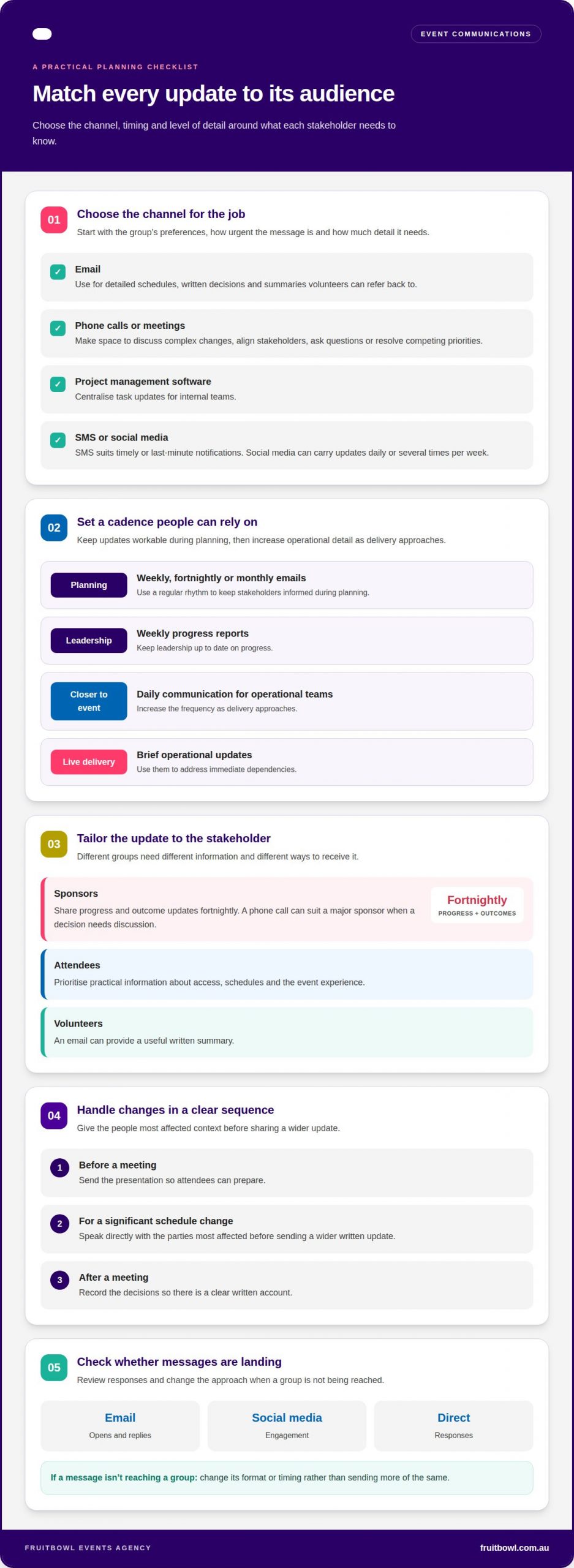
Choose channels according to each group’s preferences, message urgency and required detail. A communication plan makes communicating with event stakeholders purposeful by identifying who receives each update, through which channel and when. Email suits detailed schedules and written decisions; a phone call or meeting gives key parties space to discuss complex changes. Project management software can centralise task updates for internal teams.
Match each message to the stakeholder’s priorities. Sponsors may need fortnightly progress and outcome updates, while attendees need practical details about access, schedules and the event experience. A phone call can suit a major sponsor when a decision needs discussion; an email gives volunteers a useful written summary. Tailored messages show that each group’s involvement is understood.
Set a workable communication cadence, then adjust it as delivery approaches. Weekly, fortnightly or monthly emails can keep stakeholders informed during planning. Leadership may receive weekly progress reports, while operational teams may need daily communication closer to the event. During live delivery, brief operational updates can address immediate dependencies. Social media updates can be shared daily or several times per week, while SMS suits timely or last-minute notifications.
Use meetings when stakeholders need to align, ask questions or resolve competing priorities. Send a presentation before a scheduled meeting so attendees can prepare, then record decisions afterwards. For a significant schedule change, speak directly with the parties most affected before sending a wider written update. This gives key groups context and keeps the broader message consistent.
Review whether communicating with event stakeholders is working through email opens and replies, social media engagement and direct responses. If a message isn’t reaching a group, change its format or timing rather than sending more of the same. For complex events, structured event planning support can help coordinate communications alongside delivery. Choose channels that make the next action clear for each audience.
3. What Is Stakeholder Communication?
Stakeholder communication is an ongoing exchange of messages, decisions and responses, not simply announcements. It builds shared understanding and gives organisers a record of what each party has raised. For example, record a venue manager’s access concern alongside the decision and any resulting change.
Active listening makes feedback useful. In a meeting, summarise a stakeholder’s concern, ask a clarifying question and confirm the next step. If a supplier flags a delivery conflict, capture the affected schedule, the operational impact and the agreed response. This approach distinguishes an immediate issue from a suggestion for later consideration.
Track communication in one organised record, such as a stakeholder log or project system. Note the date, stakeholder, topic, communication channel, response, decision owner and follow-up action. Record verbal agreements in writing, then share the summary with the people involved. Clear records help teams retrieve earlier messages and reduce misunderstandings during event delivery.
For Australian events, requirements may apply when communications collect or use personal information. The event’s context and the information involved shape what organisers need to consider, including how survey responses are handled. Keep feedback requests relevant, explain their purpose clearly and limit access to collected responses to appropriate team members.
After the event, gather feedback through a short survey, stakeholder interviews or a review meeting. Ask about organisation, communication, reporting and whether agreed goals were met. Compare responses with the event plan, then document lessons and adjustments for future delivery. Report back to stakeholders with a concise summary of what they raised, what changed in response and what the team will carry forward. This closes the feedback loop and informs the next planning process.
4. A phased approach to implementing stakeholder communication
Build the communication plan around the event timeline, with an owner and purpose for each update. At project start, align stakeholders on shared goals, roles and success measures. Map each stakeholder group to its concerns, preferred channels and ability to influence delivery. This gives the team a clear basis for communicating effectively and maintaining relationships as decisions develop.
During early planning, consult the relevant local council or regulatory body about notification guidelines. Send initial stakeholder notifications at least 6–8 weeks before the event date; larger events may need several months’ notice. Explain the event’s purpose, likely effects and how people can raise concerns. For a change requiring public announcement, notify sponsors and other key stakeholders 24 to 72 hours beforehand.
As planning advances, set milestones for progress updates, supplier coordination and contingency messages. Monthly supplier meetings can establish a routine, with meetings becoming more frequent closer to event day. If scope or budget changes, explain what changed, what it means and what action follows. Share updates while the team is still collecting information, rather than waiting for every detail to be finalised.
During live delivery, keep operational messages direct and assign responsibility for issuing them. Daily briefings can surface emerging issues, confirm decisions and clarify who owns each next action. Record decisions promptly, then send written confirmation of verbal agreements. After the event, collect stakeholder feedback, report key outcomes and identify improvements for the next planning cycle. This connects engagement with delivery.
For a structured approach across planning and event delivery, plan your event with Fruitbowl.
Fruitbowl Events Agency
Fruitbowl Events Agency brings stakeholder communication into the wider event plan, connecting planning, logistics, programming and on-site delivery. This integrated approach is useful when internal teams, sponsors, suppliers and attendees need coordinated information as decisions progress.
For Corporate Events, Festivals & Public Events, Conferences & Seminars and Government Activations, the team can align communication with event objectives and delivery requirements. That means planning messages around key milestones, clarifying responsibilities and coordinating updates as the event takes shape. It’s a practical next step when stakeholder needs vary or communication must work alongside complex event logistics.
Contact Fruitbowl Events Agency to discuss your event and its stakeholder communication needs.
Make stakeholder communication part of the next event decision
The next event decision is an opportunity to strengthen stakeholder relationships. Treat each change as a chance to clarify who is affected, what they need to know and how the update supports the event’s objectives. A disciplined approach to communicating with event stakeholders gives the team a consistent basis for responding to new concerns as plans develop.
Fruitbowl Events Agency brings communication planning into the coordination of Corporate Events, Festivals & Public Events and Conferences & Seminars. This is valuable when stakeholder needs intersect with event logistics, programming and on-site delivery. Clear responsibilities and well-timed updates can help keep those moving parts aligned.
For support shaping an event around its stakeholders, contact Fruitbowl Events Agency. A considered plan can give your team a clear foundation for the work ahead.
Frequently Asked Questions
What Is Stakeholder Communication?
Stakeholder communication is the planned exchange of information between an event team and the people connected to its decisions or delivery. It includes sharing updates, receiving responses and following through on agreed actions. For example, if a speaker’s session time changes, communication should reach the speaker, stage manager and affected program teams, not just the person who approved the change.
Why is stakeholder engagement important?
Stakeholder engagement helps organisers surface constraints before they disrupt delivery. A venue contact might identify an access issue, while a sponsor may raise a concern about how their involvement is represented. Considering those perspectives can inform practical decisions and support working relationships. Engagement also gives stakeholders a clear way to raise concerns, rather than relying on assumptions or informal updates.
How do you identify stakeholder needs?
Trace the event’s decisions and delivery tasks to identify who depends on each one. For a public program, this may include the person approving the schedule, the team managing performers and the contact responsible for venue access. Ask each stakeholder what information they need to act, what could affect their responsibilities and how they prefer to raise an issue. Record the answers alongside their role.
How often should stakeholders receive updates?
Set update frequency according to the planning stage and each stakeholder’s responsibilities. Weekly, fortnightly or monthly emails can suit planning updates, while operational teams may need daily communication closer to delivery. Don’t send every group every internal detail. Send an update when a decision affects a stakeholder’s next action, and keep the agreed routine for ordinary progress so recipients know when to expect news.
How should you communicate during unexpected situations?
Use a clear, consistent message that explains what happened, what it means, what action people should take and when the next update will arrive. For example, if severe weather changes an outdoor event schedule, tell affected attendees where to find the revised arrangements and brief operational teams through their established channel. Use one contact point for public and media enquiries to keep responses aligned.
What is a stakeholder in events?
An event stakeholder is a person or organisation that can influence the event, contribute to its delivery or be affected by it. This can include the host, attendees, performers, suppliers, sponsors, venue representatives, council contacts and nearby businesses. A local trader near a festival may be a stakeholder even without a formal event role, because event activity could affect access to their premises.
OUR BLOG
Event Insights & Expertise
Our blog is your go-to resource for all things events. From expert insights and the latest industry trends to practical planning tips, we share everything you need to deliver standout experiences.
Contact Us