Common Event Planning Mistakes to Avoid: A Practical Guide

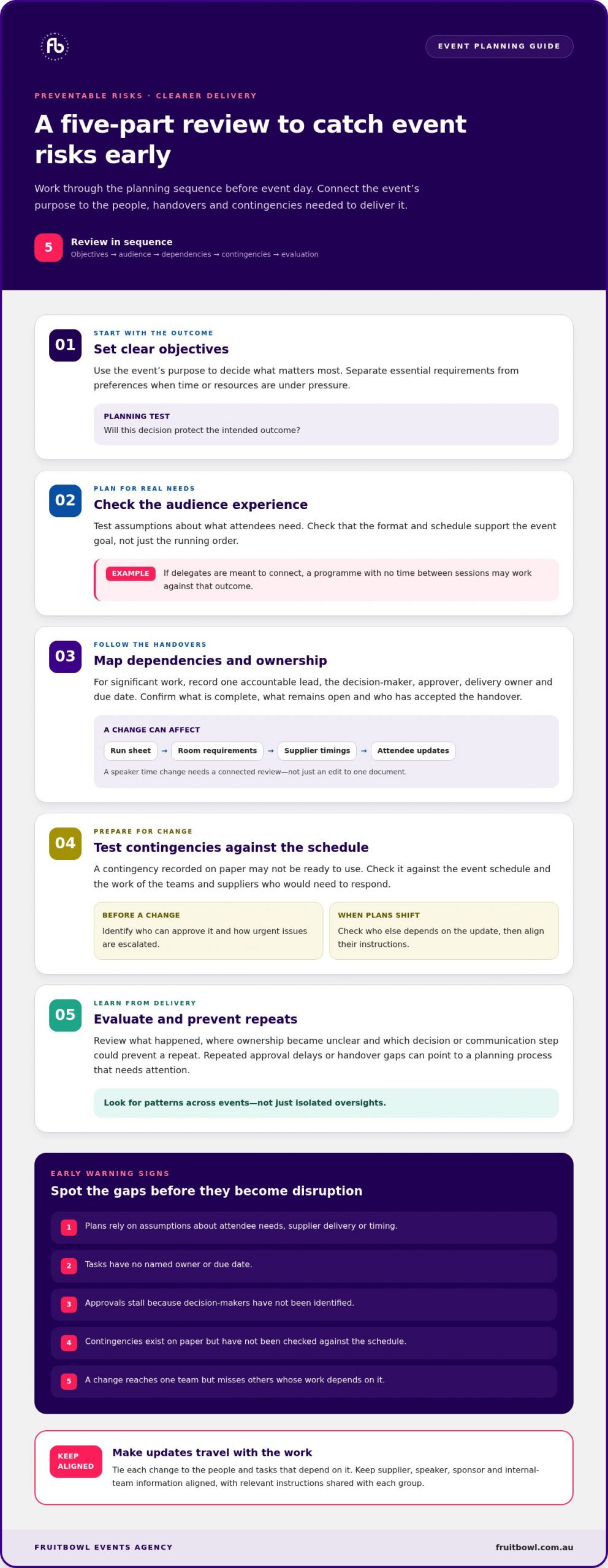
What if the event-day problems that worry you most begin with a planning decision nobody clearly owns? The common event planning mistakes to avoid are often less about one forgotten detail and more about gaps between audience needs, suppliers and delivery teams. Those gaps can turn a manageable change into visible disruption.

It’s understandable to feel pressure when every decision competes for attention. You need to balance the event’s objectives with a smooth attendee experience, clear responsibilities and operational readiness. A practical plan makes those priorities easier to manage.

This guide explains how to identify preventable risks early, assign ownership, communicate changes and prepare contingencies before they affect delivery. It also covers the planning details that deserve attention first, from stakeholder coordination to event safety and technical production. For more complex events, integrated management can reduce the pressure created by fragmented planning. Fruitbowl Events Agency brings this end-to-end approach to conferences, festivals, corporate events and activations, drawing on experience delivering more than 2,500 events. You’ll learn how to coordinate moving parts with greater confidence and protect the experience you intend attendees to have.

Key Takeaways

  • Use clear priorities to connect event goals with practical delivery decisions.
  • Learn how assigning one accountable lead to each task or approval can reduce communication gaps.
  • See how the common event planning mistakes to avoid can differ across conferences, festivals and public activations.
  • Follow a review sequence covering objectives, audience needs, dependencies, contingencies and evaluation.
  • Recognise when coordinated, end-to-end event management can help keep complex delivery moving in one direction.

Common event planning mistakes to avoid start with unclear priorities

Coordinating people, deadlines, suppliers and attendee expectations can put pressure on even an experienced team. The challenge isn’t simply keeping a long task list moving. Each decision needs to support the event’s purpose, and the people responsible for delivery need to understand what matters most.

A planning mistake is a preventable gap between an event goal and its delivery. For example, if the goal is to help conference delegates connect, a programme with no time between sessions may work against that outcome, even if every speaker arrives on schedule. Small oversights can affect the attendee experience, disrupt operations, introduce safety concerns or weaken organisational reputation. The principles of event management span planning, coordination and logistics, so decisions in one area can have practical consequences elsewhere.

Clear objectives help teams prioritise event decisions by showing which tasks directly protect the intended outcome and which can be adjusted. Use that test to distinguish essential requirements from preferences when deadlines or resources are under pressure.

Watch for early warning signs such as:

  • Plans built on assumptions about what attendees need, suppliers will provide or timings will allow.
  • Tasks discussed in meetings but left without a named owner or due date.
  • Approvals delayed because decision-makers haven’t been identified.
  • Contingencies recorded on paper but not tested against the event schedule.
  • Changes communicated to one team but not to others whose work depends on them.

Why do preventable event planning mistakes happen?

Competing priorities make unassigned tasks easy to overlook. A team may focus on securing speakers and finalising the programme while nobody checks how a schedule change affects room access, supplier arrival times or attendee updates. Assumptions add to the risk: a supplier may not understand a brief in the same way as the organiser, and an audience’s needs may differ from what the team expects.

One isolated oversight can be corrected without pointing to a wider weakness. A pattern, such as repeated approval delays or the same handover gaps across events, suggests the planning process needs attention. Review what happened, where ownership became unclear and which decision or communication step could prevent a repeat.

Which early warning signs should organisers notice?

Look for decisions that are repeatedly deferred or made without the stakeholders who will deliver them or be affected by them. A plan is also harder to action if it lacks a clear owner, deadline, approval point or escalation pathway. These are practical controls, not administrative extras: they clarify who acts, by when and what happens if a decision is blocked.

Late changes need a connected review, not just an edit to one document. If a speaker’s time shifts, check the run sheet, room requirements, supplier timings and attendee communications. This simple habit helps reveal knock-on effects while there’s still time to coordinate a response.

Event planning mistakes often begin with weak ownership and communication

A detailed plan can still fail if nobody knows who is accountable for moving each decision forward. Ownership means assigning one lead to each task, decision or approval. That person may coordinate others rather than complete every action, but they’re responsible for tracking progress, resolving blockers and confirming when the work is done.

Clear task ownership turns separate efforts into reliable event coordination. Without it, the same task can be handled twice while another is missed. A speaker briefing, for example, might be prepared by both the programme and communications teams, while nobody checks that the final timing reaches the technical crew. The issue isn’t only duplicated effort. It’s the handover gap between teams.

How do unclear roles create event-day problems?

Record the decision-maker, approver and delivery owner for each significant workstream in one shared plan. This makes it easier to see who can resolve a question and who needs to be informed. Define handover points too: the person passing work on should confirm what’s complete, what remains open and who has accepted responsibility. An assumed handover is a risk, not a completed task.

Communication gaps can then cascade. If a programme change isn’t passed to the supplier responsible for technical production, equipment or setup may not align with the revised schedule. If a speaker receives different timing from the on-site team, they may arrive or prepare for the wrong slot. Attendees can also receive outdated information, while internal teams lose time reconciling conflicting instructions.

These are common event planning mistakes to avoid because the consequences often cross team boundaries. A change that seems minor in one workstream can affect supplier call times, speaker preparation, sponsor commitments and attendee messaging. Tie updates to the people and tasks that depend on them, not only to the person who requested the change.

What communication gaps should an event plan close?

Set a practical rhythm for routine updates, identify which changes need approval and specify how urgent issues should be escalated. Keep supplier, speaker, sponsor and internal-team information aligned, while sharing only the instructions relevant to each group. This creates a clear path from decision to delivery without relying on informal conversations or scattered messages.

The run sheet should be the current reference for timings and operational instructions, with named owners and escalation contacts alongside key activities. Include the version date or update status, and make clear where the authoritative copy sits. When timings change, update the run sheet and communicate the revision to affected teams. Otherwise, different people may act on different versions. A short acknowledgement from each handover owner helps confirm the change has been received.

For complex events, coordinated planning can connect stakeholder liaison, technical production and on-site delivery in one workflow. Fruitbowl provides end-to-end event management across Australia, helping bring these moving parts together. Details of Fruitbowl’s event management outline this approach to coordinating delivery.

The biggest event planning risks vary by audience and event format

A planning check that suits a small conference may not address the pressures of a festival or public activation. The audience journey, programme structure, operating environment and number of dependencies all shape which risks deserve attention first. Treating every event the same can leave important details unexamined, even when the overall plan looks complete.

Use this format comparison to choose a starting point, then adapt the checks to the event design and its audience. These are common event planning mistakes to avoid, not universal rules: the programme, operating environment and audience needs determine which issues matter most.

  • Conference: A likely blind spot is a tight transition between registration, sessions and speaker changeovers. Check arrival flow, presentation readiness and the time needed to reset rooms between programme items.
  • Festival: A likely blind spot is planning crowd movement around programme peaks or changing conditions. Review how people move between areas, where staff need to be positioned and how operational changes will be communicated.
  • Public activation: A likely blind spot is assuming people will understand how to participate or move through the experience. Check that entry, activity instructions and exit routes are clear for the expected audience.

Build accessibility into these checks from the outset. Consider whether event information is understandable and accessible, whether arrival details are clear, and whether the attendee journey is practical for the people expected. Avoid assuming one format or channel will suit everyone. Where audience feedback or known access needs are available, use them to inform decisions about information, movement and participation.

Which attendee experience mistakes are easiest to overlook?

Entry arrangements can look straightforward on a plan but create friction if registration, ticketing or sign-in procedures don’t match the expected arrival pattern. Review how attendees find the entrance, what they need to present and where they go next. For conferences, consider session access after check-in; for activations, make participation instructions easy to follow. Test the journey from an attendee’s point of view.

How do operational and technical risks differ across events?

Conferences often depend on smooth speaker transitions, registration flow and presentation readiness. Festivals and public activations may place greater emphasis on crowd movement, staff positioning and responding to changing conditions. Across all formats, test sound, screens and other relevant technical elements in context. Document a workable contingency so teams know the next step if an element fails.

Prioritise risks by considering both their potential effect and their connections to other parts of delivery. A technical issue might affect a speaker, schedule and attendee information; a bottleneck might influence staffing and the timing of an activity. A concise review of audience needs, programme dependencies and the operating environment helps organisers focus on the issues most likely to affect delivery.
Common Event Planning Mistakes to Avoid: A Practical Guide

A practical event planning checklist can prevent mistakes before event day

A useful checklist is more than a record of tasks. It’s a repeatable review that connects event objectives with decisions, responsibilities and delivery requirements. Work through the sequence below, then revisit it whenever a significant change affects the plan. This makes it easier to spot common event planning mistakes to avoid before they reach attendees or disrupt the event team.

  1. Objectives: Confirm what the event needs to achieve and use those outcomes to guide priorities.
  2. Audience: Review attendee needs, arrival information, access and the intended experience.
  3. Ownership: Check that each task, decision and approval has a named lead and due date.
  4. Dependencies: Identify which activities rely on another team, supplier, approval or technical requirement.
  5. Contingencies: Record plausible disruptions, response leads and workable alternatives.
  6. Evaluation: Decide how the team will assess delivery against the objectives and capture lessons afterwards.

When a detail changes, trace its effects through the schedule, team responsibilities and attendee communications. A revised session time, for instance, may affect room preparation, speaker instructions and information already sent to attendees. Update the relevant documents together and make clear which version is current. Keep budget oversight at the process level too: record decisions, approvals and changes against the event plan so the team can see what has been agreed without relying on scattered updates.

How should teams review event readiness before delivery?

Bring operational, safety and technical leads into the same readiness review. Check owners, due dates, approvals and dependencies against the current plan, then confirm changes have reached everyone responsible for affected tasks. Record open risks, decisions still required and escalation routes in one shared place. For conference-specific planning, a conference logistics checklist can help structure the operational review.

What should a useful contingency plan include?

Identify plausible disruptions relevant to the event, then assign a lead to coordinate each response. Document who has authority to make the decision, how the change will be communicated and which alternative delivery options are practical. Rehearse critical handovers so the people involved understand their roles and can act on the same information. Preparation can help teams respond with greater clarity, but no plan can prevent every disruption.

A readiness process is most useful when teams apply it across the whole event, rather than treating each workstream in isolation. Fruitbowl’s end-to-end event management brings planning, logistics, technical production, event safety and on-site delivery into a coordinated approach. The end-to-end event management service connects these elements across complex event delivery.

Avoid event planning mistakes with coordinated, end-to-end delivery

When an event involves multiple stakeholders, suppliers and connected workstreams, managing each part separately can create gaps between the plan and what happens on the day. Coordinated event management brings planning, logistics, stakeholder liaison and on-site delivery into a connected process. This makes it easier to track how a change in one area affects the rest of the event, while keeping decisions aligned with the intended attendee experience.

Fruitbowl is an Australian event agency delivering end-to-end planning and on-site delivery for conferences, festivals, corporate events, government activations and brand activations. Its experience spans 2,500+ events delivered and 50+ successful events every year. Fruitbowl has operated for 28+ years, with 85+ years of combined team experience. These figures provide context for the team’s experience, not a guarantee of any particular event outcome.

What can end-to-end event management bring together?

Connected delivery means planning and logistics can be coordinated with stakeholder communication, event safety, technical production and on-site operations. Fruitbowl’s In-House AV Production covers staging, lighting, sound, vision, LED screens and technical direction. Event Safety & Compliance includes risk assessments, crowd and traffic management, and emergency procedures, bringing key operational considerations into the broader delivery plan.

Integration matters because workstreams depend on one another. A revised programme may affect technical cues, staging requirements, supplier coordination and the information shared with stakeholders. Coordinating these moving parts helps teams consider the effects together instead of treating each update as an isolated task. Fruitbowl also manages corporate events, with event delivery aligned to organisational objectives.

When is it helpful to bring in an event management team?

Professional support can be useful when an event has complex stakeholder relationships, a public audience, several delivery workstreams or technical and safety requirements that need close coordination. The appropriate level of support depends on the project: Event Management can be complete or partial, tailored to the areas where coordination is most needed.

For organisers, the decision often comes down to capacity and connection. If internal teams are spending more time resolving handovers than progressing the event, or if a change in one area repeatedly creates uncertainty elsewhere, a coordinated approach may reduce that pressure. It also gives planning, production and on-site delivery a shared operational direction.

Fruitbowl’s event management services bring planning and delivery together for projects that need coordinated support.

Set your next event up for confident delivery

Your next planning decision can shape more than the schedule. It can establish how your team will respond to change, keep stakeholders aligned and make the experience feel coherent for attendees. Before moving into delivery, choose one upcoming decision that could affect several parts of the event and make its impact visible to the people involved.

The common event planning mistakes to avoid are easier to address when coordination is treated as part of the event design, not left until the final checks. A fresh perspective can help connect creative intent with operational delivery and identify where your team needs additional support.

Fruitbowl works with organisations on events across Australia, bringing planning and delivery together around each project’s objectives. To discuss your next event and the delivery support it needs, get in touch with Fruitbowl.

With clear direction and the right coordination, your next event can move forward with greater confidence.

Frequently Asked Questions

What is the most common event planning mistake?

There’s no single mistake that applies to every event, but unclear objectives and unassigned responsibilities can undermine many plans. If a team hasn’t agreed whether an event is intended to inform, celebrate or encourage participation, it can struggle to judge competing requests. Start by documenting the intended outcomes, naming accountable leads and agreeing how changes will be communicated. These are practical common event planning mistakes to avoid across different event formats.

How do you avoid event planning mistakes?

Start with a clear purpose and an audience-focused plan, then turn key decisions into trackable actions. For example, if a programme includes a live presentation, record who supplies the final materials, who approves them and when they’re due. Keep a current version of timings and instructions, review readiness with relevant teams, and document responses to plausible disruptions. After delivery, capture lessons while team observations and attendee feedback are still fresh.

What happens if an event has no contingency plan?

Without a contingency plan, teams may need to make urgent decisions without agreed responsibilities, communication steps or alternatives. A delayed speaker, staffing change or technical issue can leave people uncertain about who has authority to adjust the programme. Prepare by identifying plausible disruptions and documenting a response lead, decision pathway and alternative action for each priority scenario. This supports a more coordinated response, but it can’t ensure that disruptions won’t occur.

How can event organisers improve the attendee experience?

Plan the attendee journey from the first invitation through arrival, participation and departure. Check that essential details, such as entry instructions and programme information, are easy to understand and accessible to the intended audience. Consider how registration or entry will work at busy arrival periods, and gather relevant feedback to identify friction points. A conference delegate, festival visitor and activation participant may each need different information, so shape the experience around the event format.

Why should event teams test AV equipment before an event?

Testing gives technical teams an opportunity to identify problems before they affect presentations, performances or audience participation. Test the equipment and connections required for the actual programme, including transitions between speakers or content. Confirm that speakers and production staff have aligned technical requirements and timings. If a presentation file won’t load or a microphone needs replacing, a documented response plan helps clarify the next action rather than leaving the team to improvise.

When should you engage an event management agency?

Consider an event management agency when delivery involves several stakeholders, complex logistics, technical production, a public audience or coordinated safety planning. Support may cover the whole project or selected parts, depending on your team’s capacity and the event’s needs. Fruitbowl provides complete or partial Event Management, including planning, logistics and on-site delivery. Agreeing the project’s objectives and decision pathways early helps the delivery team coordinate its work as plans develop.

How do you evaluate whether an event was successful?

Evaluate success against the objectives set during planning, rather than relying on one headline measure. If the aim was to build participation, for example, consider relevant engagement measures alongside attendee feedback and observations from the team. Compare intended and actual delivery, noting changes that affected the programme or experience. Record what should be repeated, revised or removed for future events, and assign an owner to each follow-up action so the review informs practice.

What if the event-day problems that worry you most begin with a planning decision nobody clearly owns? The common event planning mistakes to avoid are often less about one forgotten detail and more about gaps between audience needs, suppliers and delivery teams. Those gaps can turn a manageable change into visible disruption.

It’s understandable to feel pressure when every decision competes for attention. You need to balance the event’s objectives with a smooth attendee experience, clear responsibilities and operational readiness. A practical plan makes those priorities easier to manage.

This guide explains how to identify preventable risks early, assign ownership, communicate changes and prepare contingencies before they affect delivery. It also covers the planning details that deserve attention first, from stakeholder coordination to event safety and technical production. For more complex events, integrated management can reduce the pressure created by fragmented planning. Fruitbowl Events Agency brings this end-to-end approach to conferences, festivals, corporate events and activations, drawing on experience delivering more than 2,500 events. You’ll learn how to coordinate moving parts with greater confidence and protect the experience you intend attendees to have.

Key Takeaways

  • Use clear priorities to connect event goals with practical delivery decisions.
  • Learn how assigning one accountable lead to each task or approval can reduce communication gaps.
  • See how the common event planning mistakes to avoid can differ across conferences, festivals and public activations.
  • Follow a review sequence covering objectives, audience needs, dependencies, contingencies and evaluation.
  • Recognise when coordinated, end-to-end event management can help keep complex delivery moving in one direction.

Common event planning mistakes to avoid start with unclear priorities

Coordinating people, deadlines, suppliers and attendee expectations can put pressure on even an experienced team. The challenge isn’t simply keeping a long task list moving. Each decision needs to support the event’s purpose, and the people responsible for delivery need to understand what matters most.

A planning mistake is a preventable gap between an event goal and its delivery. For example, if the goal is to help conference delegates connect, a programme with no time between sessions may work against that outcome, even if every speaker arrives on schedule. Small oversights can affect the attendee experience, disrupt operations, introduce safety concerns or weaken organisational reputation. The principles of event management span planning, coordination and logistics, so decisions in one area can have practical consequences elsewhere.

Clear objectives help teams prioritise event decisions by showing which tasks directly protect the intended outcome and which can be adjusted. Use that test to distinguish essential requirements from preferences when deadlines or resources are under pressure.

Watch for early warning signs such as:

  • Plans built on assumptions about what attendees need, suppliers will provide or timings will allow.
  • Tasks discussed in meetings but left without a named owner or due date.
  • Approvals delayed because decision-makers haven’t been identified.
  • Contingencies recorded on paper but not tested against the event schedule.
  • Changes communicated to one team but not to others whose work depends on them.

Why do preventable event planning mistakes happen?

Competing priorities make unassigned tasks easy to overlook. A team may focus on securing speakers and finalising the programme while nobody checks how a schedule change affects room access, supplier arrival times or attendee updates. Assumptions add to the risk: a supplier may not understand a brief in the same way as the organiser, and an audience’s needs may differ from what the team expects.

One isolated oversight can be corrected without pointing to a wider weakness. A pattern, such as repeated approval delays or the same handover gaps across events, suggests the planning process needs attention. Review what happened, where ownership became unclear and which decision or communication step could prevent a repeat.

Which early warning signs should organisers notice?

Look for decisions that are repeatedly deferred or made without the stakeholders who will deliver them or be affected by them. A plan is also harder to action if it lacks a clear owner, deadline, approval point or escalation pathway. These are practical controls, not administrative extras: they clarify who acts, by when and what happens if a decision is blocked.

Late changes need a connected review, not just an edit to one document. If a speaker’s time shifts, check the run sheet, room requirements, supplier timings and attendee communications. This simple habit helps reveal knock-on effects while there’s still time to coordinate a response.

Event planning mistakes often begin with weak ownership and communication

A detailed plan can still fail if nobody knows who is accountable for moving each decision forward. Ownership means assigning one lead to each task, decision or approval. That person may coordinate others rather than complete every action, but they’re responsible for tracking progress, resolving blockers and confirming when the work is done.

Clear task ownership turns separate efforts into reliable event coordination. Without it, the same task can be handled twice while another is missed. A speaker briefing, for example, might be prepared by both the programme and communications teams, while nobody checks that the final timing reaches the technical crew. The issue isn’t only duplicated effort. It’s the handover gap between teams.

How do unclear roles create event-day problems?

Record the decision-maker, approver and delivery owner for each significant workstream in one shared plan. This makes it easier to see who can resolve a question and who needs to be informed. Define handover points too: the person passing work on should confirm what’s complete, what remains open and who has accepted responsibility. An assumed handover is a risk, not a completed task.

Communication gaps can then cascade. If a programme change isn’t passed to the supplier responsible for technical production, equipment or setup may not align with the revised schedule. If a speaker receives different timing from the on-site team, they may arrive or prepare for the wrong slot. Attendees can also receive outdated information, while internal teams lose time reconciling conflicting instructions.

These are common event planning mistakes to avoid because the consequences often cross team boundaries. A change that seems minor in one workstream can affect supplier call times, speaker preparation, sponsor commitments and attendee messaging. Tie updates to the people and tasks that depend on them, not only to the person who requested the change.

What communication gaps should an event plan close?

Set a practical rhythm for routine updates, identify which changes need approval and specify how urgent issues should be escalated. Keep supplier, speaker, sponsor and internal-team information aligned, while sharing only the instructions relevant to each group. This creates a clear path from decision to delivery without relying on informal conversations or scattered messages.

The run sheet should be the current reference for timings and operational instructions, with named owners and escalation contacts alongside key activities. Include the version date or update status, and make clear where the authoritative copy sits. When timings change, update the run sheet and communicate the revision to affected teams. Otherwise, different people may act on different versions. A short acknowledgement from each handover owner helps confirm the change has been received.

For complex events, coordinated planning can connect stakeholder liaison, technical production and on-site delivery in one workflow. Fruitbowl provides end-to-end event management across Australia, helping bring these moving parts together. Details of Fruitbowl’s event management outline this approach to coordinating delivery.

The biggest event planning risks vary by audience and event format

A planning check that suits a small conference may not address the pressures of a festival or public activation. The audience journey, programme structure, operating environment and number of dependencies all shape which risks deserve attention first. Treating every event the same can leave important details unexamined, even when the overall plan looks complete.

Use this format comparison to choose a starting point, then adapt the checks to the event design and its audience. These are common event planning mistakes to avoid, not universal rules: the programme, operating environment and audience needs determine which issues matter most.

  • Conference: A likely blind spot is a tight transition between registration, sessions and speaker changeovers. Check arrival flow, presentation readiness and the time needed to reset rooms between programme items.
  • Festival: A likely blind spot is planning crowd movement around programme peaks or changing conditions. Review how people move between areas, where staff need to be positioned and how operational changes will be communicated.
  • Public activation: A likely blind spot is assuming people will understand how to participate or move through the experience. Check that entry, activity instructions and exit routes are clear for the expected audience.

Build accessibility into these checks from the outset. Consider whether event information is understandable and accessible, whether arrival details are clear, and whether the attendee journey is practical for the people expected. Avoid assuming one format or channel will suit everyone. Where audience feedback or known access needs are available, use them to inform decisions about information, movement and participation.

Which attendee experience mistakes are easiest to overlook?

Entry arrangements can look straightforward on a plan but create friction if registration, ticketing or sign-in procedures don’t match the expected arrival pattern. Review how attendees find the entrance, what they need to present and where they go next. For conferences, consider session access after check-in; for activations, make participation instructions easy to follow. Test the journey from an attendee’s point of view.

How do operational and technical risks differ across events?

Conferences often depend on smooth speaker transitions, registration flow and presentation readiness. Festivals and public activations may place greater emphasis on crowd movement, staff positioning and responding to changing conditions. Across all formats, test sound, screens and other relevant technical elements in context. Document a workable contingency so teams know the next step if an element fails.

Prioritise risks by considering both their potential effect and their connections to other parts of delivery. A technical issue might affect a speaker, schedule and attendee information; a bottleneck might influence staffing and the timing of an activity. A concise review of audience needs, programme dependencies and the operating environment helps organisers focus on the issues most likely to affect delivery.

A practical event planning checklist can prevent mistakes before event day

A useful checklist is more than a record of tasks. It’s a repeatable review that connects event objectives with decisions, responsibilities and delivery requirements. Work through the sequence below, then revisit it whenever a significant change affects the plan. This makes it easier to spot common event planning mistakes to avoid before they reach attendees or disrupt the event team.

  1. Objectives: Confirm what the event needs to achieve and use those outcomes to guide priorities.
  2. Audience: Review attendee needs, arrival information, access and the intended experience.
  3. Ownership: Check that each task, decision and approval has a named lead and due date.
  4. Dependencies: Identify which activities rely on another team, supplier, approval or technical requirement.
  5. Contingencies: Record plausible disruptions, response leads and workable alternatives.
  6. Evaluation: Decide how the team will assess delivery against the objectives and capture lessons afterwards.

When a detail changes, trace its effects through the schedule, team responsibilities and attendee communications. A revised session time, for instance, may affect room preparation, speaker instructions and information already sent to attendees. Update the relevant documents together and make clear which version is current. Keep budget oversight at the process level too: record decisions, approvals and changes against the event plan so the team can see what has been agreed without relying on scattered updates.

How should teams review event readiness before delivery?

Bring operational, safety and technical leads into the same readiness review. Check owners, due dates, approvals and dependencies against the current plan, then confirm changes have reached everyone responsible for affected tasks. Record open risks, decisions still required and escalation routes in one shared place. For conference-specific planning, a conference logistics checklist can help structure the operational review.

What should a useful contingency plan include?

Identify plausible disruptions relevant to the event, then assign a lead to coordinate each response. Document who has authority to make the decision, how the change will be communicated and which alternative delivery options are practical. Rehearse critical handovers so the people involved understand their roles and can act on the same information. Preparation can help teams respond with greater clarity, but no plan can prevent every disruption.

A readiness process is most useful when teams apply it across the whole event, rather than treating each workstream in isolation. Fruitbowl’s end-to-end event management brings planning, logistics, technical production, event safety and on-site delivery into a coordinated approach. The end-to-end event management service connects these elements across complex event delivery.

Avoid event planning mistakes with coordinated, end-to-end delivery

When an event involves multiple stakeholders, suppliers and connected workstreams, managing each part separately can create gaps between the plan and what happens on the day. Coordinated event management brings planning, logistics, stakeholder liaison and on-site delivery into a connected process. This makes it easier to track how a change in one area affects the rest of the event, while keeping decisions aligned with the intended attendee experience.

Fruitbowl is an Australian event agency delivering end-to-end planning and on-site delivery for conferences, festivals, corporate events, government activations and brand activations. Its experience spans 2,500+ events delivered and 50+ successful events every year. Fruitbowl has operated for 28+ years, with 85+ years of combined team experience. These figures provide context for the team’s experience, not a guarantee of any particular event outcome.

What can end-to-end event management bring together?

Connected delivery means planning and logistics can be coordinated with stakeholder communication, event safety, technical production and on-site operations. Fruitbowl’s In-House AV Production covers staging, lighting, sound, vision, LED screens and technical direction. Event Safety & Compliance includes risk assessments, crowd and traffic management, and emergency procedures, bringing key operational considerations into the broader delivery plan.

Integration matters because workstreams depend on one another. A revised programme may affect technical cues, staging requirements, supplier coordination and the information shared with stakeholders. Coordinating these moving parts helps teams consider the effects together instead of treating each update as an isolated task. Fruitbowl also manages corporate events, with event delivery aligned to organisational objectives.

When is it helpful to bring in an event management team?

Professional support can be useful when an event has complex stakeholder relationships, a public audience, several delivery workstreams or technical and safety requirements that need close coordination. The appropriate level of support depends on the project: Event Management can be complete or partial, tailored to the areas where coordination is most needed.

For organisers, the decision often comes down to capacity and connection. If internal teams are spending more time resolving handovers than progressing the event, or if a change in one area repeatedly creates uncertainty elsewhere, a coordinated approach may reduce that pressure. It also gives planning, production and on-site delivery a shared operational direction.

Fruitbowl’s event management services bring planning and delivery together for projects that need coordinated support.

Set your next event up for confident delivery

Your next planning decision can shape more than the schedule. It can establish how your team will respond to change, keep stakeholders aligned and make the experience feel coherent for attendees. Before moving into delivery, choose one upcoming decision that could affect several parts of the event and make its impact visible to the people involved.

The common event planning mistakes to avoid are easier to address when coordination is treated as part of the event design, not left until the final checks. A fresh perspective can help connect creative intent with operational delivery and identify where your team needs additional support.

Fruitbowl works with organisations on events across Australia, bringing planning and delivery together around each project’s objectives. To discuss your next event and the delivery support it needs, get in touch with Fruitbowl.

With clear direction and the right coordination, your next event can move forward with greater confidence.

Frequently Asked Questions

What is the most common event planning mistake?

There’s no single mistake that applies to every event, but unclear objectives and unassigned responsibilities can undermine many plans. If a team hasn’t agreed whether an event is intended to inform, celebrate or encourage participation, it can struggle to judge competing requests. Start by documenting the intended outcomes, naming accountable leads and agreeing how changes will be communicated. These are practical common event planning mistakes to avoid across different event formats.

How do you avoid event planning mistakes?

Start with a clear purpose and an audience-focused plan, then turn key decisions into trackable actions. For example, if a programme includes a live presentation, record who supplies the final materials, who approves them and when they’re due. Keep a current version of timings and instructions, review readiness with relevant teams, and document responses to plausible disruptions. After delivery, capture lessons while team observations and attendee feedback are still fresh.

What happens if an event has no contingency plan?

Without a contingency plan, teams may need to make urgent decisions without agreed responsibilities, communication steps or alternatives. A delayed speaker, staffing change or technical issue can leave people uncertain about who has authority to adjust the programme. Prepare by identifying plausible disruptions and documenting a response lead, decision pathway and alternative action for each priority scenario. This supports a more coordinated response, but it can’t ensure that disruptions won’t occur.

How can event organisers improve the attendee experience?

Plan the attendee journey from the first invitation through arrival, participation and departure. Check that essential details, such as entry instructions and programme information, are easy to understand and accessible to the intended audience. Consider how registration or entry will work at busy arrival periods, and gather relevant feedback to identify friction points. A conference delegate, festival visitor and activation participant may each need different information, so shape the experience around the event format.

Why should event teams test AV equipment before an event?

Testing gives technical teams an opportunity to identify problems before they affect presentations, performances or audience participation. Test the equipment and connections required for the actual programme, including transitions between speakers or content. Confirm that speakers and production staff have aligned technical requirements and timings. If a presentation file won’t load or a microphone needs replacing, a documented response plan helps clarify the next action rather than leaving the team to improvise.

When should you engage an event management agency?

Consider an event management agency when delivery involves several stakeholders, complex logistics, technical production, a public audience or coordinated safety planning. Support may cover the whole project or selected parts, depending on your team’s capacity and the event’s needs. Fruitbowl provides complete or partial Event Management, including planning, logistics and on-site delivery. Agreeing the project’s objectives and decision pathways early helps the delivery team coordinate its work as plans develop.

How do you evaluate whether an event was successful?

Evaluate success against the objectives set during planning, rather than relying on one headline measure. If the aim was to build participation, for example, consider relevant engagement measures alongside attendee feedback and observations from the team. Compare intended and actual delivery, noting changes that affected the programme or experience. Record what should be repeated, revised or removed for future events, and assign an owner to each follow-up action so the review informs practice.

Back to Articles
Request A Quote

Make an
Enquiry

Untitled design

What Makes Us Different?

True end-to-end solution so you can hand off to us, focus on your priorities and enjoy the event without any stress

Unmatched industry expertise looking after diverse range of high-profile events, cultural festivals & activations

Meticulous attention to every detail and precise execution of events with our streamlined processes

Tailored solutions with bespoke strategies to ensure we align with your brand and objectives

Make an Enquiry

"*" indicates required fields

This field is for validation purposes and should be left unchanged.

"*" indicates required fields

This field is for validation purposes and should be left unchanged.