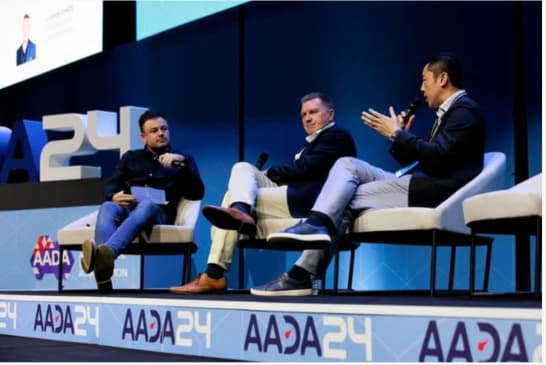
Association Conference Management: 2026 Strategic Guide

The most technically flawless association conference you’ve ever attended probably looked effortless. It wasn’t. Behind every seamless keynote, every perfectly timed breakout session, and every satisfied sponsor was a disciplined framework of decisions made months in advance by people who understood exactly what was at stake. That’s the reality of effective association conference management, and it’s far more demanding than most association boards anticipate until they’re already deep in the planning cycle.

If your team is feeling the pressure of competing committee priorities, plateauing sponsorship revenue, and the ever-growing complexity of hybrid delivery, you’re not alone. These are the defining challenges facing association leaders across Australia right now, and they don’t resolve themselves through goodwill and spreadsheets.

This guide is built to change that. Drawing on the principles that underpin high-impact conference delivery, it covers how to align stakeholder requirements with logistical precision, protect your sponsorship revenue, and create a delegate experience that genuinely elevates your association’s reputation. What follows is a strategic framework designed to bring order, clarity, and confidence to every stage of your 2026 conference planning.

Key Takeaways

  • Effective association conference management requires a fundamentally different approach to corporate event planning — one that accounts for member-driven objectives, governance structures, and rotating committee priorities.
  • A robust budget management framework and a strategic approach to sponsorship and exhibition sales are essential to protecting your conference’s long-term financial sustainability.
  • Technical direction and AV management are not peripheral concerns — they are the backbone of a credible plenary experience and must be integrated into your planning framework from the outset.
  • Associations with rotating conference locations across Australia require a partner with genuine national reach and the venue relationships to negotiate maximum value in any market.
  • Twenty-eight years of industry experience translates into a measurable advantage — the ability to anticipate risk, resolve complexity before it surfaces on-site, and deliver a delegate experience that strengthens your association’s reputation.

What is Association Conference Management in 2026?

At its core, association conference management is the specialised coordination of large-scale events for member-based and for-purpose organisations. But that definition only captures the surface of what’s actually involved. Unlike a product launch or a corporate leadership summit, an association conference exists to serve an entire membership community, advance a profession, and reinforce the credibility of the organisation that convenes it. The stakes are categorically different, and the management discipline required reflects that.

Association conventions and conferences have a long and structured history as vehicles for professional development, peer connection, and sector-wide advocacy. What’s changed in 2026 is the level of operational sophistication members now expect as standard, and the complexity of delivering that experience across rotating locations, hybrid formats, and increasingly demanding sponsor requirements.

Three factors distinguish association conference management from its corporate counterpart:

  • Governance structures: Decisions move through boards, sub-committees, and elected representatives, not a single client contact with clear authority.
  • Member-driven objectives: Success is measured by professional value delivered to attendees, not commercial outcomes alone.
  • Reputational weight: A poorly executed conference reflects directly on the association’s standing within its sector, often for years.

A Professional Conference Organiser (PCO) operating in this environment isn’t simply a logistics provider. They function as a strategic partner, translating the association’s mission into a coherent event architecture, then executing every component with the precision that protects the organisation’s reputation on the day.

The Shift Toward Experience-Driven Conferences

Passive, session-heavy programmes are losing ground. Members arrive at conferences expecting meaningful interaction, genuine intellectual challenge, and production values that reflect the professionalism of their sector. Aligning the event theme with the association’s long-term strategic direction isn’t optional; it’s the difference between a conference that builds loyalty and one that simply fills a calendar slot. Technical excellence, from AV delivery to platform reliability, is now a baseline expectation rather than a differentiator.

Navigating Association Governance and Stakeholders

The ‘too many cooks’ challenge is real, and it’s one of the most underestimated risks in the planning cycle. Effective association conference management requires clearly defined reporting lines between the managing agency and the board, with sub-committee input structured so it informs decisions rather than delays them. Every logistical choice, from venue selection to session sequencing, must be traceable back to the organisation’s broader strategic goals. Without that discipline, competing priorities fragment the programme and erode the delegate experience before the event even opens.

The Core Pillars of Comprehensive Conference Logistics

Logistics is where strategy either holds or collapses. A well-constructed conference vision means nothing if the venue contract leaves your association exposed, if the registration platform creates friction on day one, or if your keynote speaker arrives without a briefing document and addresses the wrong audience entirely. Effective association conference management is built on a set of interlocking disciplines, each of which demands the same level of rigour as the programme itself.

The conference logistics coordinator role sits at the centre of this framework. In 2026, that function has evolved well beyond scheduling and supplier calls. A skilled logistics coordinator is simultaneously a risk manager, a stakeholder liaison, and a real-time problem solver. They hold the architecture of the event together across every workstream, from abstract submissions to bump-out, and their effectiveness directly determines whether the programme runs with the precision your members expect.

Abstract management and programme development deserve particular attention. Content quality isn’t self-regulating. Without a structured submission and review process, programmes become uneven, sessions overlap thematically, and the intellectual coherence that makes a conference genuinely valuable starts to erode. A disciplined abstract management framework, with clear submission criteria, blind review protocols, and a programme committee that operates to a defined timeline, protects the standard of content before a single slide is loaded.

Registration is often underestimated as a logistical concern. It shouldn’t be. The registration experience is the first material touchpoint your delegates have with the event, and a clunky or confusing process sets a tone that’s difficult to recover from. Frictionless entry means intuitive platform design, accurate confirmation workflows, dietary and accessibility data captured at source, and on-site check-in that moves efficiently regardless of volume.

Venue and Supplier Management

Venue selection for association conferences requires evaluation across three dimensions: accessibility for a national membership base, technical infrastructure capable of supporting hybrid delivery and multi-room AV, and sustainability credentials that align with the values of a member-driven organisation. Contract negotiation should extract maximum value on attrition clauses, catering minimums, and exclusivity provisions. Managing third-party vendors, from caterers to AV crews to transport providers, requires consistent service level expectations enforced across every supplier relationship, not just the headline ones.

Speaker and Talent Coordination

Sourcing high-calibre keynote speakers and entertainers is a procurement exercise that carries significant reputational weight. Technical riders, travel logistics, and accommodation requirements for both international and domestic talent must be managed with precision and lead time. Critically, every speaker needs a thorough briefing on the association’s audience, sector context, and the specific tone the programme is designed to strike. A brilliant speaker who misreads the room delivers a forgettable session. One who’s been properly prepared delivers a defining moment.

Associations working with an experienced partner can access established talent relationships and the logistical infrastructure to manage complex speaker requirements without the internal resourcing burden. Explore how end-to-end conference management can take that coordination off your committee’s plate entirely.

Integrating Technical Direction and Creative Vision

There’s a persistent misconception in conference planning that technical production and creative vision operate as separate workstreams, one handled by the AV crew and the other by a designer or marketing team. In practice, the two are inseparable. When they’re managed in isolation, the result is a plenary session where the lighting undercuts the keynote’s impact, where slide transitions clash with the programme’s emotional arc, or where a beautifully conceived theme fails to translate into anything a delegate actually experiences. Effective association conference management demands that technical direction and creative vision be developed together, from the earliest planning stages, not reconciled at the last minute in a venue loading dock.

AV management for events is the structural backbone of a credible plenary experience. Audio clarity, display resolution, lighting temperature, and stage sightlines are not production details. They’re the conditions under which your speakers are heard, your content lands, and your association’s authority is either confirmed or quietly eroded. A technical director who understands the programme’s intent can shape those conditions to serve every session, not just the headline keynote.

Bridging the gap between concept and execution requires a disciplined translation process. A creative brief that specifies mood, colour palette, and thematic language must be converted into technical specifications: fixture types, rigging points, screen configurations, signal pathways. Without that translation, creative concepts remain aspirational. With it, they become the architecture of the delegate experience.

High-Stakes Technical Execution

Multi-day association conferences carry compounding technical risk. Redundancy planning is non-negotiable: live stream failover systems, duplicate presentation servers, and backup audio routing must be engineered into the infrastructure before bump-in begins. Complex staging across multiple rooms requires a centralised technical management structure with clear communication protocols between crew leads. Every technical decision must remain grounded in logistical reality; the most ambitious production design is only as valuable as its capacity to be executed reliably, on time, across every session of a four-day programme.

Creative Theming and Branding

An association’s visual identity shouldn’t appear only on the registration desk signage and the lanyard. A cohesive creative vision extends through every physical and digital touchpoint: stage set design, holding slides, social function theming, gala dinner centrepieces, and the ambient environment delegates move through between sessions. This consistency isn’t decorative. Research into event experience consistently links environmental coherence with higher delegate satisfaction and stronger post-event recall of the organisation’s brand positioning. When the creative production is purposeful and unified, it reinforces the association’s authority within its sector in ways that a polished programme alone cannot achieve.
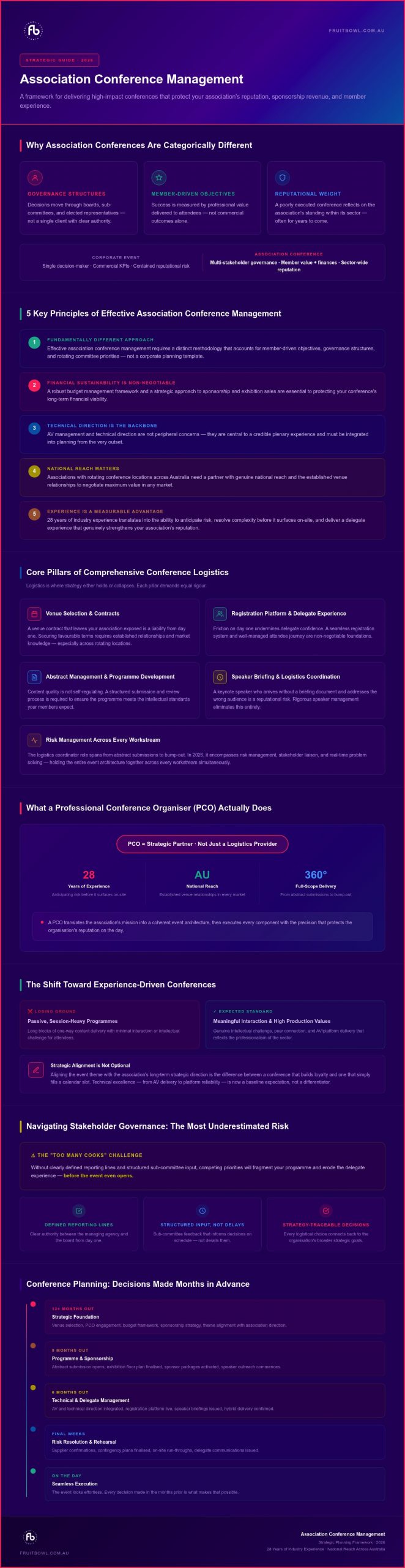
Financial pressure is the silent disruptor of association conference management. Boards approve ambitious programmes, committees build detailed run sheets, and then the budget reality arrives. Without a robust financial framework established at the very start of the planning cycle, cost overruns accumulate quietly across supplier categories until they become impossible to absorb. The discipline required isn’t reactive. It’s structural.

A sound budget framework for association conferences separates fixed costs from variable ones, establishes contingency reserves before expenditure begins, and maintains rolling reconciliation throughout the planning cycle rather than a single audit at the end. Financial reporting to boards and auditors must be transparent, timely, and formatted to support governance decisions, not just satisfy compliance requirements. When a board can see a clear, current picture of revenue against expenditure at any point in the cycle, it makes better decisions faster.

Delegate pricing sits at the intersection of financial sustainability and member value. Setting registration fees too low to fill seats creates a shortfall that sponsorship revenue rarely covers completely. Setting them too high risks suppressing attendance and undermining the member benefit the conference exists to deliver. The calibration requires honest modelling of expected attendance, a realistic assessment of production costs, and a sponsorship revenue projection that’s grounded in confirmed commitments rather than optimistic forecasts.

Driving Sponsorship ROI

The ‘logo on a slide’ model has a limited shelf life, and most industry partners already know it. Sponsors are allocating budgets with greater scrutiny, and they’re looking for measurable engagement, not passive brand placement. Effective sponsorship packages in 2026 are built around genuine integration: session naming rights tied to relevant programme content, curated networking opportunities with specific delegate cohorts, and visibility within the event app that reflects how delegates actually navigate the conference experience. Post-event reporting that quantifies sponsor engagement, including session attendance figures, app interaction data, and exhibition traffic, transforms a transactional arrangement into a relationship worth renewing.

  • Tiered packages should differentiate meaningfully across levels, with each tier offering a distinct value proposition rather than simply more logo placements.
  • Programme integration works best when it’s contextually relevant; a technology partner presenting a case study within a dedicated session carries more weight than a banner in the foyer.
  • Post-event reporting should be a contractual deliverable, not an afterthought, and should include metrics sponsors can take back to their own boards.

Risk Management and Compliance

Risk management is where many conference plans remain dangerously thin. Basic event insurance is a starting point, not a strategy. A comprehensive event risk management plan for a large-scale association gathering addresses a far wider scope: crowd management protocols, emergency evacuation procedures, supplier default contingencies, data privacy compliance under Australian privacy legislation, and the specific obligations that apply to public-facing activations and government-regulated venues.

National safety standards vary across states and territories, and a conference that rotates locations across Australia must adapt its compliance framework accordingly. What’s required in Queensland isn’t identical to what applies in Victoria or Western Australia. Managing that complexity demands experience with the regulatory landscape in each market, not a generic checklist applied uniformly.

This is precisely where a seasoned conference management partner earns its place. The value isn’t just operational; it’s the confidence that comes from working with a team that has navigated high-stakes public activations before, understands where the compliance gaps tend to appear, and has the supplier relationships and contingency protocols already in place when conditions change on-site.

Speak with Fruitbowl Events about building a financially sustainable conference framework that protects your association’s revenue, satisfies your board’s governance requirements, and gives your sponsors a return worth coming back for.

Strategic Partnerships: Why Experience Matters

Choosing a conference management partner is one of the most consequential decisions an association board will make in any planning cycle. The difference between an agency that manages logistics and one that genuinely understands association conference management at a strategic level is measurable, and it shows up in ways that matter: in the quality of the delegate experience, in the confidence of the board, and in the renewal conversations with sponsors the following year.

Twenty-eight years of corporate event management experience doesn’t simply mean a longer client list. It means a team that has encountered every category of risk, resolved every variety of on-site crisis, and built the supplier relationships and institutional knowledge that allow problems to be anticipated rather than reacted to. That depth of experience translates directly into fewer surprises for your committee and a more controlled outcome for your members.

For associations that rotate their annual conference across Australia, national reach isn’t a convenience. It’s a structural requirement. Venue relationships in Brisbane don’t transfer to Adelaide. Preferred AV suppliers in Melbourne may not have the crew capacity to service a Perth convention centre at the same standard. A partner with genuine national infrastructure brings consistent service quality regardless of location, and the negotiating leverage to extract maximum value from venue contracts in any market.

Evaluating a Conference Management Partner

The right agency demonstrates a track record across both logistics and creative production, not one at the expense of the other. Assess their capacity to manage diverse stakeholder groups, including boards, sub-committees, and external sponsors, without losing momentum. Technical literacy is non-negotiable in 2026: a modern PCO must understand AV infrastructure, hybrid platform requirements, and the production decisions that shape the delegate experience at a fundamental level, not just coordinate with a separate technical crew.

Transitioning to a Managed Partnership

The handover from internal planning to a managed partnership works best when it’s structured early. Bringing an experienced partner into the planning cycle at the strategy stage, rather than the logistics stage, means their expertise shapes the programme architecture rather than simply executing someone else’s decisions. Clear governance protocols, defined communication channels, and a shared project timeline remove the friction that often accompanies this transition.

The Future of Association Conferences

The defining trends of 2026 are hyper-personalisation and AI integration, and associations that ignore them risk losing ground to more agile competitors for member attention. Personalised session recommendations, AI-assisted matchmaking for networking, and dynamic content delivery based on delegate profiles are moving from innovation to expectation. Staying ahead of these shifts requires a partner who’s already building them into their operational frameworks, not discovering them alongside you.

Your conference should be the unmissable event in your sector’s calendar. That outcome doesn’t happen by accident. It’s the product of disciplined planning, experienced execution, and a partnership built on genuine strategic alignment. Contact Fruitbowl Events Agency for a strategic consultation and find out what a fully managed approach can deliver for your 2026 programme.

Build Your 2026 Conference on a Foundation That Holds

Association conference management in 2026 demands more than good intentions and a capable committee. It requires a disciplined framework that integrates governance, logistics, technical production, and financial sustainability into a single, coherent delivery structure. When those elements work together, the result isn’t just a well-run event; it’s a conference that measurably strengthens your association’s standing within its sector.

The associations that consistently deliver that outcome share one common advantage: they don’t carry the full weight of that complexity alone. Fruitbowl Events Agency brings 28 years of experience, genuine national delivery capability, and deep technical direction expertise to every conference they manage. That combination means your board can lead with confidence, your sponsors return the following year, and your members leave with a stronger connection to your organisation.

Your 2026 programme deserves that level of partnership. Connect with Fruitbowl Events to start the conversation and take the first step toward a conference your membership won’t forget.

Frequently Asked Questions About Association Conference Management

What is the difference between a PCO and an event manager?

A Professional Conference Organiser (PCO) specialises in the end-to-end management of conferences and seminars, with deep expertise in abstract management, programme development, delegate registration, and governance structures specific to member-based organisations. A general event manager typically focuses on logistics and production without that sector-specific knowledge. For association conferences, the distinction matters considerably: a PCO understands how to work within board governance frameworks and translate member-driven objectives into a coherent event architecture.

How much does association conference management typically cost?

We’re not able to quote industry pricing here, as management fees vary significantly based on conference scale, duration, location, technical complexity, and the scope of services engaged. The most reliable approach is to request a detailed proposal from your shortlisted agencies that clearly separates management fees from pass-through supplier costs. This gives your board a transparent picture of what’s being charged for expertise versus what’s being procured on your behalf.

Can a conference management agency help with sponsorship sales?

Yes, and this is an area where experienced agencies add considerable value beyond logistics. A capable association conference management partner can develop tiered sponsorship packages, create post-event reporting frameworks that demonstrate measurable ROI to industry partners, and structure programme integration opportunities that go well beyond passive brand placement. Agencies with established industry networks can also support prospecting conversations, though the association’s own member relationships typically remain the primary channel for securing commitments.

How do we manage the transition from an internal committee to an external agency?

The transition works best when it’s initiated early in the planning cycle, ideally at the strategy stage rather than once logistics are already in motion. A structured handover should include clearly documented governance protocols, defined communication channels between the agency and the board, and a shared project timeline that all parties have formally agreed to. Bringing an experienced partner in early means their expertise shapes the programme architecture from the outset, rather than being applied retrospectively to decisions already made.

What technical support is required for a hybrid association conference?

Hybrid delivery requires a technical infrastructure that serves two distinct audience experiences simultaneously without compromising either. At minimum, this includes a reliable live streaming platform with failover capability, dedicated camera operators and a vision switcher for broadcast-quality output, audience interaction tools that work across both in-room and remote participants, and a technical director who understands the programme well enough to manage transitions in real time. Audio quality is frequently the point of failure in hybrid events; it deserves as much attention as the visual production.

How far in advance should we start planning our national conference?

For a national association conference with 300 or more delegates, a planning horizon of 12 to 18 months is the practical minimum. Venue availability in major Australian convention markets tightens considerably inside 12 months, and preferred dates are often secured by competing associations well in advance. Abstract submission and review cycles, sponsorship prospecting, and keynote speaker procurement all require lead time that’s difficult to compress without compromising quality. Engaging a conference management partner at the 18-month mark gives your programme the best possible foundation.

Does Fruitbowl manage association events across all of Australia?

Fruitbowl Events Agency operates with national delivery capability, which is a genuine structural requirement for associations that rotate their annual conference across different cities. Venue relationships, preferred supplier networks, and knowledge of state-specific compliance requirements don’t transfer automatically from one market to another. Fruitbowl’s established presence across Australian markets means consistent service quality and genuine negotiating leverage whether your 2026 programme is destined for Brisbane, Adelaide, Perth, or anywhere in between.

How does professional management improve delegate registration numbers?

Professional association conference management improves registration outcomes through several interconnected factors. A well-designed registration platform reduces friction at the point of sign-up, which directly affects conversion from interest to confirmed attendance. Clear, timely communications throughout the pre-event period maintain delegate intent. Accurate pricing strategy, calibrated against production costs and member value expectations, avoids the suppressed attendance that results from fees set too high. Collectively, these elements create a registration experience that reflects the professionalism of your organisation before a delegate sets foot in the venue.

The most technically flawless association conference you’ve ever attended probably looked effortless. It wasn’t. Behind every seamless keynote, every perfectly timed breakout session, and every satisfied sponsor was a disciplined framework of decisions made months in advance by people who understood exactly what was at stake. That’s the reality of effective association conference management, and it’s far more demanding than most association boards anticipate until they’re already deep in the planning cycle.

If your team is feeling the pressure of competing committee priorities, plateauing sponsorship revenue, and the ever-growing complexity of hybrid delivery, you’re not alone. These are the defining challenges facing association leaders across Australia right now, and they don’t resolve themselves through goodwill and spreadsheets.

This guide is built to change that. Drawing on the principles that underpin high-impact conference delivery, it covers how to align stakeholder requirements with logistical precision, protect your sponsorship revenue, and create a delegate experience that genuinely elevates your association’s reputation. What follows is a strategic framework designed to bring order, clarity, and confidence to every stage of your 2026 conference planning.

Key Takeaways

  • Effective association conference management requires a fundamentally different approach to corporate event planning — one that accounts for member-driven objectives, governance structures, and rotating committee priorities.
  • A robust budget management framework and a strategic approach to sponsorship and exhibition sales are essential to protecting your conference’s long-term financial sustainability.
  • Technical direction and AV management are not peripheral concerns — they are the backbone of a credible plenary experience and must be integrated into your planning framework from the outset.
  • Associations with rotating conference locations across Australia require a partner with genuine national reach and the venue relationships to negotiate maximum value in any market.
  • Twenty-eight years of industry experience translates into a measurable advantage — the ability to anticipate risk, resolve complexity before it surfaces on-site, and deliver a delegate experience that strengthens your association’s reputation.

What is Association Conference Management in 2026?

At its core, association conference management is the specialised coordination of large-scale events for member-based and for-purpose organisations. But that definition only captures the surface of what’s actually involved. Unlike a product launch or a corporate leadership summit, an association conference exists to serve an entire membership community, advance a profession, and reinforce the credibility of the organisation that convenes it. The stakes are categorically different, and the management discipline required reflects that.

Association conventions and conferences have a long and structured history as vehicles for professional development, peer connection, and sector-wide advocacy. What’s changed in 2026 is the level of operational sophistication members now expect as standard, and the complexity of delivering that experience across rotating locations, hybrid formats, and increasingly demanding sponsor requirements.

Three factors distinguish association conference management from its corporate counterpart:

  • Governance structures: Decisions move through boards, sub-committees, and elected representatives, not a single client contact with clear authority.
  • Member-driven objectives: Success is measured by professional value delivered to attendees, not commercial outcomes alone.
  • Reputational weight: A poorly executed conference reflects directly on the association’s standing within its sector, often for years.

A Professional Conference Organiser (PCO) operating in this environment isn’t simply a logistics provider. They function as a strategic partner, translating the association’s mission into a coherent event architecture, then executing every component with the precision that protects the organisation’s reputation on the day.

The Shift Toward Experience-Driven Conferences

Passive, session-heavy programmes are losing ground. Members arrive at conferences expecting meaningful interaction, genuine intellectual challenge, and production values that reflect the professionalism of their sector. Aligning the event theme with the association’s long-term strategic direction isn’t optional; it’s the difference between a conference that builds loyalty and one that simply fills a calendar slot. Technical excellence, from AV delivery to platform reliability, is now a baseline expectation rather than a differentiator.

Navigating Association Governance and Stakeholders

The ‘too many cooks’ challenge is real, and it’s one of the most underestimated risks in the planning cycle. Effective association conference management requires clearly defined reporting lines between the managing agency and the board, with sub-committee input structured so it informs decisions rather than delays them. Every logistical choice, from venue selection to session sequencing, must be traceable back to the organisation’s broader strategic goals. Without that discipline, competing priorities fragment the programme and erode the delegate experience before the event even opens.

The Core Pillars of Comprehensive Conference Logistics

Logistics is where strategy either holds or collapses. A well-constructed conference vision means nothing if the venue contract leaves your association exposed, if the registration platform creates friction on day one, or if your keynote speaker arrives without a briefing document and addresses the wrong audience entirely. Effective association conference management is built on a set of interlocking disciplines, each of which demands the same level of rigour as the programme itself.

The conference logistics coordinator role sits at the centre of this framework. In 2026, that function has evolved well beyond scheduling and supplier calls. A skilled logistics coordinator is simultaneously a risk manager, a stakeholder liaison, and a real-time problem solver. They hold the architecture of the event together across every workstream, from abstract submissions to bump-out, and their effectiveness directly determines whether the programme runs with the precision your members expect.

Abstract management and programme development deserve particular attention. Content quality isn’t self-regulating. Without a structured submission and review process, programmes become uneven, sessions overlap thematically, and the intellectual coherence that makes a conference genuinely valuable starts to erode. A disciplined abstract management framework, with clear submission criteria, blind review protocols, and a programme committee that operates to a defined timeline, protects the standard of content before a single slide is loaded.

Registration is often underestimated as a logistical concern. It shouldn’t be. The registration experience is the first material touchpoint your delegates have with the event, and a clunky or confusing process sets a tone that’s difficult to recover from. Frictionless entry means intuitive platform design, accurate confirmation workflows, dietary and accessibility data captured at source, and on-site check-in that moves efficiently regardless of volume.

Venue and Supplier Management

Venue selection for association conferences requires evaluation across three dimensions: accessibility for a national membership base, technical infrastructure capable of supporting hybrid delivery and multi-room AV, and sustainability credentials that align with the values of a member-driven organisation. Contract negotiation should extract maximum value on attrition clauses, catering minimums, and exclusivity provisions. Managing third-party vendors, from caterers to AV crews to transport providers, requires consistent service level expectations enforced across every supplier relationship, not just the headline ones.

Speaker and Talent Coordination

Sourcing high-calibre keynote speakers and entertainers is a procurement exercise that carries significant reputational weight. Technical riders, travel logistics, and accommodation requirements for both international and domestic talent must be managed with precision and lead time. Critically, every speaker needs a thorough briefing on the association’s audience, sector context, and the specific tone the programme is designed to strike. A brilliant speaker who misreads the room delivers a forgettable session. One who’s been properly prepared delivers a defining moment.

Associations working with an experienced partner can access established talent relationships and the logistical infrastructure to manage complex speaker requirements without the internal resourcing burden. Explore how end-to-end conference management can take that coordination off your committee’s plate entirely.

Integrating Technical Direction and Creative Vision

There’s a persistent misconception in conference planning that technical production and creative vision operate as separate workstreams, one handled by the AV crew and the other by a designer or marketing team. In practice, the two are inseparable. When they’re managed in isolation, the result is a plenary session where the lighting undercuts the keynote’s impact, where slide transitions clash with the programme’s emotional arc, or where a beautifully conceived theme fails to translate into anything a delegate actually experiences. Effective association conference management demands that technical direction and creative vision be developed together, from the earliest planning stages, not reconciled at the last minute in a venue loading dock.

AV management for events is the structural backbone of a credible plenary experience. Audio clarity, display resolution, lighting temperature, and stage sightlines are not production details. They’re the conditions under which your speakers are heard, your content lands, and your association’s authority is either confirmed or quietly eroded. A technical director who understands the programme’s intent can shape those conditions to serve every session, not just the headline keynote.

Bridging the gap between concept and execution requires a disciplined translation process. A creative brief that specifies mood, colour palette, and thematic language must be converted into technical specifications: fixture types, rigging points, screen configurations, signal pathways. Without that translation, creative concepts remain aspirational. With it, they become the architecture of the delegate experience.

High-Stakes Technical Execution

Multi-day association conferences carry compounding technical risk. Redundancy planning is non-negotiable: live stream failover systems, duplicate presentation servers, and backup audio routing must be engineered into the infrastructure before bump-in begins. Complex staging across multiple rooms requires a centralised technical management structure with clear communication protocols between crew leads. Every technical decision must remain grounded in logistical reality; the most ambitious production design is only as valuable as its capacity to be executed reliably, on time, across every session of a four-day programme.

Creative Theming and Branding

An association’s visual identity shouldn’t appear only on the registration desk signage and the lanyard. A cohesive creative vision extends through every physical and digital touchpoint: stage set design, holding slides, social function theming, gala dinner centrepieces, and the ambient environment delegates move through between sessions. This consistency isn’t decorative. Research into event experience consistently links environmental coherence with higher delegate satisfaction and stronger post-event recall of the organisation’s brand positioning. When the creative production is purposeful and unified, it reinforces the association’s authority within its sector in ways that a polished programme alone cannot achieve.

Financial pressure is the silent disruptor of association conference management. Boards approve ambitious programmes, committees build detailed run sheets, and then the budget reality arrives. Without a robust financial framework established at the very start of the planning cycle, cost overruns accumulate quietly across supplier categories until they become impossible to absorb. The discipline required isn’t reactive. It’s structural.

A sound budget framework for association conferences separates fixed costs from variable ones, establishes contingency reserves before expenditure begins, and maintains rolling reconciliation throughout the planning cycle rather than a single audit at the end. Financial reporting to boards and auditors must be transparent, timely, and formatted to support governance decisions, not just satisfy compliance requirements. When a board can see a clear, current picture of revenue against expenditure at any point in the cycle, it makes better decisions faster.

Delegate pricing sits at the intersection of financial sustainability and member value. Setting registration fees too low to fill seats creates a shortfall that sponsorship revenue rarely covers completely. Setting them too high risks suppressing attendance and undermining the member benefit the conference exists to deliver. The calibration requires honest modelling of expected attendance, a realistic assessment of production costs, and a sponsorship revenue projection that’s grounded in confirmed commitments rather than optimistic forecasts.

Driving Sponsorship ROI

The ‘logo on a slide’ model has a limited shelf life, and most industry partners already know it. Sponsors are allocating budgets with greater scrutiny, and they’re looking for measurable engagement, not passive brand placement. Effective sponsorship packages in 2026 are built around genuine integration: session naming rights tied to relevant programme content, curated networking opportunities with specific delegate cohorts, and visibility within the event app that reflects how delegates actually navigate the conference experience. Post-event reporting that quantifies sponsor engagement, including session attendance figures, app interaction data, and exhibition traffic, transforms a transactional arrangement into a relationship worth renewing.

  • Tiered packages should differentiate meaningfully across levels, with each tier offering a distinct value proposition rather than simply more logo placements.
  • Programme integration works best when it’s contextually relevant; a technology partner presenting a case study within a dedicated session carries more weight than a banner in the foyer.
  • Post-event reporting should be a contractual deliverable, not an afterthought, and should include metrics sponsors can take back to their own boards.

Risk Management and Compliance

Risk management is where many conference plans remain dangerously thin. Basic event insurance is a starting point, not a strategy. A comprehensive event risk management plan for a large-scale association gathering addresses a far wider scope: crowd management protocols, emergency evacuation procedures, supplier default contingencies, data privacy compliance under Australian privacy legislation, and the specific obligations that apply to public-facing activations and government-regulated venues.

National safety standards vary across states and territories, and a conference that rotates locations across Australia must adapt its compliance framework accordingly. What’s required in Queensland isn’t identical to what applies in Victoria or Western Australia. Managing that complexity demands experience with the regulatory landscape in each market, not a generic checklist applied uniformly.

This is precisely where a seasoned conference management partner earns its place. The value isn’t just operational; it’s the confidence that comes from working with a team that has navigated high-stakes public activations before, understands where the compliance gaps tend to appear, and has the supplier relationships and contingency protocols already in place when conditions change on-site.

Speak with Fruitbowl Events about building a financially sustainable conference framework that protects your association’s revenue, satisfies your board’s governance requirements, and gives your sponsors a return worth coming back for.

Strategic Partnerships: Why Experience Matters

Choosing a conference management partner is one of the most consequential decisions an association board will make in any planning cycle. The difference between an agency that manages logistics and one that genuinely understands association conference management at a strategic level is measurable, and it shows up in ways that matter: in the quality of the delegate experience, in the confidence of the board, and in the renewal conversations with sponsors the following year.

Twenty-eight years of corporate event management experience doesn’t simply mean a longer client list. It means a team that has encountered every category of risk, resolved every variety of on-site crisis, and built the supplier relationships and institutional knowledge that allow problems to be anticipated rather than reacted to. That depth of experience translates directly into fewer surprises for your committee and a more controlled outcome for your members.

For associations that rotate their annual conference across Australia, national reach isn’t a convenience. It’s a structural requirement. Venue relationships in Brisbane don’t transfer to Adelaide. Preferred AV suppliers in Melbourne may not have the crew capacity to service a Perth convention centre at the same standard. A partner with genuine national infrastructure brings consistent service quality regardless of location, and the negotiating leverage to extract maximum value from venue contracts in any market.

Evaluating a Conference Management Partner

The right agency demonstrates a track record across both logistics and creative production, not one at the expense of the other. Assess their capacity to manage diverse stakeholder groups, including boards, sub-committees, and external sponsors, without losing momentum. Technical literacy is non-negotiable in 2026: a modern PCO must understand AV infrastructure, hybrid platform requirements, and the production decisions that shape the delegate experience at a fundamental level, not just coordinate with a separate technical crew.

Transitioning to a Managed Partnership

The handover from internal planning to a managed partnership works best when it’s structured early. Bringing an experienced partner into the planning cycle at the strategy stage, rather than the logistics stage, means their expertise shapes the programme architecture rather than simply executing someone else’s decisions. Clear governance protocols, defined communication channels, and a shared project timeline remove the friction that often accompanies this transition.

The Future of Association Conferences

The defining trends of 2026 are hyper-personalisation and AI integration, and associations that ignore them risk losing ground to more agile competitors for member attention. Personalised session recommendations, AI-assisted matchmaking for networking, and dynamic content delivery based on delegate profiles are moving from innovation to expectation. Staying ahead of these shifts requires a partner who’s already building them into their operational frameworks, not discovering them alongside you.

Your conference should be the unmissable event in your sector’s calendar. That outcome doesn’t happen by accident. It’s the product of disciplined planning, experienced execution, and a partnership built on genuine strategic alignment. Contact Fruitbowl Events Agency for a strategic consultation and find out what a fully managed approach can deliver for your 2026 programme.

Build Your 2026 Conference on a Foundation That Holds

Association conference management in 2026 demands more than good intentions and a capable committee. It requires a disciplined framework that integrates governance, logistics, technical production, and financial sustainability into a single, coherent delivery structure. When those elements work together, the result isn’t just a well-run event; it’s a conference that measurably strengthens your association’s standing within its sector.

The associations that consistently deliver that outcome share one common advantage: they don’t carry the full weight of that complexity alone. Fruitbowl Events Agency brings 28 years of experience, genuine national delivery capability, and deep technical direction expertise to every conference they manage. That combination means your board can lead with confidence, your sponsors return the following year, and your members leave with a stronger connection to your organisation.

Your 2026 programme deserves that level of partnership. Connect with Fruitbowl Events to start the conversation and take the first step toward a conference your membership won’t forget.

Frequently Asked Questions About Association Conference Management

What is the difference between a PCO and an event manager?

A Professional Conference Organiser (PCO) specialises in the end-to-end management of conferences and seminars, with deep expertise in abstract management, programme development, delegate registration, and governance structures specific to member-based organisations. A general event manager typically focuses on logistics and production without that sector-specific knowledge. For association conferences, the distinction matters considerably: a PCO understands how to work within board governance frameworks and translate member-driven objectives into a coherent event architecture.

How much does association conference management typically cost?

We’re not able to quote industry pricing here, as management fees vary significantly based on conference scale, duration, location, technical complexity, and the scope of services engaged. The most reliable approach is to request a detailed proposal from your shortlisted agencies that clearly separates management fees from pass-through supplier costs. This gives your board a transparent picture of what’s being charged for expertise versus what’s being procured on your behalf.

Can a conference management agency help with sponsorship sales?

Yes, and this is an area where experienced agencies add considerable value beyond logistics. A capable association conference management partner can develop tiered sponsorship packages, create post-event reporting frameworks that demonstrate measurable ROI to industry partners, and structure programme integration opportunities that go well beyond passive brand placement. Agencies with established industry networks can also support prospecting conversations, though the association’s own member relationships typically remain the primary channel for securing commitments.

How do we manage the transition from an internal committee to an external agency?

The transition works best when it’s initiated early in the planning cycle, ideally at the strategy stage rather than once logistics are already in motion. A structured handover should include clearly documented governance protocols, defined communication channels between the agency and the board, and a shared project timeline that all parties have formally agreed to. Bringing an experienced partner in early means their expertise shapes the programme architecture from the outset, rather than being applied retrospectively to decisions already made.

What technical support is required for a hybrid association conference?

Hybrid delivery requires a technical infrastructure that serves two distinct audience experiences simultaneously without compromising either. At minimum, this includes a reliable live streaming platform with failover capability, dedicated camera operators and a vision switcher for broadcast-quality output, audience interaction tools that work across both in-room and remote participants, and a technical director who understands the programme well enough to manage transitions in real time. Audio quality is frequently the point of failure in hybrid events; it deserves as much attention as the visual production.

How far in advance should we start planning our national conference?

For a national association conference with 300 or more delegates, a planning horizon of 12 to 18 months is the practical minimum. Venue availability in major Australian convention markets tightens considerably inside 12 months, and preferred dates are often secured by competing associations well in advance. Abstract submission and review cycles, sponsorship prospecting, and keynote speaker procurement all require lead time that’s difficult to compress without compromising quality. Engaging a conference management partner at the 18-month mark gives your programme the best possible foundation.

Does Fruitbowl manage association events across all of Australia?

Fruitbowl Events Agency operates with national delivery capability, which is a genuine structural requirement for associations that rotate their annual conference across different cities. Venue relationships, preferred supplier networks, and knowledge of state-specific compliance requirements don’t transfer automatically from one market to another. Fruitbowl’s established presence across Australian markets means consistent service quality and genuine negotiating leverage whether your 2026 programme is destined for Brisbane, Adelaide, Perth, or anywhere in between.

How does professional management improve delegate registration numbers?

Professional association conference management improves registration outcomes through several interconnected factors. A well-designed registration platform reduces friction at the point of sign-up, which directly affects conversion from interest to confirmed attendance. Clear, timely communications throughout the pre-event period maintain delegate intent. Accurate pricing strategy, calibrated against production costs and member value expectations, avoids the suppressed attendance that results from fees set too high. Collectively, these elements create a registration experience that reflects the professionalism of your organisation before a delegate sets foot in the venue.

Back to Articles
Request A Quote

Make an
Enquiry

Untitled design

What Makes Us Different?

True end-to-end solution so you can hand off to us, focus on your priorities and enjoy the event without any stress

Unmatched industry expertise looking after diverse range of high-profile events, cultural festivals & activations

Meticulous attention to every detail and precise execution of events with our streamlined processes

Tailored solutions with bespoke strategies to ensure we align with your brand and objectives

Make an Enquiry

"*" indicates required fields

This field is for validation purposes and should be left unchanged.

"*" indicates required fields

This field is for validation purposes and should be left unchanged.