A professional event is more than a creative vision; it is a complex logistical exercise where the margin for error is effectively zero. With in-person events now costing 47.8% more than virtual alternatives, the stakes for your budget and brand reputation have never been higher. Knowing the right questions to ask an event management company is the only way to separate the creative dreamers from the disciplined technicians who will actually deliver on the day.
You likely understand that while many can organise a room, few can navigate the intricate web of Australian safety regulations and technical production without a budget blowout. This guide provides a strategic framework to master your vetting process, ensuring your chosen partner is equipped to manage every technical requirement and compliance hurdle. We will examine twenty-one essential enquiries that expose hidden costs, verify operational depth, and confirm whether an agency truly possesses the “safe pair of hands” your high-stakes project requires.
Key Takeaways
- Learn to distinguish between boutique planners and full-service agencies to ensure your project has the logistical depth required for success.
- Identify critical questions to ask an event management company regarding their internal project management and strategic alignment with your brand.
- Gain clarity on technical production by probing how agencies manage AV, talent procurement, and venue constraints in-house.
- Protect your budget and reputation by vetting an agency’s approach to Australian OH&S compliance and comprehensive risk management.
- Discover how an end-to-end management partner provides the stability needed for complex government activations and large-scale public festivals.
Table of Contents
- Why Vetting Your Event Management Company is a Strategic Necessity
- Operational and Strategic Questions for the Vetting Process
- Technical Direction and Talent Procurement Capabilities
- Governance, Compliance, and Financial Transparency
- Making the Final Decision: Why Fruitbowl is the Safe Pair of Hands
Why Vetting Your Event Management Company is a Strategic Necessity
Selecting a partner for a high-stakes corporate activation or public festival is a decision that carries significant weight. In 2026, the complexity of technical production and the rising costs of in-person delivery mean that a minor oversight can lead to a major budget blowout. A professional agency does not simply select a venue; they engineer an environment where risk is mitigated and objectives are met with precision. The broader field of event management encompasses everything from site selection and technical direction to the rigorous management of Australian safety standards.
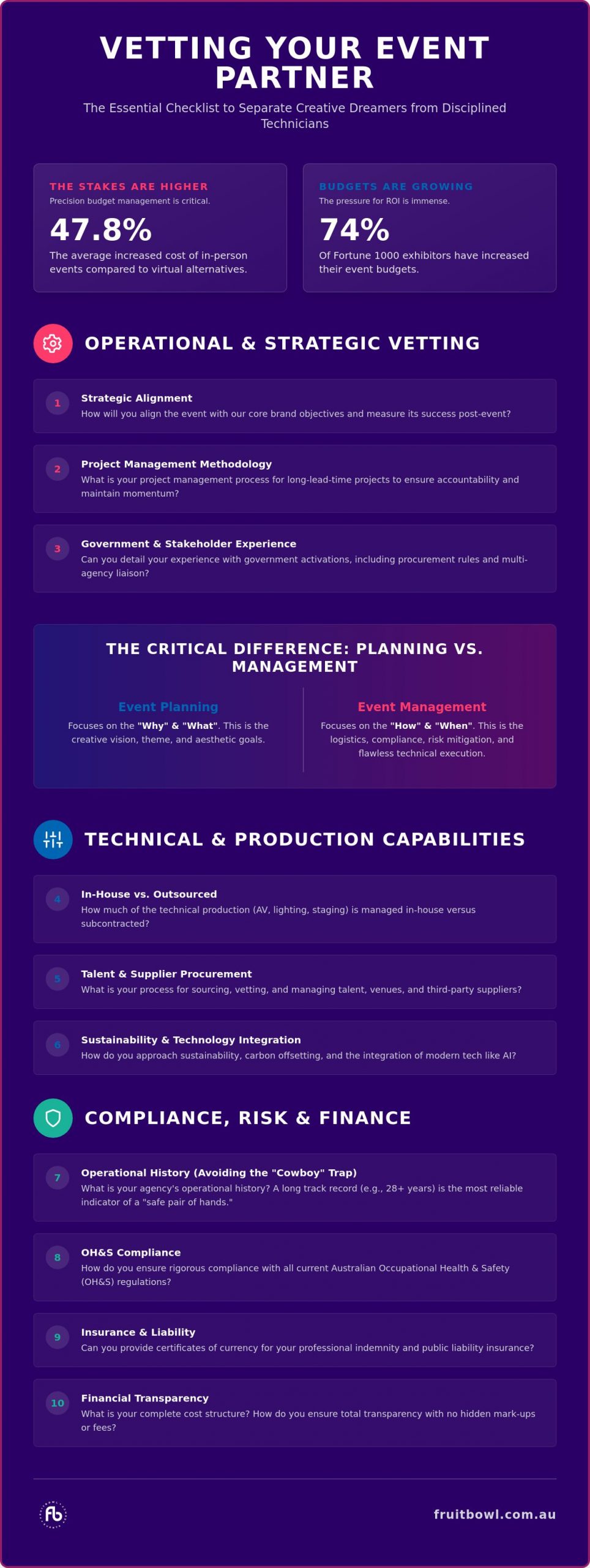
The right agency acts as a seamless extension of your internal team. They should provide a single point of contact for technical, creative, and logistical elements, ensuring that every moving part is synchronised. In the current market, where 74% of Fortune 1000 exhibitors have increased their budgets, the pressure to deliver a tangible return on investment is immense. Consequently, the questions to ask an event management company must probe their ability to handle complex logistics and integrated technology rather than just their aesthetic portfolio.
The Difference Between Planning and Management
Strategic planning focuses on the “why” and the “what” of an event, but management is defined by the “how” and the “when”. You require a partner that understands the entire lifecycle of a project, from initial concept to post-event data analysis. Utilising a professional corporate event management framework ensures that every decision is filtered through your brand objectives. This end-to-end approach prevents the fragmentation that often occurs when multiple vendors are poorly coordinated, leading to a frictionless experience for both the organiser and the attendee.
Avoiding the “Cowboy” Trap in the Events Industry
Longevity is the most reliable indicator of a “safe pair of hands”. The Australian industry is unfortunately prone to newcomers who lack the operational history required for large-scale activations or government projects. Identifying an agency with genuine longevity, such as those founded in the mid-90s with over 28 years of experience, provides a level of security that cannot be manufactured. When vetting, you must confirm they hold appropriate professional indemnity and public liability insurance. A lack of transparent operational history is a primary risk factor. These are essential questions to ask an event management company to ensure they can navigate the complexity of modern compliance without compromising the creative vision.
In 2026, sustainability and AI integration have moved from optional extras to non-negotiable requirements. Your chosen agency must demonstrate a methodical approach to carbon offsetting and waste reduction, alongside the technical know-how to implement immersive technologies. This disciplined, results-oriented approach is what separates a premier agency from a simple planning service.
Operational and Strategic Questions for the Vetting Process
Moving beyond the initial vetting, your focus must shift to the operational mechanics of the agency. When considering questions to ask an event management company, the first should always address strategic alignment. A professional partner doesn’t just execute; they internalise your brand objectives to ensure the event serves a purpose. This process requires a robust internal project management methodology, particularly for multi-month lead times where momentum can easily be lost. You need to understand how they maintain focus and accountability across a long-term project timeline.
If your project involves public spaces or departmental oversight, you must verify their experience with government event planning. These activations involve unique protocols, from strict procurement rules to inter-agency liaison. Managing stakeholders across multiple organisations requires a high level of diplomacy and structured communication. A seasoned strategist will have a clear framework for these interactions, ensuring all parties remain informed and aligned. These are the essential questions to ask an event management company to reveal their operational depth.
Industry standards for hiring an event production company suggest that cost structure and equipment ownership are vital vetting points. Probing these areas prevents the common frustration of hidden mark-ups and ensures the agency has direct control over the tools required for delivery. You might consider partnering with an established Australian agency to ensure these complexities are managed with precision from the outset.
Experience and Proven Track Record
Request case studies that match your event’s scale and complexity. If you’re organising a large-scale public activation, you’ll need an agency that specialises in festival production services. These projects involve high attendee numbers and complex site management, which are fundamentally different from indoor corporate meetings. Ask for specific examples where they navigated a live-event failure. This reveals more about their competence and “safe pair of hands” philosophy than any polished portfolio ever could.
The Team and Resource Allocation
Identify your primary point of contact early in the process. You need to know that a senior strategist is leading the project, not a junior coordinator. Ask about the ratio of senior staff to junior assistants on-site during the delivery phase. A professional firm will have a clear plan for scaling their workforce, ensuring that even as the project grows, the quality of oversight remains consistent. This transparency is vital for maintaining the security of your event’s execution.
Technical Direction and Talent Procurement Capabilities
Technical precision is the backbone of any successful high-stakes event. Creative ambition often pushes boundaries, but it must be grounded in what is technically feasible within a specific venue. When considering questions to ask an event management company, you must determine if they provide in-house technical direction or if they rely entirely on outsourced AV providers. An agency with internal technical expertise offers a higher level of oversight, ensuring that the production team understands the strategic intent behind every lighting cue and sound check. This integration is vital for maintaining the “safe pair of hands” approach that prevents public-facing failures.
The complexity of modern production requires a methodical approach to av management for events. You should ask how the agency handles technical riders and vendor contracts to avoid eleventh-hour surprises. A professional firm will conduct thorough site inspections to assess power requirements, weight loads for staging, and digital infrastructure. This level of rigour ensures that the creative vision is not just a concept, but a deliverable reality that respects the constraints of the physical space.
Integrating AV and Production
In 2026, the seamless integration of digital and physical elements is a standard expectation. You need to know how the agency manages lighting design, sound engineering, and staging to create a cohesive atmosphere. Ask about their experience with hybrid event technology and how they ensure a consistent experience for both in-person and remote audiences. A dedicated technical director should be a non-negotiable part of the team for any complex activation. They act as the central point of control, synchronising multifaceted production elements into a single, flawless timeline.
Talent and Entertainment Management
Talent procurement involves far more than just booking a headline act. You must ask how the agency vets speakers and performers to ensure they align with your brand’s corporate identity. Logistical management is a significant undertaking; you need to know who is responsible for flights, accommodation, and the specific requirements of technical riders. A critical point of vetting is the contingency plan. Ask the agency exactly what happens if a headline act cancels 24 hours before the event. A professional management partner will have a pre-vetted shortlist of alternatives and a clear protocol for emergency talent replacement, ensuring the event’s integrity remains intact.
Governance, Compliance, and Financial Transparency
The integrity of a large-scale event rests upon a foundation of rigorous governance and legal compliance. In 2026, the regulatory environment for public activations and corporate seminars has become increasingly complex, requiring a partner who treats risk management as a core discipline rather than an administrative afterthought. When determining the questions to ask an event management company, you must prioritise their approach to a comprehensive Risk Management Plan (RMP). This document should be site-specific and dynamic, addressing every potential hazard from structural integrity to data security for hybrid attendees.
Financial transparency is equally critical for maintaining stakeholder trust. You should require a clear breakdown of the agency’s financial reporting structure, specifically how they track budgets and manage third-party vendor payments. A professional firm will distinguish between their management fees and pass-through costs, ensuring you are never surprised by hidden mark-ups. This level of fiscal discipline prevents the friction that often arises from poorly managed accounts. If you require a partner that prioritises ethical and transparent delivery, you should engage a professional event management partner to oversee your next project.
Risk Mitigation and Safety
Public safety in Australia is governed by strict OH&S standards, particularly concerning temporary structures and electrical installations. You must ask which specific Australian standards the agency adheres to for staging and crowd control. A methodical agency will have a pre-defined strategy for emergency egress and incident response, ensuring that every critical path item has a viable “Plan B”. This disciplined foresight is what protects your brand from the reputational damage associated with safety failures or logistical collapses.
Budget Management and ROI
Budget creep is a significant risk in the current economic climate, where costs of goods can fluctuate during a multi-month planning phase. Ask the agency what tools they utilise for real-time budget tracking and how they report variations to your team. Beyond simple cost control, they should be able to demonstrate how they measure the success of the activation. Whether through attendee data analytics or strategic objective tracking, a professional partner provides the metrics required to justify the investment and prove a tangible return on investment. These questions to ask an event management company ensure that your budget is managed with the same precision as the event itself.
Making the Final Decision: Why Fruitbowl is the Safe Pair of Hands
Choosing a partner for a high-stakes activation is the final, most critical step in your vetting process. While the previous sections have outlined the technical and logistical hurdles of the 2026 landscape, the ultimate objective is to secure a partner who offers total operational security. Fruitbowl has been a fixture of the Australian industry since 1996, providing a level of seasoned expertise that newcomers simply cannot replicate. When you have finished reviewing your questions to ask an event management company, the evidence should point toward a partner with a proven history of navigating complex environments without compromise.
Our methodology is built on the “safe pair of hands” philosophy. We don’t just provide a service; we deliver a comprehensive, end-to-end solution that spans from initial strategy to on-site execution. For executives and government stakeholders, our corporate event management services offer the reassurance that every risk is managed and every technical detail is under expert supervision. This integrated approach eliminates the fragmentation that leads to budget blowouts and logistical failures.
Our Commitment to Professional Excellence
Longevity in the events industry is your greatest insurance policy. Over 28 years of operation, we have refined a disciplined approach to technical execution and meticulous planning. We understand that in high-pressure environments, there is no room for error. Our team specialises in integrating creative ambition with rigorous technical direction, ensuring that even the most complex festival or brand activation is delivered with surgical precision. This balance of visionary thinking and technical discipline is what separates a premier agency from a standard planning service. It remains one of the most vital questions to ask an event management company during your final deliberations.
Starting Your Project with Confidence
The transition from a conceptual brief to a robust, actionable project timeline is where our expertise becomes most visible. During your first discovery session with Fruitbowl, we focus on identifying your core objectives and the specific technical constraints of your project. We don’t believe in generic templates; every event is engineered from the ground up to ensure it meets your brand’s strategic goals. We invite you to enquire with Fruitbowl today for your 2026 event calendar and discover how a disciplined, results-oriented partnership can transform your next activation into a seamless success.
Securing Your Event Legacy in 2026
The complexity of the 2026 events landscape requires a partner who prioritises logistical rigour over mere aesthetic flair. By mastering the specific questions to ask an event management company, you ensure that your chosen agency possesses the operational depth to handle technical production, Australian safety compliance, and transparent financial reporting. A successful activation is never an accident; it’s the result of disciplined planning and the foresight to mitigate risks before they manifest on-site.
Fruitbowl brings over 28 years of proven delivery to every project, specialising in high-stakes government and corporate activations. Our end-to-end project management methodology provides the stability and clarity required to navigate even the most intricate public festivals or brand seminars. We invite you to Partner with Australia’s most experienced event strategists – Contact Fruitbowl to discuss your upcoming 2026 calendar. With a dedicated strategist at the helm, you can move forward with the confidence that your vision is in the safest possible hands. We look forward to engineering your next milestone.
Frequently Asked Questions
What is the most important question to ask an event planner?
The most critical question addresses how the agency aligns the event with your strategic brand objectives. You need to know if they understand the fundamental purpose behind the activation or if they are simply executing a logistical checklist. Probing their methodology for risk management and technical precision is equally vital for high-stakes projects where the margin for error is zero.
How do event management companies charge for their services in Australia?
Agencies typically utilise a transparent fee structure that separates professional management fees from third-party pass-through costs. This structure often involves a fixed project fee or a staged payment schedule based on the total project spend. You should always request a clear breakdown to ensure there are no hidden mark-ups on vendor payments and that all financial reporting is transparent.
Do event agencies handle venue sourcing and contract negotiation?
Yes, a full-service agency manages the entire venue lifecycle, from initial site inspections through to final contract negotiations. They leverage deep industry relationships to secure favourable terms and ensure the chosen space can support the technical requirements of your production. This oversight prevents costly venue-related oversights and ensures all logistical constraints are identified during the planning phase.
What is the difference between an event coordinator and an event management company?
An event coordinator typically focuses on on-site logistics and specific task execution, whereas a management company provides end-to-end strategic oversight. A professional agency handles the technical direction, financial governance, and risk mitigation required for complex activations. This distinction is critical when evaluating the questions to ask an event management company for large-scale public or corporate projects.
How much lead time is typically required for a large-scale corporate conference?
A large-scale corporate conference generally requires between six and twelve months of lead time for effective planning and delivery. This duration allows for comprehensive venue sourcing, talent procurement, and the development of a robust technical production plan. Starting early ensures that all strategic objectives are integrated into the project timeline without the risks associated with rushed execution or limited venue availability.
Can an event management company help with marketing and attendee registration?
Professional agencies often manage the integration of attendee registration systems and data-driven marketing strategies to ensure a cohesive brand experience. In 2026, this includes personalising attendee journeys through digital platforms and managing complex registration data for hybrid events. This end-to-end approach ensures a seamless experience for participants from the initial invitation through to post-event data analysis.
What happens if our event needs to be cancelled or rescheduled?
Your agency should have a pre-defined protocol for cancellation or rescheduling, underpinned by robust force majeure clauses in all vendor contracts. They manage the complex process of negotiating with venues and suppliers to minimise your financial exposure. Having a disciplined management partner ensures that contingency plans are established early, providing a sense of security even in unpredictable environments.
How do you ensure an event is sustainable and eco-friendly in 2026?
Sustainability is managed through a methodical strategy that includes carbon offsetting, waste reduction, and the use of renewable energy. In 2026, these practices are a core priority driven by both regulatory demands and attendee expectations. A professional firm integrates these elements into the questions to ask an event management company to ensure the project meets high environmental standards without compromising on the creative vision.
A professional event is more than a creative vision; it is a complex logistical exercise where the margin for error is effectively zero. With in-person events now costing 47.8% more than virtual alternatives, the stakes for your budget and brand reputation have never been higher. Knowing the right questions to ask an event management company is the only way to separate the creative dreamers from the disciplined technicians who will actually deliver on the day.
You likely understand that while many can organise a room, few can navigate the intricate web of Australian safety regulations and technical production without a budget blowout. This guide provides a strategic framework to master your vetting process, ensuring your chosen partner is equipped to manage every technical requirement and compliance hurdle. We will examine twenty-one essential enquiries that expose hidden costs, verify operational depth, and confirm whether an agency truly possesses the “safe pair of hands” your high-stakes project requires.
Key Takeaways
- Learn to distinguish between boutique planners and full-service agencies to ensure your project has the logistical depth required for success.
- Identify critical questions to ask an event management company regarding their internal project management and strategic alignment with your brand.
- Gain clarity on technical production by probing how agencies manage AV, talent procurement, and venue constraints in-house.
- Protect your budget and reputation by vetting an agency’s approach to Australian OH&S compliance and comprehensive risk management.
- Discover how an end-to-end management partner provides the stability needed for complex government activations and large-scale public festivals.
Table of Contents
- Why Vetting Your Event Management Company is a Strategic Necessity
- Operational and Strategic Questions for the Vetting Process
- Technical Direction and Talent Procurement Capabilities
- Governance, Compliance, and Financial Transparency
- Making the Final Decision: Why Fruitbowl is the Safe Pair of Hands
Why Vetting Your Event Management Company is a Strategic Necessity
Selecting a partner for a high-stakes corporate activation or public festival is a decision that carries significant weight. In 2026, the complexity of technical production and the rising costs of in-person delivery mean that a minor oversight can lead to a major budget blowout. A professional agency does not simply select a venue; they engineer an environment where risk is mitigated and objectives are met with precision. The broader field of event management encompasses everything from site selection and technical direction to the rigorous management of Australian safety standards.
The right agency acts as a seamless extension of your internal team. They should provide a single point of contact for technical, creative, and logistical elements, ensuring that every moving part is synchronised. In the current market, where 74% of Fortune 1000 exhibitors have increased their budgets, the pressure to deliver a tangible return on investment is immense. Consequently, the questions to ask an event management company must probe their ability to handle complex logistics and integrated technology rather than just their aesthetic portfolio.
The Difference Between Planning and Management
Strategic planning focuses on the “why” and the “what” of an event, but management is defined by the “how” and the “when”. You require a partner that understands the entire lifecycle of a project, from initial concept to post-event data analysis. Utilising a professional corporate event management framework ensures that every decision is filtered through your brand objectives. This end-to-end approach prevents the fragmentation that often occurs when multiple vendors are poorly coordinated, leading to a frictionless experience for both the organiser and the attendee.
Avoiding the “Cowboy” Trap in the Events Industry
Longevity is the most reliable indicator of a “safe pair of hands”. The Australian industry is unfortunately prone to newcomers who lack the operational history required for large-scale activations or government projects. Identifying an agency with genuine longevity, such as those founded in the mid-90s with over 28 years of experience, provides a level of security that cannot be manufactured. When vetting, you must confirm they hold appropriate professional indemnity and public liability insurance. A lack of transparent operational history is a primary risk factor. These are essential questions to ask an event management company to ensure they can navigate the complexity of modern compliance without compromising the creative vision.
In 2026, sustainability and AI integration have moved from optional extras to non-negotiable requirements. Your chosen agency must demonstrate a methodical approach to carbon offsetting and waste reduction, alongside the technical know-how to implement immersive technologies. This disciplined, results-oriented approach is what separates a premier agency from a simple planning service.
Operational and Strategic Questions for the Vetting Process
Moving beyond the initial vetting, your focus must shift to the operational mechanics of the agency. When considering questions to ask an event management company, the first should always address strategic alignment. A professional partner doesn’t just execute; they internalise your brand objectives to ensure the event serves a purpose. This process requires a robust internal project management methodology, particularly for multi-month lead times where momentum can easily be lost. You need to understand how they maintain focus and accountability across a long-term project timeline.
If your project involves public spaces or departmental oversight, you must verify their experience with government event planning. These activations involve unique protocols, from strict procurement rules to inter-agency liaison. Managing stakeholders across multiple organisations requires a high level of diplomacy and structured communication. A seasoned strategist will have a clear framework for these interactions, ensuring all parties remain informed and aligned. These are the essential questions to ask an event management company to reveal their operational depth.
Industry standards for hiring an event production company suggest that cost structure and equipment ownership are vital vetting points. Probing these areas prevents the common frustration of hidden mark-ups and ensures the agency has direct control over the tools required for delivery. You might consider partnering with an established Australian agency to ensure these complexities are managed with precision from the outset.
Experience and Proven Track Record
Request case studies that match your event’s scale and complexity. If you’re organising a large-scale public activation, you’ll need an agency that specialises in festival production services. These projects involve high attendee numbers and complex site management, which are fundamentally different from indoor corporate meetings. Ask for specific examples where they navigated a live-event failure. This reveals more about their competence and “safe pair of hands” philosophy than any polished portfolio ever could.
The Team and Resource Allocation
Identify your primary point of contact early in the process. You need to know that a senior strategist is leading the project, not a junior coordinator. Ask about the ratio of senior staff to junior assistants on-site during the delivery phase. A professional firm will have a clear plan for scaling their workforce, ensuring that even as the project grows, the quality of oversight remains consistent. This transparency is vital for maintaining the security of your event’s execution.
Technical Direction and Talent Procurement Capabilities
Technical precision is the backbone of any successful high-stakes event. Creative ambition often pushes boundaries, but it must be grounded in what is technically feasible within a specific venue. When considering questions to ask an event management company, you must determine if they provide in-house technical direction or if they rely entirely on outsourced AV providers. An agency with internal technical expertise offers a higher level of oversight, ensuring that the production team understands the strategic intent behind every lighting cue and sound check. This integration is vital for maintaining the “safe pair of hands” approach that prevents public-facing failures.
The complexity of modern production requires a methodical approach to av management for events. You should ask how the agency handles technical riders and vendor contracts to avoid eleventh-hour surprises. A professional firm will conduct thorough site inspections to assess power requirements, weight loads for staging, and digital infrastructure. This level of rigour ensures that the creative vision is not just a concept, but a deliverable reality that respects the constraints of the physical space.
Integrating AV and Production
In 2026, the seamless integration of digital and physical elements is a standard expectation. You need to know how the agency manages lighting design, sound engineering, and staging to create a cohesive atmosphere. Ask about their experience with hybrid event technology and how they ensure a consistent experience for both in-person and remote audiences. A dedicated technical director should be a non-negotiable part of the team for any complex activation. They act as the central point of control, synchronising multifaceted production elements into a single, flawless timeline.
Talent and Entertainment Management
Talent procurement involves far more than just booking a headline act. You must ask how the agency vets speakers and performers to ensure they align with your brand’s corporate identity. Logistical management is a significant undertaking; you need to know who is responsible for flights, accommodation, and the specific requirements of technical riders. A critical point of vetting is the contingency plan. Ask the agency exactly what happens if a headline act cancels 24 hours before the event. A professional management partner will have a pre-vetted shortlist of alternatives and a clear protocol for emergency talent replacement, ensuring the event’s integrity remains intact.
Governance, Compliance, and Financial Transparency
The integrity of a large-scale event rests upon a foundation of rigorous governance and legal compliance. In 2026, the regulatory environment for public activations and corporate seminars has become increasingly complex, requiring a partner who treats risk management as a core discipline rather than an administrative afterthought. When determining the questions to ask an event management company, you must prioritise their approach to a comprehensive Risk Management Plan (RMP). This document should be site-specific and dynamic, addressing every potential hazard from structural integrity to data security for hybrid attendees.
Financial transparency is equally critical for maintaining stakeholder trust. You should require a clear breakdown of the agency’s financial reporting structure, specifically how they track budgets and manage third-party vendor payments. A professional firm will distinguish between their management fees and pass-through costs, ensuring you are never surprised by hidden mark-ups. This level of fiscal discipline prevents the friction that often arises from poorly managed accounts. If you require a partner that prioritises ethical and transparent delivery, you should engage a professional event management partner to oversee your next project.
Risk Mitigation and Safety
Public safety in Australia is governed by strict OH&S standards, particularly concerning temporary structures and electrical installations. You must ask which specific Australian standards the agency adheres to for staging and crowd control. A methodical agency will have a pre-defined strategy for emergency egress and incident response, ensuring that every critical path item has a viable “Plan B”. This disciplined foresight is what protects your brand from the reputational damage associated with safety failures or logistical collapses.
Budget Management and ROI
Budget creep is a significant risk in the current economic climate, where costs of goods can fluctuate during a multi-month planning phase. Ask the agency what tools they utilise for real-time budget tracking and how they report variations to your team. Beyond simple cost control, they should be able to demonstrate how they measure the success of the activation. Whether through attendee data analytics or strategic objective tracking, a professional partner provides the metrics required to justify the investment and prove a tangible return on investment. These questions to ask an event management company ensure that your budget is managed with the same precision as the event itself.
Making the Final Decision: Why Fruitbowl is the Safe Pair of Hands
Choosing a partner for a high-stakes activation is the final, most critical step in your vetting process. While the previous sections have outlined the technical and logistical hurdles of the 2026 landscape, the ultimate objective is to secure a partner who offers total operational security. Fruitbowl has been a fixture of the Australian industry since 1996, providing a level of seasoned expertise that newcomers simply cannot replicate. When you have finished reviewing your questions to ask an event management company, the evidence should point toward a partner with a proven history of navigating complex environments without compromise.
Our methodology is built on the “safe pair of hands” philosophy. We don’t just provide a service; we deliver a comprehensive, end-to-end solution that spans from initial strategy to on-site execution. For executives and government stakeholders, our corporate event management services offer the reassurance that every risk is managed and every technical detail is under expert supervision. This integrated approach eliminates the fragmentation that leads to budget blowouts and logistical failures.
Our Commitment to Professional Excellence
Longevity in the events industry is your greatest insurance policy. Over 28 years of operation, we have refined a disciplined approach to technical execution and meticulous planning. We understand that in high-pressure environments, there is no room for error. Our team specialises in integrating creative ambition with rigorous technical direction, ensuring that even the most complex festival or brand activation is delivered with surgical precision. This balance of visionary thinking and technical discipline is what separates a premier agency from a standard planning service. It remains one of the most vital questions to ask an event management company during your final deliberations.
Starting Your Project with Confidence
The transition from a conceptual brief to a robust, actionable project timeline is where our expertise becomes most visible. During your first discovery session with Fruitbowl, we focus on identifying your core objectives and the specific technical constraints of your project. We don’t believe in generic templates; every event is engineered from the ground up to ensure it meets your brand’s strategic goals. We invite you to enquire with Fruitbowl today for your 2026 event calendar and discover how a disciplined, results-oriented partnership can transform your next activation into a seamless success.
Securing Your Event Legacy in 2026
The complexity of the 2026 events landscape requires a partner who prioritises logistical rigour over mere aesthetic flair. By mastering the specific questions to ask an event management company, you ensure that your chosen agency possesses the operational depth to handle technical production, Australian safety compliance, and transparent financial reporting. A successful activation is never an accident; it’s the result of disciplined planning and the foresight to mitigate risks before they manifest on-site.
Fruitbowl brings over 28 years of proven delivery to every project, specialising in high-stakes government and corporate activations. Our end-to-end project management methodology provides the stability and clarity required to navigate even the most intricate public festivals or brand seminars. We invite you to Partner with Australia’s most experienced event strategists – Contact Fruitbowl to discuss your upcoming 2026 calendar. With a dedicated strategist at the helm, you can move forward with the confidence that your vision is in the safest possible hands. We look forward to engineering your next milestone.
Frequently Asked Questions
What is the most important question to ask an event planner?
The most critical question addresses how the agency aligns the event with your strategic brand objectives. You need to know if they understand the fundamental purpose behind the activation or if they are simply executing a logistical checklist. Probing their methodology for risk management and technical precision is equally vital for high-stakes projects where the margin for error is zero.
How do event management companies charge for their services in Australia?
Agencies typically utilise a transparent fee structure that separates professional management fees from third-party pass-through costs. This structure often involves a fixed project fee or a staged payment schedule based on the total project spend. You should always request a clear breakdown to ensure there are no hidden mark-ups on vendor payments and that all financial reporting is transparent.
Do event agencies handle venue sourcing and contract negotiation?
Yes, a full-service agency manages the entire venue lifecycle, from initial site inspections through to final contract negotiations. They leverage deep industry relationships to secure favourable terms and ensure the chosen space can support the technical requirements of your production. This oversight prevents costly venue-related oversights and ensures all logistical constraints are identified during the planning phase.
What is the difference between an event coordinator and an event management company?
An event coordinator typically focuses on on-site logistics and specific task execution, whereas a management company provides end-to-end strategic oversight. A professional agency handles the technical direction, financial governance, and risk mitigation required for complex activations. This distinction is critical when evaluating the questions to ask an event management company for large-scale public or corporate projects.
How much lead time is typically required for a large-scale corporate conference?
A large-scale corporate conference generally requires between six and twelve months of lead time for effective planning and delivery. This duration allows for comprehensive venue sourcing, talent procurement, and the development of a robust technical production plan. Starting early ensures that all strategic objectives are integrated into the project timeline without the risks associated with rushed execution or limited venue availability.
Can an event management company help with marketing and attendee registration?
Professional agencies often manage the integration of attendee registration systems and data-driven marketing strategies to ensure a cohesive brand experience. In 2026, this includes personalising attendee journeys through digital platforms and managing complex registration data for hybrid events. This end-to-end approach ensures a seamless experience for participants from the initial invitation through to post-event data analysis.
What happens if our event needs to be cancelled or rescheduled?
Your agency should have a pre-defined protocol for cancellation or rescheduling, underpinned by robust force majeure clauses in all vendor contracts. They manage the complex process of negotiating with venues and suppliers to minimise your financial exposure. Having a disciplined management partner ensures that contingency plans are established early, providing a sense of security even in unpredictable environments.
How do you ensure an event is sustainable and eco-friendly in 2026?
Sustainability is managed through a methodical strategy that includes carbon offsetting, waste reduction, and the use of renewable energy. In 2026, these practices are a core priority driven by both regulatory demands and attendee expectations. A professional firm integrates these elements into the questions to ask an event management company to ensure the project meets high environmental standards without compromising on the creative vision.
OUR BLOG
Event Insights & Expertise
Our blog is your go-to resource for all things events. From expert insights and the latest industry trends to practical planning tips, we share everything you need to deliver standout experiences.
Contact Us